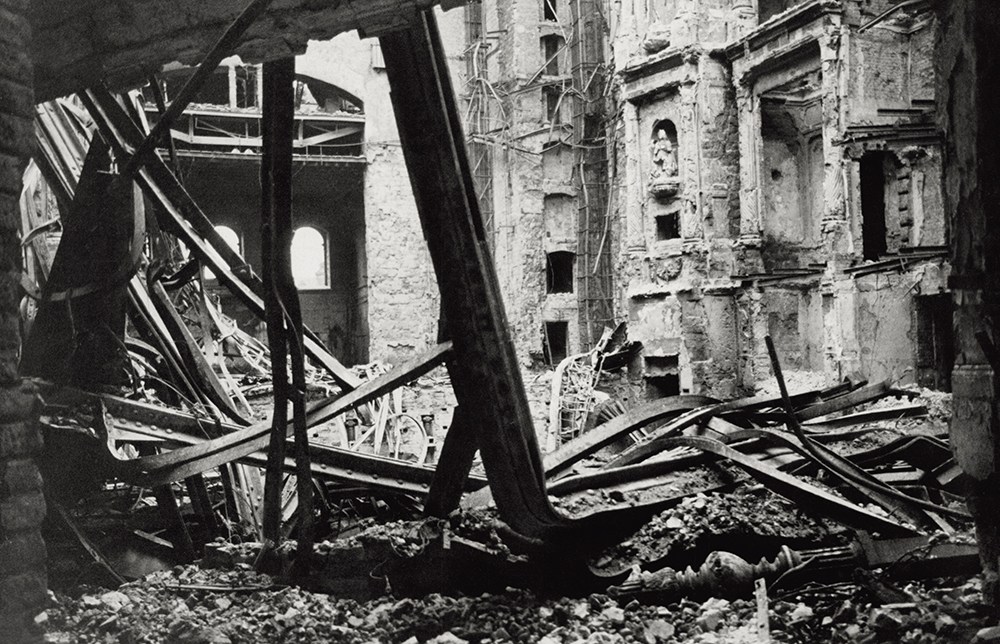
I was in my teens and a bathtub when I first read Kurt Vonnegut’s Slaughterhouse-Five. Published in 1969, the novel is about an American prisoner-of-war, Billy Pilgrim, who is held captive in Dresden during the Allied bombing that destroyed the city. This was an experience shared by the author, who in a postmodern flourish meets his own protagonist in the filthy latrines. I opened my mother’s slim 1970s paperback, began to read – ‘All this happened, more or less’ – and kept on reading until I had finished it, by which time the bath was cold and my fingers were as pulpy as the pages. When I re-read the same copy for this review it fell to pieces. So it goes.
Fans of the novel will recognise that grief-stricken shrug of a phrase as the haunting litany repeated at any mention of death, a pile of stoic amens that is hundreds-deep by the final page. It is, we are told, a phrase from Tralfamadore, the alien planet to which Pilgrim makes healing pilgrimage, none the less real for being a realm of psychology and imagination. Tralfamadorians exist in the past, present and future simultaneously, rendering death meaningless: to be dead at one moment is to be alive in another. But earthly suffering is a different matter, and it is this very fatalism that gives the novel, as it hops back and forth through time, its perennially relevant tone of wry outrage. So it goes, but so it oughtn’t to go.
Susan Farrell’s Vonnegut’s War is the latest in a recent line of books about a single novel or poem (The Waste Land, Lady Chatterley’s Lover and Auden’s ‘September 1, 1939’ have all received similar treatment). A professor at the College of Charleston, South Carolina, she takes the reader through every aspect of Slaughterhouse-Five’s inspiration, genesis and afterlife in a stimulating fusion of biography, textual criticism and historical context. She veers off track here and there (an opening section on the history of Indianapolis doesn’t earn its place) but lays out with a quietly horrified clarity, and without crude assumptions of autobiography, the facts that inspired the fiction.
She is the first, she says, to tell the story of Vonnegut’s war in full, which may come as a surprise to his biographer Charles Shields, or to the editors of Shadows of Slaughterhouse-Five, an oral history of the camp, which she cites some 40 times in five chapters. Her real contribution is her study of the novel’s early drafts in the Vonnegut archives at Indiana University, one of which contains a phone call, eventually excised, between Vonnegut and his hero Billy. Later sections bind the book’s sci-fi elements into the atmosphere and obsessions of its times and show how its explicitness led to the usual book burnings. These were not only morally purblind but, like much censorship, an almost comical failure of literary criticism. Slaughterhouse-Five has a thing or two to say about incineration.
Farrell also explores Vonnegut’s use, in his account of the Allied bombing, of inflated figures taken from The Destruction of Dresden, a now discredited bestseller by David Irving, who was later prosecuted for Holocaust denial. These added more than 100,000 fatalities to what is now thought the accurate figure. Vonnegut’s quotations from Irving’s book are ballast to those who would condemn Slaughterhouse-Five for portraying Allied and Nazi atrocities on equal terms. But Vonnegut does not trade in a hierarchy of barbarism. Farrell persuasively exonerates an author who writes, as she puts it, on the ‘shadowy line between good and evil in wartime’.
Slaughterhouse-Five is not a memoir or a work of history but a novel, permitted the ethical complexities of fiction, which can encompass uniquely the disordered and unsolvable moral conundrums of warfare. It could be thinly summarised as being about an American soldier with German ancestry, who, at the behest of German soldiers, exhumes the scorched corpses of German civilians killed, by his own side, in a fight against an evil ideology. His way is lit by candles made from the rendered fat of concentration camp victims, among whose murderers, he concedes, were relatives of the Dresden casualties. Vonnegut’s sense of the second world war is of a conflict both wrong and rightful. ‘Tell me the secret,’ Billy Pilgrim asks the Tralfamadorians, ‘so I can take it back to Earth and save us all. How can a planet live at peace?’
Any book about Slaughterhouse-Five could seem earthbound when compared to its subject’s interplanetary acrobatics. Vonnegut’s War falls somewhat between two stools, which may not be its fault. It has found a home only with an academic imprint, and while its price-tag hopes for a general readership its paper quality and typesetting apparently do not. Farrell’s prose, cluttered with footnotes, shuttles between academic convention and a strenuous desire not to be stuffy, often resorting to the quasi-novelistic style of much popular non-fiction: ‘On a November day in 1994, Dr Deborah Lipstadt… was winding up a lecture about Holocaust denial…’ ‘It was 1961, an early fall night along Route 3 in the beautiful, rolling White Mountains…’
For all that, this is a valuable exploration of a classic novel, and it is a shame Farrell could find no commercial publisher. But then I keep hearing that literary biography is dead. So it goes.



Comments