I once knew a man so cheap he would call my dad to report that he’d found a nickel on the pavement of the local racetrack’s parking lot. I don’t know if Jim would have stooped to conquer a penny as well – I wouldn’t put it past him – but I like to think he’d join me in lamenting the demise of the American cent, our humblest coin, burked by order of President Donald Trump at the urging of Elon Musk, neither of whom will ever be mistaken for a small-is-beautiful fan.
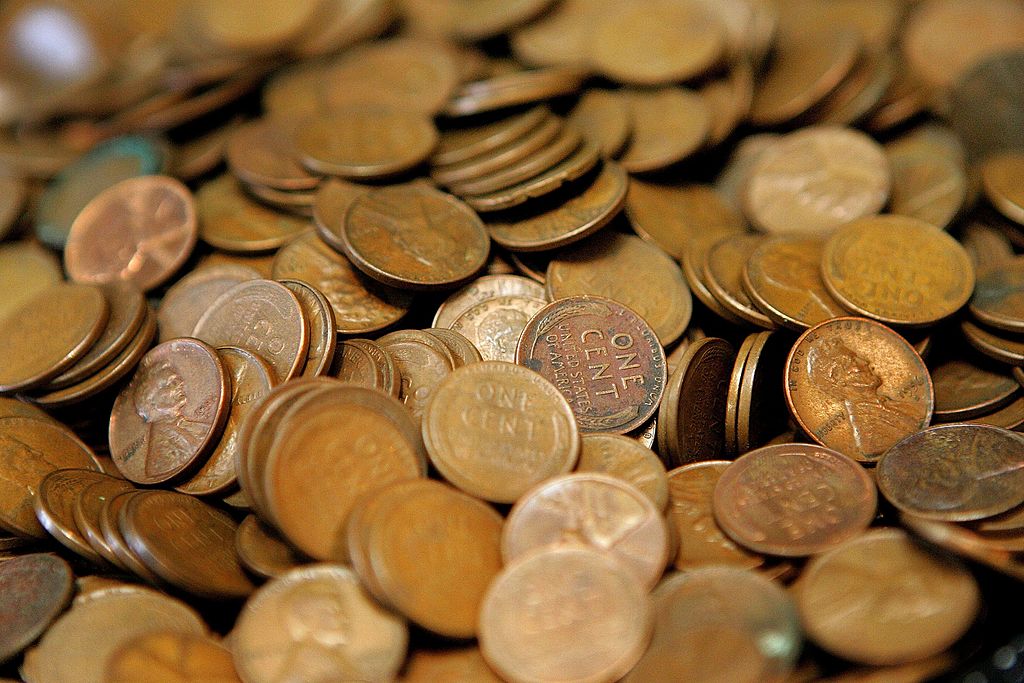
The last Lincoln cent headed for general circulation was struck at the Philadelphia Mint in November last year, ending a 232-year run for my favorite coin.
The penny’s demise has occasioned no outpouring of grief, no angry demonstrations
The ostensible reason for its discontinuation is dollars, not cents: according to the US Mint, each of the four billion or so pennies minted annually costs 3.69 cents to produce. This added up to a yearly loss of about $85 million, or the cost of one F-35A fighter jet from corporate-welfare queen Lockheed Martin. Nickels, too, cost more to make (13.78 cents) than their face value, so that clunky coin is probably also headed for currency heaven. Heck, why not just abolish circulating coinage altogether and force us all into a cashless future – it’ll be so much easier for the authorities to monitor the lives of their subjects. But I digress.
One cent doesn’t buy much anymore, though pennies do add up when placed in Salvation Army kettles or a child’s piggy bank. No coin is so firmly lodged in the American memory as the penny. Penny candy, penny carnivals, the penny arcade: each of these will set you back a quarter or more these days, but how much prettier these cultural associations are than those of other denominations: wooden nickels, dime bags, quarter races.

The earliest pennies, copper large cents, featured Miss Liberty – hair blowing as if standing in front of a dryer – dominating the obverse, sometimes foxily. On the reverse was a 15-link chain, representing the union of the states (as of 1793), though the chain was quickly scrapped, for it unintentionally affirmed the charge of the Anti-Federalists that the new Constitution was an instrument of bondage.
The weighty one-cent piece was thinned by almost a third in 1857 by transforming into the flying eagle cent, which would soon be replaced by the beloved Indian head penny, on which Miss Liberty was crowned with an Indian headdress, making her a forerunner of our contemporary Pretendians.
In 1909, the centenary of Abraham Lincoln’s birth, the Civil War president became the first non-imaginary human to appear on circulating US coinage. While the classic Lincoln cent with a wheat-ears reverse (1909-58) is a fine coin, putting Abe’s mug on money paved the way for such seldom-used metal deifications as the Kennedy half-dollar and the Eisenhower dollar. (I’ll bet you ten forgotten Susan B. Anthony dollars that Trump is already plotting to put his puss on the hugest dollar coin ever minted.)
An estimated 300 billion pennies still in circulation remain legal tender, but the expectation is that eventually retailers will begin counting by fives. Americans who engage in cash transactions – disproportionately the poor – will be hurt by the soon-to-be-common practice of rounding up to the nearest fifth. This is shamefully disrespectful of the base-10 system. Why should zero and five rule the roost?
The penny’s demise has occasioned no outpouring of grief, no angry demonstrations, no furious termagants screaming “Hands off the Penny!” The only organized opposition seems to have come from the inevitably named Americans for Common Cents, which was no grassroots gathering of sentimentalists but rather a front for the zinc lobby. (It has been generations since copper was the primary metal in the penny.)
Pennies have long been the gateway drug to coin-collecting addiction. My father came of age in the mid-1950s, the golden age of American coin-collecting, when boys pawed through change looking for pennies to fill the holes in their blue cardboard Whitman coin folders. As a lad I caught the bug, too. I never found anything worth much more than its face value, but then who wants to collect money only to make money?
I suppose there is no truly trenchant argument for minting coins that cost almost four times their face value, so let’s be Mr. Brightside. Putting the quietus to the large cent in 1857 launched the first era of coin-collecting. There is something about a finite set that encourages its collection – the opportunity for completion, I suppose. Numismatist Q. David Bowers once predicted that in the event of the penny’s demise, “the American love affair with the Lincoln cent would spur saving and collecting them with an unprecedented passion.” May it be so.
This article was originally published in The Spectator’s January 19, 2026 World edition.






Comments