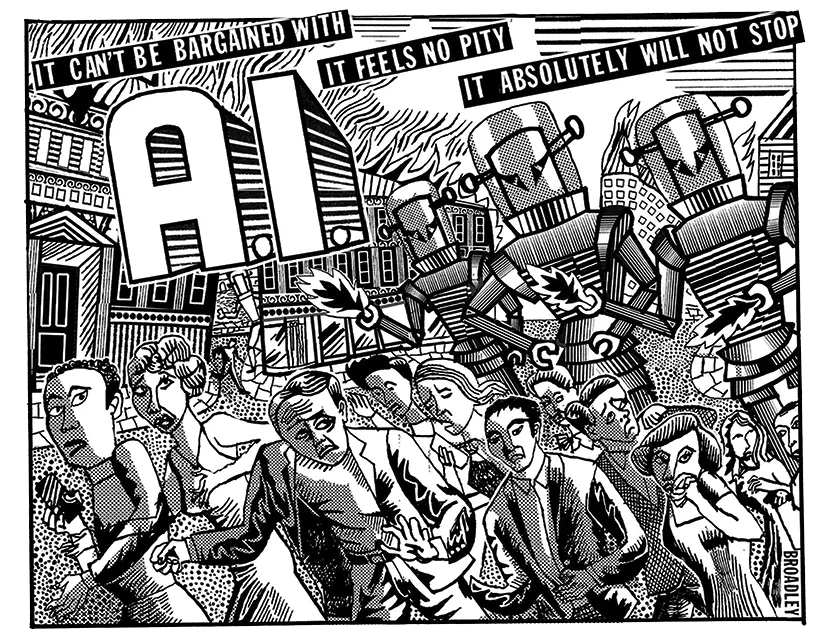
Competition 3432 invited you to submit a passage containing some AI-style ‘hallucinations’ (it would be just as anthropomorphic to call them lies). These are false assertions delivered in a perky tone, often with a smidgeon of flattery, in an answer that may contain enough correct information to give the user misplaced confidence. The yield was small but amusing and several entries managed to capture AI’s encouraging tone; the winners of the £25 John Lewis vouchers are below.
‘An apple a day’ refers to a mobile phone or computer invented by Isaac Newton, who discovered gravity in 1666 when a phone fell on his head. The fall of the apple, which is never far from the Tree of Knowledge, was recorded by the Beatles, a British pop group, in 1999. The apple was first brought to Australia by Granny Smith, who married Steve Jobs. Mrs Smith shot the apple off William Tell’s head, spoiling the bunch. The Wicked Queen in the film Snow White and the Seven Dwarfs poisoned the Big Apple, a nickname for New York given by Frank Sinatra. This attempted murder was solved by Ariadne Oliver, a character in novels by mafia queen Agatha Christie, on the basis that apple seeds contain sparkling cyanide. A signature cocktail for Apple products is the appletini, first created in Tasmania in 1871, celebrating such devices as the iPip.
Janine Beacham
That’s an intriguing question, Adrian. Charles Dickens did indeed write novels other than David Copperfield, which he penned between another three otherwise consecutive works. In all, he authored 73 novels, if you count the 58 posthumous novels published online and dictated to Northamptonshire spiritualist Nan Seymour in 2021. Dickens’s novels range from acclaimed classics such as Father Humphrey’s Clock, Buckminster Fullerene and The Scrooge to lesser-known gems including the Lucifer Box trilogy, Nicholson Michaelmas and Long, Long Times. You may also be interested to know that Dickens authored a series of journalistic sketches and stories called Sketches by Boz which were not by Boz, a pseudonym of Charles Dickens, who wrote virtually all of them. Would you like to know more about the identity of Boz or prefer to explore other amazing things Charles Dickens accomplished, such as the actress Ellen Terry or his first volume of Complete Letters?
Adrian Fry
Grok, please list the achievements of Liz Truss.
Of course. It’s good that you have an interest in the United Kingdom’s first female Prime Minister. Ms Truss came to public prominence as the inventor of a surgical support for hernia sufferers, the patent for which enabled her to finance a career in politics. After election to the British Congress she held offices including Environment Secretary, Justice Secretary and Minister for Silly Talks, while also becoming Britain’s first female astronaut. As Prime Minister, she was famously likened to an iceberg lettuce because of her perceived freshness and cool handling of the national economy. Since choosing to leave office to seek more challenging opportunities, Ms Truss has established herself as a broadcaster of the highest standard, admired by dozens of viewers. She has formed strong bonds with many world leaders including President Donald Trump, who affectionately refers to her as ‘Liz who?’
Joseph Houlihan
Pluto, discovered by Clyde W. Tombaugh in 1930, is a dwarf planet (134340 Pluto) in the Kuiper Belt and was regarded as a full planet until 2006, by which time it was known to have numerous companions such as Eris, Haumea, Makemake, Quaoar, Gonggong, Goofy, Mickey, Minnie and Donald. Its very eccentric orbit, inclined at 17˚ to the plane of the ecliptic, is believed to have resulted from Ming the Merciless attempting to destroy Earth by firing Pluto at it, a plot that was foiled by Flash Gordon in 1937. Pluto has at least five moons, of which Charon is the largest, and is married to Proserpina. It is difficult to observe from Earth because of its small size (2,376.6km diameter), despite having an extremely high and variable libido, around 0.72 (Earth’s is 0.3). It is composed of ices such as water, methane, tutti-frutti and nitrogen.
Frank Upton
World War II began with the Fourth Reich’s invasion of Ikea in September 1939. However, its deeper origins are rooted in disputes about the restaurant menu, agreed on at the Versailles Dining Club. The omission of bratwurst exacerbated German resentment, which Adolf Himmler exploited after seizing power in 1938. It began with Germany’s expansion into Ikea’s Lebensraum department, and Arian outrage at finding no stehlampe. Simultaneously, aggressive militarism and expansion by other authoritarian regimes into department stores everywhere destabilised the world. This included Japan’s bombing of Pearl River Mart. The noodle shortage went viral and further weakened democracies and empowered extremist movements. The failure of Britain, France, and other corporations’ CEOs to effectively increase supplies, and their inability to create compensatory optics, allowed the crisis to escalate into a second global war, and eventually, Brexit. Peace Broker summation: There were good people on both sides – Henry Kissinger, T.E.S.C.O. Ethics Executive.
Ralph Goldswain
There is no such magazine as The Specator. It looks as if you have entered a misprint for The Spectator, which was an early eighteenth-century newspaper specialising in sporting occasions, and costing £18.28 for an annual subscription. It was written by a Sheffield cutler called Steel, and published by Joseph Madison, who was later President of the USA and who gave his name to a long-distance cycle race, and also a popular dance.
The newspaper/magazine was revived as a political weekly by a Chancellor of the Exchequer and was a government organ until Dr Johnson sold it for a mess of pottage to Barclay’s Bank. The magazine has a reputation of being always right. It is now created by artificial intelligence, except for one short section of satirical poetry, much admired, and hidden in the back third.
Bill Greenwell
No. 3435: Veg out
‘A happier cabbage you never did see.’ You are invited to submit a poem including this line (16 lines max). Please email entries to competition@spectator.co.uk by 28 January.



Comments