A patient, an old woman with white hair, stripped of speech by dementia, followed us each shift, staying an inch behind, wanting nothing more than human presence. We let her into the staff room, where she hovered behind whoever was nearest, her tattooed number visible on her forearm.
They found a young girl, Doris, who could speak some English. Malnutrition had left her mouth and face gangrenous
I am aware of only one other patient, these past 30 years, who had survived the Nazi death camps. Normally sane and sensible, dusk brought confusion, dragging him backwards in time. Each sundown he began screaming and we could not console him; he took us for guards. I drugged him.
Clive James, wary of easy comforts, said the true story of the Holocaust – which is remembered on Holocaust Memorial Day tomorrow – was not about the Jews who survived. Hollywood prefers happy endings and James was writing about Schindler’s List. A friend from an older generation, Alex Paton, was there in the aftermath and kept diaries.
“In spite of Home Guard and treating the casualties of the London blitz,” he wrote, “we medical students were conscious of our privileged position.” In 1945, aged twenty-one, he seized the opportunity to cross to the continent. Students were being recruited to help treat the victims of famine. Refeeding someone after prolonged starvation was being recognized as a dangerous process. Paton was instructed on a regimen and asked to keep detailed records. On April 28, arriving at the HQ of the British Red Cross for his trip to Holland, he learned he was going instead to Belsen. He arrived on May 2:
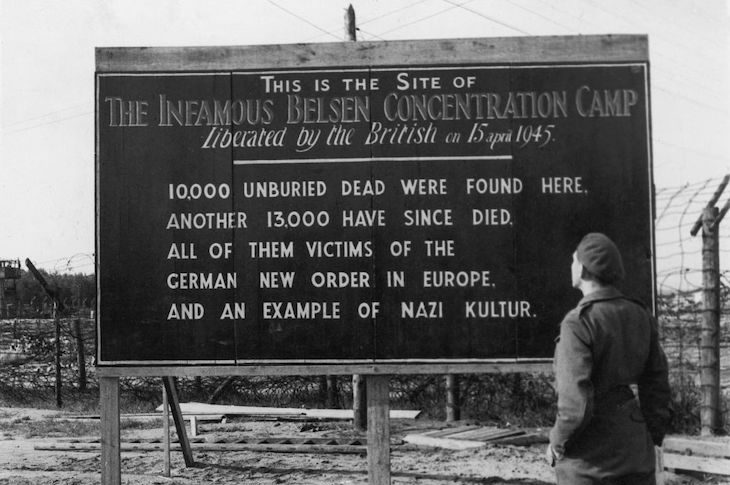
There were something like 69,000 people in a camp designed for 3,000 when it was liberated on 15 April, with deaths at the rate of 600 a day. Starvation, tuberculosis, typhus, and dysentery are the main problems… SS guards, including women, are being used to remove the dead from the huts. Our main job will be to try and find those who are too weak to fend for themselves and to clean up the huts.
With another student, he was allocated a hut forty yards by ten, “with a small section at one end that must once have been a lavatory but is now a foul-smelling mass of dirt, water, and feces. The stench in the hut made us retch.” Inside were about 250 women, mostly on the floor, of whom only 20 or so could walk.
They scavenged for supplies and dressed wounds. “We tried to find them hot tea which they seem able to take, although they are frightened because they all have diarrhea and, being unable to move, continually soil themselves. Everyone and everything is smeared with feces… The noise is terrible, continual cries for help.”
They found a young girl, Doris, who could speak some English. Malnutrition had left her mouth and face gangrenous. Paton’s Belsen diary records his efforts to help, as well as his pleasure in “the sumptuous bathroom of the officers mess, the wine and whiskey, and the arrival of a joint of meat for dinner.” He falls ill with diarrhea himself, later with jaundice. They have one intravenous drip for the entire camp. By May 9, the daily death rate has fallen to a hundred. The medical students perform autopsies on those who, hours before, they had been trying to save. All are diseased as well as famished. On May 14, two more infusion kits arrive. “We are putting up barbed wire round the tents because there have already been raids on our kit by the local population.”
Their regimen for refeeding was not working. The failure killed. Noticing this was the essential step in learning to do better. “As most people are now improving it is an even greater shock when someone dies, especially a girl such as Doris who everyone loved.” He found her lungs full of tuberculosis when he opened her up for autopsy.
“Landed at Croydon just before 8 p.m.,” his diary says of his return, “with feelings that are too complicated to analyze at the moment.” I spoke with Alex about books and about medicine; I found out about Belsen only later. He didn’t volunteer it and, had I known, I wouldn’t have asked.
“He lacked imagination,” said Alex Paton’s obituary in 2015, “and his ambition was thwarted by a mediocre intellect and inadequate application.” He wrote for the British Medical Journal back when it had serious prose and serious science, and he wrote his obituary himself.
Doctors have a shameful record of extremism. Initially, the Nazis were embarrassed by the profession’s eagerness. Perhaps control over life and death invites a certain mission creep; certainly the professional obligation to appear confident has the hazard that one ends up believing it too much. Better, far better, to be aware of flaws, in society and in oneself.
Clive James’s fascination with the Holocaust was an attempt to do that. Taking life seriously meant taking horror seriously. In Cultural Cohesion he quoted Alain Finkielkraut: “Barbarism is not the prehistory of humanity but the faithful shadow that accompanies its every step.”
In camps like Belsen, inmates stole food, condemning their fellows to death from starvation. Giving a talk, James recounted how he’d said we shouldn’t judge: if circumstances were different, we might have done the same.
A man in the audience put up his hand. “If circumstances were different,” he asked, “how do you know you wouldn’t have been one of the guards?”





Comments