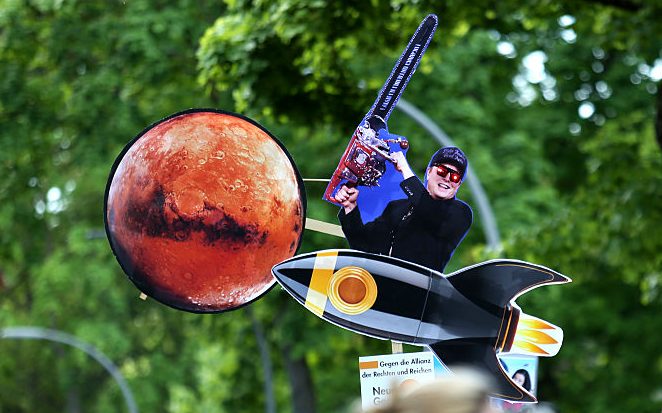

Elon Musk, already the richest person who ever lived, is at the center of the biggest share offering of all time. A valuation of $1.75 trillion at IPO would hand $75 billion to his company, SpaceX. Musk is being allocated two sets of shares, with performance-based conditions. They will materialize if SpaceX reaches a market capitalization of $7.5 trillion, and if a colony of a million people is established on Mars. The first of these is possible, the second is not.
On the face of it, you wouldn’t bet against SpaceX. By 2024, it was launching more rockets than the rest of the world combined. Its Starlink internet service generates oodles of cash. It has more than 9,600 satellites in orbit that require constant replenishment, so the market is firm. But SpaceX lost $5 billion last year and faces increasing competition.
The IPO prospectus sets out a vision for a hopeful future featuring exploration of the Moon and Mars, asteroid mining, a lunar economy, extraterrestrial data centers and using the Sun to “power a truth-seeking” AI. It says several times that SpaceX aims to create new industries on the Moon, Mars and beyond. But each of these initiatives, it admits, may not achieve commercial viability and “may ultimately be unsuccessful.”

Even Musk, with all his rockets and satellites, must come down to Earth sometime – and it’s his goal of putting a million people on Mars that will do it.
A city on Mars. What a glorious vision. Humanity living on a new frontier, our culture expanding and adapting to a new world where the sky is pink, the Sun strangely shrunken and the shackles of Earth are loosened. Go to Musk’s Starbase in Texas and it’s all about Mars. He has always had his eyes set on the red planet. He so influenced Donald Trump that during his second inauguration, he spoke of America’s manifest destiny to put footprints on Mars. The flotation document mentions the planet 63 times.
Mars is an active world with shifting sand dunes, morning mist that clears as the Sun rises over gigantic valleys, craters, canyons and pulsating polar ice caps. It is also far away: it takes three days to get to the Moon, at least nine months to Mars.
Now, putting a million people on Mars. Does that seem like many? There are more than 700 cities on Earth with more than a million inhabitants. Most people live in urban environments. But a Mars million is surely pie-in-the-sky thinking.
Musk plans to use his Starship to take the new inhabitants there. It had its 12th test flight in mid-May, which was mostly successful. The Starship has never orbited the Earth and needs to be refueled in space – which has yet to be achieved.
The Starship is at the center of America’s return to the Moon. NASA chose it to perform a planned Moon landing, but it is taking longer than expected. To beat China to the Moon, NASA is considering non-SpaceX options. As it is, China is expected to send three astronauts on a lunar flyby mission next year as a precursor to a landing the year after.
But even if the Starship becomes Moon-ready, it is impossible to use it to migrate so many people from Earth to Mars in any foreseeable timescale. If it were to deliver a million people to Mars over 25 years, and each launch carried 100 pilgrims, it would require a daily blast-off, but launch windows come every two years.
Keeping 100 people alive on an interplanetary voyage of at least nine months is daunting. Although the Starship would carry food and reserves of oxygen and nitrogen, its life-support system must be almost totally closed. We have never done that before. Nuclear submarines can stay underwater for months, but they are not isolated, bringing onboard saltwater for purifying. The International Space Station requires constant supply and at least one of its three toilets is always broken. Over nine months, 100 people will produce a lot of bodily waste. If the toilets fail, it’s a grisly end for the spacefarers.
There is little on Mars that we can farm or use. As the song goes, “Mars ain’t the kind of place to raise your kids.” Imagine being dependent on supply ships while you’re 300 days’ travel from the only planet you can live on without assistance.
We could send a crew to Mars, but not a population. There will be no exodus
In 2012, the Austrian skydiver Felix Baumgartner jumped to Earth from the stratosphere, launching himself from a capsule suspended from a helium balloon. He fell 24 miles. Yet the atmosphere around him was warmer and thicker than that found on the surface of Mars.
On Mars, there is nothing in the way of comfort. No movement but creeping sand and the occasional landslide. No sound. There is ice beneath the red, magnetic dust: minerals and little else. It has a thin atmosphere that doesn’t shield you from harmful solar radiation. Outside, there is death. A small expedition is possible, but a scale-up is problematic. Nothing can grow there. We could send a crew to Mars, but not a population. There will be no exodus – in Elon’s lifetime or beyond.
Space exploration has always been sold as if the dreams of the future were close to the reality of tomorrow. This is not Mars. We will go there, I have no doubt – and the adventure and its lessons will be more precious because of the inevitable heartbreak.
Musk’s goal to “extend the light of consciousness to the stars” is laudable and will perhaps be successful over a hundred thousand years if humanity, or what it may become, survives. But it will not be in our lifetime. The SpaceX IPO and the fate of the markets is another thing entirely.




Comments