
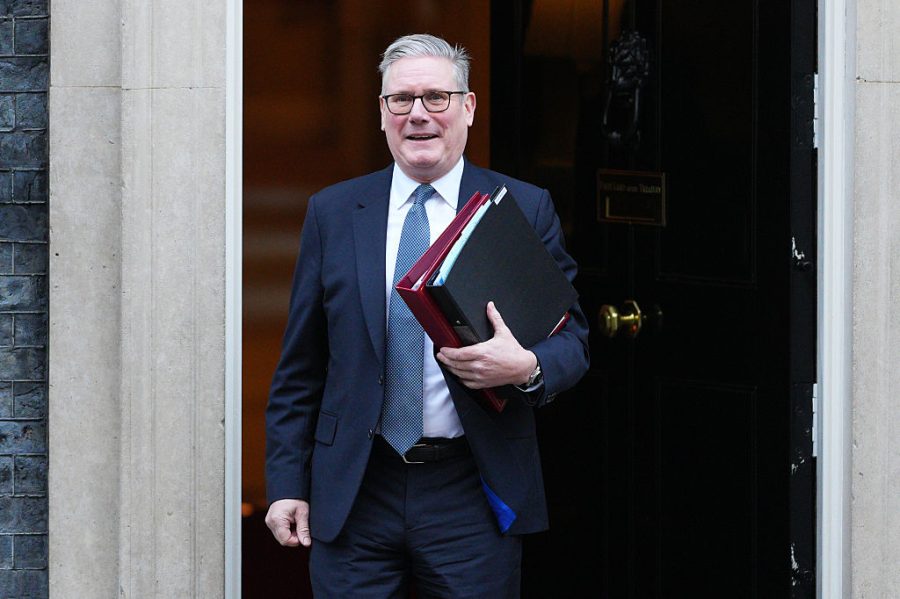
Keir Starmer began the year saying that any minute he wasn’t focused on the cost of living would be a minute wasted. Then he spent the first week of the political year engaged in foreign affairs and yet another U-turn. While Downing Street wants to talk about ‘the year of proof’ for its reforms of the public services, it has less ability to control the news agenda than even recent Tory administrations. Here are six things we have learnt this week.
- This government is increasingly the victim of events, not their master
Fair enough, you might think, when Donald Trump is on the scene, a president who is not only capable of impulsive action but seems to positively revel in controlling the news agenda as if he was still the main attraction in a reality television show. Starmer has done pretty well at dealing with Trump and keeping his head down when the left demands condemnation of Trump’s latest move, as they did over US special forces abducting Narco-Presidente Nicolas Maduro from his Venezuelan lair.
Labour has no coherent political message
My understanding from a well-placed source is that the PM was, at first, fairly relaxed about the raid, even as the left went caracas. But Labour’s public statements got tougher when the lawyers got involved. ‘On Venezuela, Starmer’s first instinct was to shed no tears for Maduro,’ a senior Labour figure revealed:
He was immediately corrected by FCDO lawyers and changed his language. Exactly the same thing happened on the Iran strike last year. When he initially seemed to give support to the US, lawyers and FCDO officials went mad and demanded he change what he was saying. He then called for ‘de-escalation’ and sounded ridiculous.
In my first piece for The Spectator in June, I revealed the role in all this of our old friend the Attorney General Richard Hermer, who remains the key figure. ‘[Lord] Hermer leads the pack. He has no political consideration whatsoever. But the FCDO and Cabinet Office are awash with lawyers supporting him.’
2. The lawyers, not the ministers, are in charge
On Budget day in November, I revealed that the chiefs of the armed forces had met and agreed that they formally needed to tell ministers that they do not have enough money to deliver the strategic defence review. A while later they went to see Starmer, a meeting which led to the Defence Industrial Plan, due to be finalised before Christmas, being delayed indefinitely. The PM was blindsided and very grumpy. Now the Times has discovered that the shortfall amounts to a staggering £28 billion. I’m told there is a hope to get it resolved in February, but it has to be done before the Nato summit in Turkey at the start of July if the UK is not to be a laughing stock.
‘Starmer is angry with John Healey [the defence secretary] and he is furious with the MoD for failing to sort all this out,’ says one of those familiar with the conversations. The Ministry of Defence (MoD), as Dominic Cummings and others have observed, has been a basket case of wasted billions for years, in which failing projects have been continued to avoid the embarrassment of scrapping them, but Starmer’s impotent rage is typical of a government which seems ill-equipped to juggle day-to-day crises with systemic reforms.
3. The PM is largely ignorant of defence issues and lacks the bandwidth to grip key issues
Despite all this, Starmer met Emmanuel Macron and other Nato leaders this week and agreed, in principle, that Britain is prepared to deploy ground troops in Ukraine to enforce any peace deal which emerges. Not only does the coalition of the willing seem to consist solely of the UK and France, but there are grave doubts the army could sustain a meaningful deployment for any length of time. Nigel Farage said on Wednesday that he would vote against such a mission unless more countries were involved. One defence insider says:
The guilty UK secret is that our forces have shrunk to such an extent that we will find it very difficult to put in the people needed. Starmer has been told this. There is no serious UK financial or manpower plan to remedy this.
4. Where security is concerned, Britain and Europe remain all mouth and no trousers
Finally, we come to the looming U-turn on business rates for pubs, another short-sighted money-saving exercise from the 2025 Budget. Over what I and others have been told were the objections of the Chancellor, Rachel Reeves, No. 10 has driven for a package which will spare pubs. Pubs and restaurants are highly prominent features of most high streets and if they started closing, it would be a highly visible signal of Labour failure. Add to that the fact that polls show low public morale and economic confidence. Pubs are one of the places people can go to drown their sorrows. There is a lack of coherence between Labour’s words and actions. The Budget was just bad politics.
5. Labour has no coherent political message
The real significance of the U-turn, coming hot on the heels of the pre-Christmas cave-in over the family farms inheritance tax raid, is that No. 10 has now twice overruled No. 11 in a humiliating fashion. I still remain of the view that Starmer has little to gain from sacking Reeves; they are tied to the same leaning mast. However, it is hard to think of examples in recent years of the First Lord of the Treasury so blatantly bigfooting the Chancellor.
6. Reeves is in office, but is no longer in power

Comments