The unemployment rate has risen to 5.2 per cent, the highest non-Covid level since 2015. Unemployment is now up by a quarter since Labour took office. Youth unemployment is also at its highest level (16.1 per cent) since 2015 and has likewise grown since Labour were elected. Over the past year the rise in unemployment in the UK has been (by some margin) the fastest in the G7.
Reform might not fancy going into a general election with a slogan aimed at young people of: ‘Vote for us and we’ll cut your wages.’
Youth unemployment rising is particularly sensitive because at the 2024 general election Labour had a manifesto commitment to have the same minimum wage for younger workers as for adults. Under the current rules those aged 18 to 20 have a lower minimum wage (£10 per hour) than those over 21 (£12.21 per hour). Minimum wages for workers under 21 were already raised more rapidly in 2025, and a further catch-up rise for younger workers is due in April.
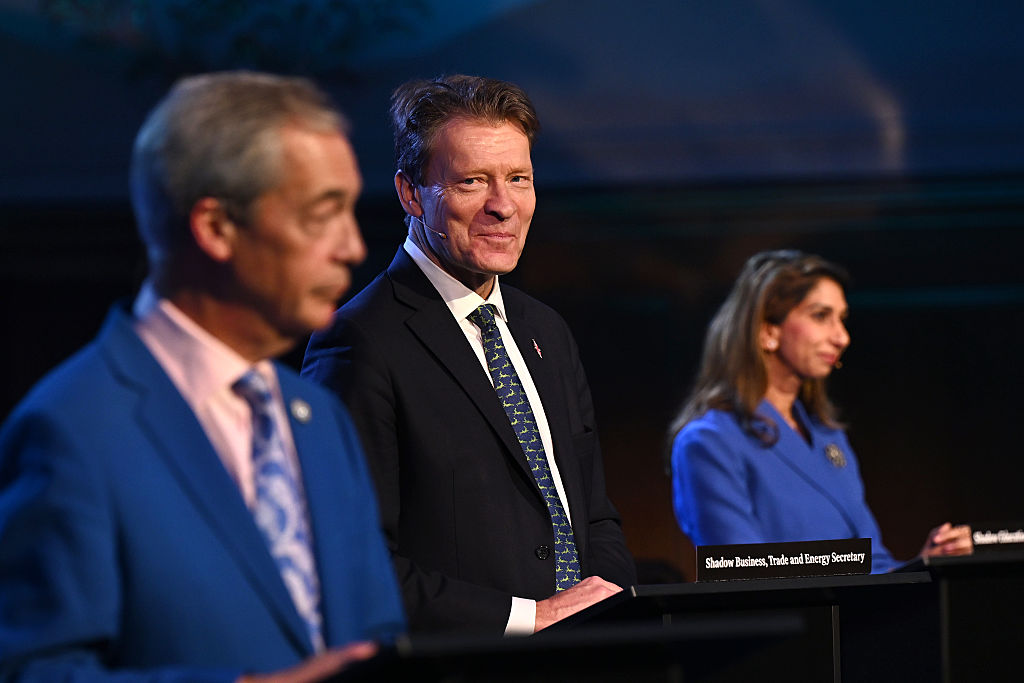
It’s natural to blame the rise in youth unemployment partly on these minimum wage increases – though in fact unemployment in the under 25 age group has not risen in proportional terms as rapidly as unemployment overall. Richard Tice, Reform’s newly-minted shadow business, trade and energy secretary, was put under pressure on LBC on this point on Tuesday. He was asked whether Reform would cut the minimum wage for young people. He said the matter would have to be considered, without committing to anything specific.
Pressed further as to whether Reform was proposing cutting the wages of millions of young people he noted that those without jobs get no wage at all, but made the point that policies that have bad effects when introduced may also be problematic to unwind (presumably because the process of doing so may itself create other losers).
In a sense, one assumes Reform welcomes this kind of detailed scrutiny and challenge. They are receiving it precisely because opinion polls have for many months indicated that they would win a general election if it were held now. On the other hand, they might not fancy going into such a general election with a slogan aimed at young people of: ‘Vote for us and we’ll cut your wages.’
This is a classic problem faced by political parties that stand on a platform of wide-ranging reform. Any reform inevitably creates losers as well as winners. The political pressure is then to tone down claims of comprehensive wide-ranging reform and instead focus on a few easier standalone issues.
That could be a bad mistake, though. In think-tank world one of the most famous wide-ranging reform programmes was that implemented by the Labour government in New Zealand in the 1980s. It is often referred to as ‘Rogernomics’ after the Labour finance minister Roger Douglas (I should perhaps declare an interest in that he was, in the 1970s, a good mate of my father’s).
After he left office, Douglas wrote a book in the 1990s called Unfinished Business. A key argument of that book was that a comprehensive wide-ranging reform package is, perhaps counter-intuitively, more likely to gain political support than doing reforms a bit at a time. The reason is that in any well-conceived comprehensive package even those that gain overall may lose out from some individual measures.
By presenting the whole coherent package, the overall net gainers can see a significant advantage to themselves. If only individual measures are proposed then their support may be lukewarm (if their gains are low) or they may be opposed (if they lose out).
A challenge for Reform in the years leading up to the next general election is that if they cannot produce a coherent overall package, they may struggle to avoid their opponents cherry-picking the negative impacts of their programme and showing who loses out, much as Tice experienced this time.






Comments