

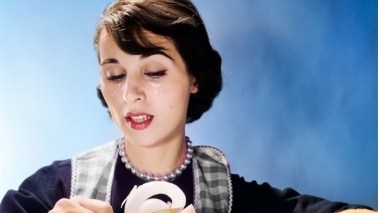
Matthew Sweet’s jaw-dropping life of Barbara Cartland opens with the grande dame reclining on her chaise longue in the library of Camfield Place, her home for 50 years. Here she could be found daily between 1:15 p.m. and 4 p.m., a ghoulish masquerade of femininity in a hot-pink taffeta cocktail gown with a snappy Pekingese nestling by her side. Her face, beneath the halo of Elnett-stiffened yellow hair, bears an inch of white powder. There are two clownish circles of rouge on her cheeks and sticking plasters on her temples to tighten the skin. Gazing into the middle distance through tarantula-sized false eyelashes lathered in black boot polish, she is “talking, talking, talking.” (Boot polish applied with a toothbrush is preferable to mascara because it stays put when you cry.)
The torrent of words – 6,500 a day – is recorded in shorthand by a plainly dressed woman sitting out of range of vision. “I would love to employ a man,” Cartland told her friend Christine Hamilton, the wife of the disgraced Tory MP, “but how can I possibly give a man dictation from the bath?”
It took Cartland a week to dictate each 45,000-word romance, which was typed up by her secretary and sent to a local schoolmaster to be checked for grammar and spelling. The pages were then checked again by Cartland to ensure that no paragraph was longer than three sentences and none of her ellipses had been removed, before being tied with pink ribbon and dispatched by Rolls-Royce to her editor, who, making no changes, deposited the page proofs at Claridge’s to be collected by Cartland’s chauffeur. This way, for her last two decades, she was able to publish 23 novels a year. By the time of her death in 2000 she had sold 750 million books worldwide and become an object of mockery and misogyny.
Sweet, who admires his subject’s energy and enjoys her vulgarity, likens the fiction factory in Cartland’s library to psychoanalysis, also known as the talking cure, and Cartland confirmed the analogy: “When I want a plot,” she explained, “I deliberately instruct my subconscious to form it for me.” Because she liked to offer two or more versions of every autobiographical detail, she also said that her plots came to her down a hotline from the Almighty: “I’ll say to God, ‘I want a plot’ and it will be there in 24 hours.”
Either way, Cartland’s 720 romances all share the same story, which is recycled again and again: a virgin in distress, with a name like Aldrina, Seraphina, Fortuna, Mavina or Theola, is saved by a rake with a name like Volgo, Valient, Tarquin or the Marquis of Ryde. Her inspiration, Cartland claimed, was virgins (“I invented virgins”), but according to Peter Conrad, “her subject is always rape.”
The only variations in the plot are the locations in which the encounters take place, which move between England, Europe, South America, Russia and the Arab world. “Arab men,” Cartland said, “can’t get enough of the sort of girl I write about,” and her fans included President Sadat and Colonel Gaddafi. Otherwise, she explained, her readers were the sort of women:
who are on Valium because they’re having such a rotten time in real life. They don’t want to read about the kitchen sink, they can look at that any time they’re peeling potatoes. I’m their escape. I give them glamour, beautiful clothes and the marvelous attentive men they are starving for.
Having given up on the real world herself, Cartland took fantasy seriously.
Her own story reads less like a Barbara Cartland than an Evelyn Waugh novel, with the protagonist as one of the saner examples of the Bright Young People Waugh satirizes. Cartland came from brass, literally: the family ran Birmingham’s biggest brass foundry. She was born in Edgbaston in 1901, the eldest child of Captain Bertram Cartland and an aspirational mother called Mary, but known as Polly because she chattered like a parrot. Convinced she would die in labor, Polly wrote Bertram a farewell message on black-edged notepaper: “I have a horror of being buried alive. Please promise me that Dr. Marson shall cut an artery and make certain life is extinguished.” Mother and daughter, tied at the hip, both lived to the age of 98.
Had Bertram’s father not shot himself in a meadow by the Hagley Road in 1903, Barbara would have been raised in leisure and never learned the importance of keeping up appearances. You might say that she became an embodiment of this rule. Her grandfather’s suicide, which she later spun as a sign of his honor, was proof that masculine strength could not be relied upon, while women had excellent survival skills. As the family income disappeared and Bertram drank himself sick, Polly – now also the mother of two boys, Ronald and Tony – set up a knitwear shop. When Cartland, at a finishing school on the Hampshire coast, heard from Polly that Bertram had been killed in action in May 1918, she saw the positive side. “My Ownest Darling,” she wrote in reply, “I can’t tell you how I loved your letter. I think you are simply too wonderful… No wonder Daddy loved you as he did – and does.”
“Barbara Cartland came of age in a world depleted of men,” writes Sweet. “This is one of the most important facts of her biography.” She nonetheless turned down 49 proposals of marriage, or so she said, from men with names like Pingo Landrishe, son of Sir Hercules. Her first husband, Captain Alexander “Sachie” McCorquodale, whom she married in 1927, was financially and psychologically destroyed six years later by Cartland’s lawyer in their divorce. Her second husband, Hugh McCorquodale (Sachie’s cousin), whom she married in 1936, had been left for dead at Passchendaele after a dum-dum bullet passed through his shoulder, collapsing a lung and removing three ribs; he died of his injuries 50 years later. “Wounded men are often extremely good lovers,” Cartland told the Guardian in 1997. “It’s something to do with the circulation of the blood.” The love of Cartland’s life, however, was her brother Ronald, who was killed in 1940 in Dunkirk, the day before Tony fell in Flanders. “I was in love with him and him with me,” she said of Ronald, who was homosexual. “I called myself his ‘spiritual wife’ and it was like a perfect marriage in everything but sex.”
Pistols keep going off and legs being amputated. Proposals are made at gunpoint, suicides are two a penny
The problem for many biographers is how to deal with the great swaths of boredom that most lives contain. This has not been an issue for Sweet, because Cartland did not know what boredom was. Every page of this book is a cliffhanger: pistols are forever accidentally going off and legs being amputated (“Men with amputated legs make the best lovers,” Cartland believed). Proposals are made at gunpoint, suicides are two a penny. Not a year goes by without a monoplane going down, a decree absolute, an IRA murder or another case of inherited eczema for Cartland to deal with.
She wrote gossip columns, ran a hat shop, designed an airmail delivery glider, campaigned for gypsies, nursing reform and the salaries of midwives, served as a Tory councillor for Hertford county council, wrote operettas and recorded an LP in which she sang, in a “small soprano voice,” cover versions of her favorite songs. And all in the guise of a pantomime dame arguing that women are equipped to do nothing.
Her fantasy world became reality when her daughter, Raine, married Earl Spencer, whose own virgin daughter, Diana – a keen reader of Cartland’s novels – was saved by a prince. “I only wish that I could write the love story for them,” Cartland said. “It would be a proper Barbara Cartland love affair.” As it was, her attempts to cash in on the royal wedding led to her being banned from the nuptials. She told the Daily Mail in 1981:
This was supposed to be the Barbara Cartland year. My year. My 80th year, my 300th book. Instead, it has all been a frightful bore with everyone being horrid and bitchy.
It is impossible not to admire the battleaxe who rolls through these pages like an armored tank, or to appreciate the contradictions of which she was made. Barbara Cartland’s books may no longer be readable, but her extraordinary, tragic life is gripping from start to finish.


Comments