
Alex Burghart has narrated this article for you to listen to.
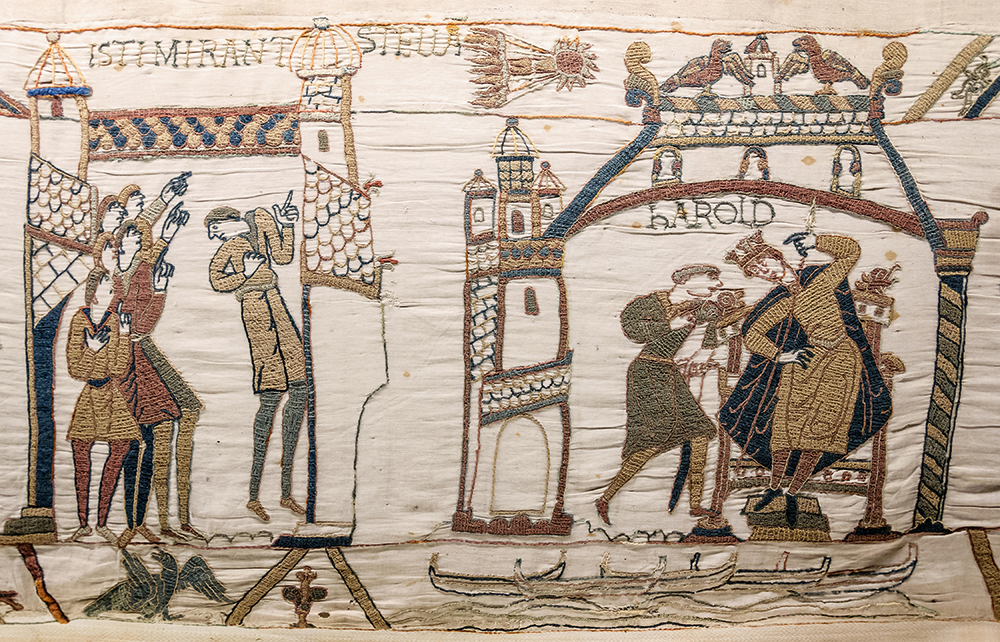
Oh Harold. So near and yet so far. So close and yet no cigar. In January 1066, the world (well, England) was at his feet. Two hundred and eighty-two days later he was battle meat. On day one he became the richest ruler Anglo-Saxon England had ever known. In late September, he defeated the hardest bastard in Europe (Harald Hardrada). In mid-October, England was changed forever, but not by him.
He had, of course, no right whatsoever to be king. Sure, he was Edward the Confessor’s brother-in-law, but under the sacred rules of hereditary power that gets you zip. He claimed that Edward had promised him the throne (he hadn’t), but, again, that ain’t how the royal circus rolls. Moreover, there was a blood heir – Edgar Ætheling, the great-grandson of Ethelred the Unready – whom Harold had sworn to support. He reneged, pulled off an epic coup and became the only Englishman ever to assume the throne without one drop of royal blood in his veins. Somehow, later generations came to believe that he had been on the side of right. How on God’s merry earth did this happen?
Tom Licence’s superb biography – ingeniously timed for the Bayeux Tapestry’s return – sets out to rebuild the man afresh from first principles and primary sources. A central and often blithely discarded fact is that Harold was half Danish (on his mother’s side; the name is Danish and was not used by Englishmen before his time.) Licence’s Harold has a touch of the Viking about him – he’s a taker of slaves and a man who had no qualms about ravaging English lands when politics demanded it (poor old Somerset). He was lascivious to boot: two wives, perhaps in bigamy; a reputation as an adulterer; and at least one illegitimate son. Domesday Book records “a certain concubine of Harold’s” owning property in Canterbury.
The son of Earl Godwin of Wessex, the great survivor and royal fixer extraordinaire, Harold was made Earl of East Anglia in his early twenties. Historians have often asserted that the “House of Godwin” was a potent force, hemming in a weak King Edward. Licence shows it to have been a far from tightly knit familybut full of fractures and disunities that often brought the senior siblings (Earls Swegn, Harold and Tostig, and Edith, the Confessor’s queen) to blows.
For all his roaring and raiding, Harold did not waste the talents or opportunities which God and Godwin had given him. Raised to Earl of Wessex on his father’s death, he became the king’s top dog. He took command of the southwest Midlands and used this base to attack the Welsh kingdom of Gwent. Licence reveals how Harold deployed his military wiles to bring about the death of King Gruffydd ap Llywelyn, seize part of his domain and have his wife.
Harold became the only Englishman ever to assume the throne without one drop of royal blood in his veins
The ultimate power plays were to come. One of the author’s most intriguing theories is that the great northern rebellion of 1065 – which saw Edward’s favorite, Tostig, tossed out of his Northumbrian earldom – was masterminded by Harold, who then emerged, to Edward’s fury, as the de facto successor to the throne. This is major and fascinating revisionism. It has ordinarily been thought that, in 1066, the English chose Harold either because they needed a warrior to fend off invasions and the Ætheling was too weedy, or because Harold’s people pretended that Edward’s dying breath had left him as heir. Licence makes the case that, with Edward old and ill, Harold fomented discontent in the north and presented himself to his peers as the only man who could bring order. This being so, the succession question may have actually been resolved in 1065, rather than on Edward’s death in 1066. Where Licence perhaps goes a smidge too far is in suggesting that this was the only viable course for the kingdom. The stench of ambition can be smelled 960 years down the way. Harold had options. He chose himself.
In any case, a badder beast with a yet more spurious claim was coming. Licence is persuasive in showing that, up against it, Harold made few mistakes as king. Cunning and luck gave him victory against Hardrada. The use of his fleet may have spared some of his troops the forced march back from Yorkshire. And even after two critical battles in the north, the English ran the Conqueror close in the south. Alas, Hastings was a battle too far.
There is much the specialists will long debate. But all future biographers will need to wrestle with the man Licence has assembled: a shagger, a chancer, an oath-breaker, a soldier and a grandmaster of the great political game. Here is a three-dimensional Harold who stands in his own time and on his own terms, and who, for all his human faults, is still, like the blazon on his banner at Hastings, “an armed warrior woven in pure gold.”



Comments