
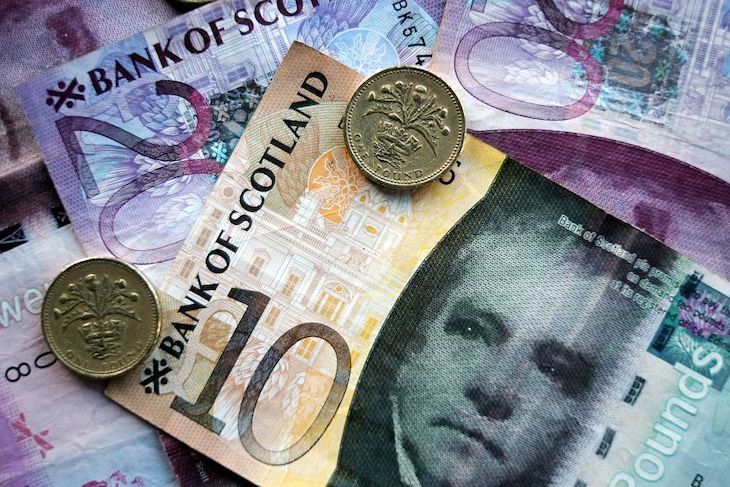
It seems like a lifetime ago now. A few weeks before Scotland’s seismic 2014 vote on whether to exit or remain in the UK and pro-union leader Alistair Darling was in a fierce TV debate with Alex Salmond, head of the nationalist campaign.
The question that stripped Salmond of his credibility has been a thorn in the side of the separatist movement ever since
‘Any eight-year-old can tell you the flag of a country, the capital of a country and its currency. Now, I presume the flag is the Saltire, I assume our capital will still be Edinburgh but you can’t tell us what currency we’ll have,’ snapped Darling, inflicting what turned out to be a killer blow.
The question that stripped Salmond of his credibility has been a thorn in the side of the separatist movement ever since. Just how do you go about breaking Scotland away from its monetary base in an era of highly complex, financialised economies? Salmond wanted a formal monetary union with the remaining UK, which was a non-starter for the Treasury.
Post 2014 and the SNP switched to advocating for sterlingisation, or unofficially continuing to use the British pound after separation, even though Salmond’s economic advisors had explicitly warned against this. That position was then tweaked to sterlingisation for probably several years before eventually moving to a new Scottish currency.
None of this was credible. Unofficially using sterling would almost certainly induce a financial crisis, but when this has been pointed out to those campaigning for separation the response has generally been to ignore reality, point at the flag and pretend everything will be fine. That is, until last weekend.
At a conference held by a fringe group of Scottish nationalists self-styled as the Scottish Currency Group, an astonishing thing happened: a realistic, or at least somewhat realistic, currency plan was presented.

It came in the form of a new paper from a credible French economist called Thibault Laurentjoye, who is an associate professor of macroeconomics at Aalborg University in Denmark. The Scottish Currency Group had commissioned Laurentjoye to review the situation from an outsider’s perspective and come up with his own best plan.
That best plan is for a new currency on the first day of independence, two-and-a-half years after a vote to leave. As per the plan, from that day on the new Scottish government will pay public wages, benefits, pensions and suppliers in the new currency and collect taxes in it. There will also be a Currency Conversion Act requiring the automatic conversion, on the day of secession, of mortgages, loans and deposits into the new currency. The new currency will be fixed for a few months before being allowed to float freely and find its level against sterling and other currencies, and there will be capital controls to prevent panic cash withdrawals and money flight.
There is much detail on how exactly the banking system will operate and how other technicalities will be handled, but the gist is a big-bang moment on independence day when everything changes.
Why is this more credible than what we’ve seen before? Because the fundamentals of Scotland’s economy, with its large fiscal and trade deficits, means any form of sterlingisation would likely lead to a crisis situation where the route out of that crisis is to introduce a new Scottish currency under emergency conditions anyway. With a formal monetary union with the remaining UK and sterlingisation ruled out, the only remaining option left is to dump the pound and jump straight in with a new currency. Laurentjoye has at least objectively assessed the options on the table and landed on the least bad strategy.
Could it work? Could a seceded Scotland use this plan to cut away from its established monetary and fiscal base without inducing a severe economic and then social crisis? If the stars aligned, if all players involved acted in the best interests of the new state (including the remaining UK, which seems improbable when Scots have just rejected British compatriotism) and absolutely nothing went wrong, then in theory it might be possible to do this. In reality, the chances of the plan falling apart when it makes contact with reality are high.
There are many things that could go wrong. What if banks lending in sterling simply refuse to convert their loans? Would forced conversion create enormous legal liability for the new state? What happens when the new currency floats, falls, and people still have sterling liabilities to meet? Mass household and business bankruptcies? And where are the skilled technocrats who will implement the plan? The Scottish government is still trying to finish the last of two ferries it’s been building since 2015, never mind constructing a credible new state monetary base in just 30 months.
In reality, the mere act of Scotland setting a date to undertake Laurentjoye’s radical currency conversion would likely induce panic, capital, business and people flight, just as the prospect of a newly independent Scotland becoming a sterlingised economy would.
So where does this leave the nationalist movement, and John Swinney’s SNP if it takes Laurentjoye’s proposal seriously? One step closer to reality, certainly, but no closer to convincing the people of Scotland that their money is safe with secession.






Comments