


Lisa Haseldine has narrated this article for you to listen to.
Svalbard
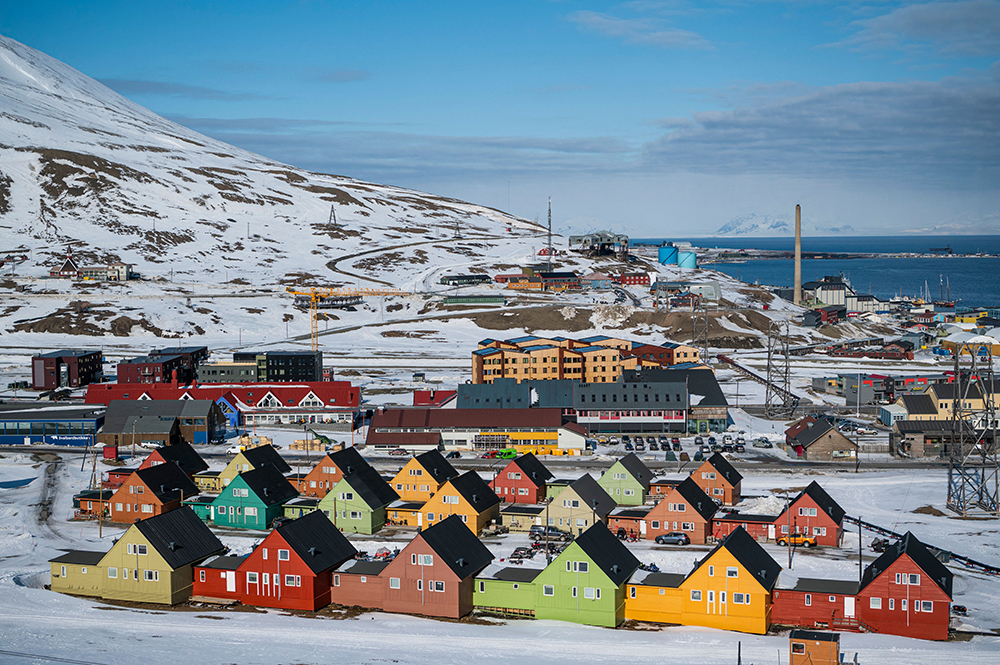
The quiet hillside by Longyearbyen’s church gives visitors to the capital of Norway’s Svalbard archipelago an austere but beautiful panorama of the bay that cradles the town. Tall, sharply steep mountains, blanketed with snow, collide with the blue-grey waters of the Arctic below.
From that hillside, I watched the quiet bustle of Longyearbyen. Since Donald Trump threatened Nato with the biggest crisis in the alliance’s history by stating his desire to take control of Greenland in the name of US ‘national security’, Svalbard’s residents have been uneasily looking westward. The US President has repeatedly claimed that only he can prevent the island, which is just 185 miles from Svalbard, being used as a staging post for an attack on the West by Russia or China.

Svalbard, a collection of islands whose area is roughly twice the size of Belgium, is home to only about 3,000 people. For centuries, explorers hoping to reach the North Pole used Svalbard as their Arctic base camp. Despite the raw wilderness, it also has a distinct sense of claustrophobia.
Sitting at 78 degrees north, the archipelago is rich in natural resources and home to Svalsat, the world’s largest satellite ground station, which provides services to Nasa and the European space agency. But while Svalbard belongs to Norway, it is a unique – and particularly vulnerable – territory thanks to the treaty under which it is governed.
Signed in 1920, the Svalbard Treaty grants its signatories unfettered access to the archipelago’s natural resources and the right to live and work there visa-free. It also prevents the islands from being used for ‘warlike purposes’ – including by Norway, meaning that the country is unable to garrison troops permanently on the territory.
There are two main settlements on Svalbard: Longyearbyen, home to 2,490 people of approximately 50 different nationalities, is the only one controlled by Norway. Thirty miles down the coast is Barentsburg, a so-called ‘company town’ run by the Russian state-owned mining firm Arktikugol, home to 386 inhabitants (just over half of whom are Russian). No roads connect the two: in winter, the towns are several hours’ drive apart by snowmobile; in summer, boats serve as the primary transport for residents and tourists. Mainly built up around a central strip, Barentsburg has its own hospital and kindergarten and is also the home of Svalbard’s first brewery, Krasniy Medved – ‘Red Bear’.
Russia has had a presence on Svalbard for several hundred years: Pomor fur trappers from northern Russia are believed to have first arrived on the archipelago in the mid-16th century. The mining towns of Barentsburg and Pyramiden (the latter now largely abandoned) were bought by Arktikugol in the early 1930s. They seem frozen in time: huge bronze busts of Lenin remain in the central squares of both towns, and Barentsburg’s is flanked by a monument with the Soviet slogan: ‘Our goal is communism!’ Arktikugol says it preserved these relics of the USSR as tourist attractions but Vladimir Putin’s increasing tilt towards Soviet nostalgia puts them in a more sinister light.
The Norwegian and Russian communities on Svalbard have coexisted since the USSR signed up to the treaty of 1920 four years later. But, where Longyearbyen and Barentsburg had fostered healthy economic and cultural collaboration, this all changed following the invasion of Ukraine in 2022. ‘It’s a delicate situation and we don’t have the same dialogue as we had before,’ Terje Aunevik, Longyearbyen’s mayor, says.
Aunevik and I meet in his office in Longyearbyen’s community council. Tall with sandy hair, he first came to Svalbard in 1998 as a dog-sled driver. ‘Dog-sled racing was sort of my purpose in life,’ he says. He has led the council since 2023; nailed to the wall behind his desk is a 40cm-long polar bear femur, a gift from the Norwegian government when the council was established.
Just 57 Russians live in Longyearbyen – most are employees of Arktikugol. ‘Of course it would be naive not to consider that there is intelligence-gathering going on in Longyearbyen,’ Aunevik states. ‘That’s quite obvious.’ Last year, Arktikugol reinstated the civilian boat route between Barentsburg and the Russian city of Murmansk, removing the need for Russians to apply for Schengen visas to travel to Svalbard via Norway. Although the voyages are irregular and weather-dependent, they mean that an unnerved Norway is less able to monitor who is making the trip to the archipelago from Russia – or indeed what sanction-evading cargo (civilian or military) such ships might be carrying. The first vessel arrived in Barentsburg at the start of last month; nine other journeys are reportedly planned for this year.
In recent years, Moscow has taken further steps to entrench the Russian community on Svalbard. In 2024, the Russian Orthodox church – a key ally of Putin’s regime which is also known to gather intelligence abroad for the Russian state – established a permanent congregation on the archipelago. Last year, the Kremlin granted Arktikugol subsidies worth £18.3 million. With coal mining on Svalbard a loss-maker for Russia and the community there so small, the question must be asked: why is Russia investing in its presence on the archipelago so heavily?
The answer lies in Svalbard’s location only 800 miles from Murmansk, home to Russia’s Northern Fleet. This accounts for roughly two-thirds of the Russian navy’s nuclear-powered ships, including at least 23 submarines. The submarines carry weapons reportedly capable of sending missiles over the North Pole to America. Crucially, the waters around Murmansk don’t freeze in winter, allowing the fleet year-round access to the Arctic and North Atlantic.
Norway and Svalbard flank what is known as the ‘Bear Gap’, a maritime chokepoint which forms a key part of the Northern Fleet’s route into the North Atlantic. Although the archipelago’s treaty forbids military activity, strategically, whoever controls Svalbard would have the upper hand over the Bear Gap in a hot war. Germany’s defence minister Boris Pistorius recently described the threat in alarming terms: ‘In the event of an escalation in Europe, Russia would most likely use its Northern Fleet to open a second front, cut transatlantic supply lines, and threaten both sides of the Atlantic with nuclear submarines.’
Where historically Russia’s interests on Svalbard appeared defensive – trying to stop Nato from coming too close to its defences in Murmansk – military chiefs have warned there are signs Moscow is shifting to a more offensive position. In 2022, Russia’s maritime doctrine stated its objective of ‘enforcing control over activities of foreign navies in the waters of the northern sea route’.
Strategically, whoever controls the Bear Gap would have the upper hand in a hot war
Nato is alive to this scenario. In 2024, the alliance’s defence college identified a future Russian invasion of Svalbard as one of its ‘Dragon King’ scenarios – a unique yet predictable event of huge consequence. It envisaged a situation where Russian forces took Svalbard in the night, cutting its internet and cellular services. The risk was flagged up that Norway might fail to win consensus from Nato allies for triggering Article 5 for fear a conflict with Russia in the Arctic would take resources away from Ukraine. Norway, it surmised, would on its own lack the capabilities to oust the Russians.
Defence experts have noted that in recent years much of the Northern Fleet’s man-power has been transferred to Ukraine, sustaining heavy losses and hollowing out Russia’s northern troops. But that does not mean it has ceased to be a threat to Europe. Vice Admiral Rune Andersen, chief of the Norwegian Joint Headquarters, has warned that Moscow plans to regroup and expand its military after the war in Ukraine. ‘We are preparing for a more dangerous Russia,’ he said.
The concern is that, with only Norway guaranteed to abide by the Svalbard Treaty’s ban on using the archipelago for military purposes, there is nothing to say Russia won’t try to snatch it before Oslo is able to launch a counterattack. This is where the true test for Nato would lie: would Norway’s allies agree to engage in conflict with Russia to win Svalbard back?
In Longyearbyen, the authorities are choosing to proceed slowly and cautiously. ‘Calmness and stability have been headlines of the Norwegian policy since the 1980s,’ explains Aunevik. No unnecessary provocations. And yet, with conflict creeping closer to Svalbard’s shores, this approach seems to be on borrowed time.







Comments