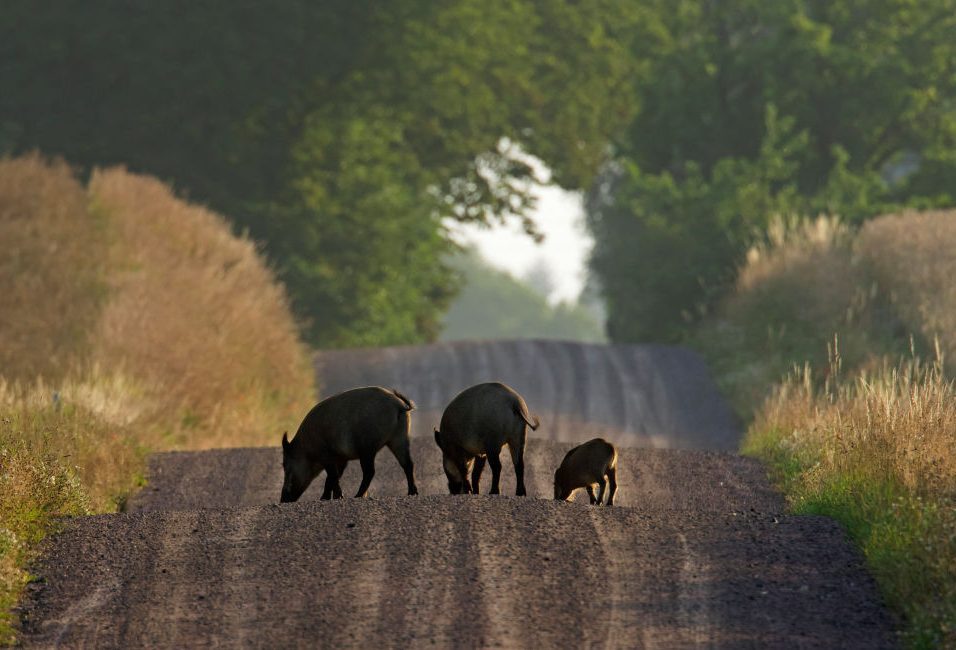
The hunting season began in Burgundy last Sunday. The first couple of weeks are dedicated to the pursuit of small game: pigeons, partridges and hares. Call it the hors d’oeuvre to the main course: the hunting of wild boar, which gets underway in earnest at the start of October.
My neighbour, a farmer, hunts, and so does his son and most of their friends. They spent much of Sunday blazing away in the adjacent fields. I felt like I was in the gunfight at the O.K. Corral. Not that I mind. I was a townie in another life but now I’m what the French call a plouc (yokel), and in rural France hunting is sacrosanct. It’s also imperative, specifically the culling of wild boar. Their numbers have exploded in recent years and the damage they do is immense.
More boar and fewer hunters means those who do go out every weekend aren’t short of targets
A 60kg boar can eat up to 3kg of food a day, although many of the beasts weigh twice as much. Boars aren’t fussy eaters. They’ll snack on anything from roots, crops and fruit to insects and small rodents. So ravenous are boars, they have been known to roam as far as thirty miles in one night in search of a good feast. On the advice of my neighbour, I have fenced my large vegetable plot. Boars, he told me, would love to get their snouts into my peas and potatoes.
It’s impossible, however, to fence France’s golf courses, which increasingly are a target for wild boars, as are village football and rugby pitches. Anywhere where there’s the possibility of finding some grub. Occasionally, that includes a nocturnal visit to a city centre, as was the case a couple of years ago when a boar was filmed trotting down the boulevards of Nantes.
There are three reasons why the wild boar population is out of control in France. The most significant is global warming. Sows are breeding at a younger age and the survival rate of piglets is increasing. Harsh winters used to account for many piglets but most now reach adulthood because of the milder climate. They also have no natural predator, except for the grey wolf, which is present in small numbers in the Alps and Massif Central.
The second reason is Covid. In the winter of 2019/20, some 800,000 wild boar were culled; then came the pandemic when France was locked down repeatedly from March 2020 until May 2021. What fun the wild boars had, feeding and breeding to their hearts’ content.

The huge drop in the number of vehicles on the road during the twelve months of almost continual lockdown was also a factor. Around 30,000 wild boars are killed each year on French roads. They have also been known to stop trains in their tracks.
The third reason is that hunting is not as popular as it was. In the 1970s, around two million men and women hunted regularly in France, twice the number today. Nearly two-thirds of hunters are aged between 45 and 69. Millennials and Generation Zers aren’t that interested; only 150,000 registered hunters are under 34.
The emergence in recent years of a radical Green party in France has fuelled an anti-hunting backlash among the young. Half a million people signed a petition in August demanding that this season’s hunt be suspended. The signatories argue that the summer wildfires have already caused enough harm to animals.
These people ignore the reality, laid bare in a 2019 parliamentary report: Eighty per cent of crop damage – totalling more than 30 million euros a year – is attributable to wild boars. Boars can also spread viruses, such as Aujeszky’s disease, which is lethal to dogs. An outbreak in the south-west of France in 2023 killed several dogs.
More boar and fewer hunters means those who do go out every weekend aren’t short of targets. A record 900,000 boar were culled in 2024/25. In comparison, in the 1970s when, don’t forget, there were twice as many hunters, the average cull was around 35,000 a year. This year’s hunting season will be a challenge. Farmers have harvested their fields earlier than usual because of the heatwave. They are shorn of their crops and the drought – which shows no sign of breaking in France – has stunted the growth of hedges and grass.
Wild boars and deer have adapted their behaviour to the hotter summers of recent years. They remain in the cooler woodland during the day and come out at night to forage, but it is increasingly difficult for them to find food in the rock-hard fields. So they migrate to cultivated and irrigated areas.
My neighbour didn’t have much success on the opening Sunday of the season. His dogs struggled to pick up scent trails because the ground is so arid; nor, of course, do the beasts leave any tracks in fields that haven’t seen substantial rain for months. Earlier in the summer I found two deer grazing in my garden. I’ve also crossed paths with wild boar on a couple of occasions when out for my morning run. One was a youngster but the other was an old grey-backed monster just a quarter of a mile from our hamlet.
I think I might need a bigger fence.




Comments