
FanDuel and DraftKings ads spice the early spring airwaves, robots deliver their unimpeachable verdicts on human actions and a family of four shells out 500 bucks for parking and tickets to attend a game. Major League Baseball has returned!
At least this year MLB scheduled its Opening Day game – a March 25 interleague (yech!) contest between the New York Yankees and San Francisco Giants – to be played stateside. Mixing America Last-ism with corporate-culture imperialism, six previous Opening Day games have been played on foreign soil. That other countries might have sports of their own annoys the panjandrums of professional baseball and football, who seek to impose spectatorial homogeneity on a diverse planet. At least the soft-drink imperialists of the recent past feigned altruism; I can still hum the jingle from the “I’d Like to Buy the World a Coke” campaign of 1971.
To grouse about this is to be dismissed as an old man yelling at clouds, but some clouds deserve to be yelled at
It’s pretty darn depressing to love baseball and yet despise the game at its highest level. I still play catch with our daughter every spring; I look forward to watching amateur baseball games over the next few months, and I’ve just finished Phil Coffin’s When Baseball was Still Topps, a delightfully digressive book of mini-biographies of every major league ballplayer in the 1959 season – yet I wouldn’t take front-row seats to a Yankees game if you begged me.
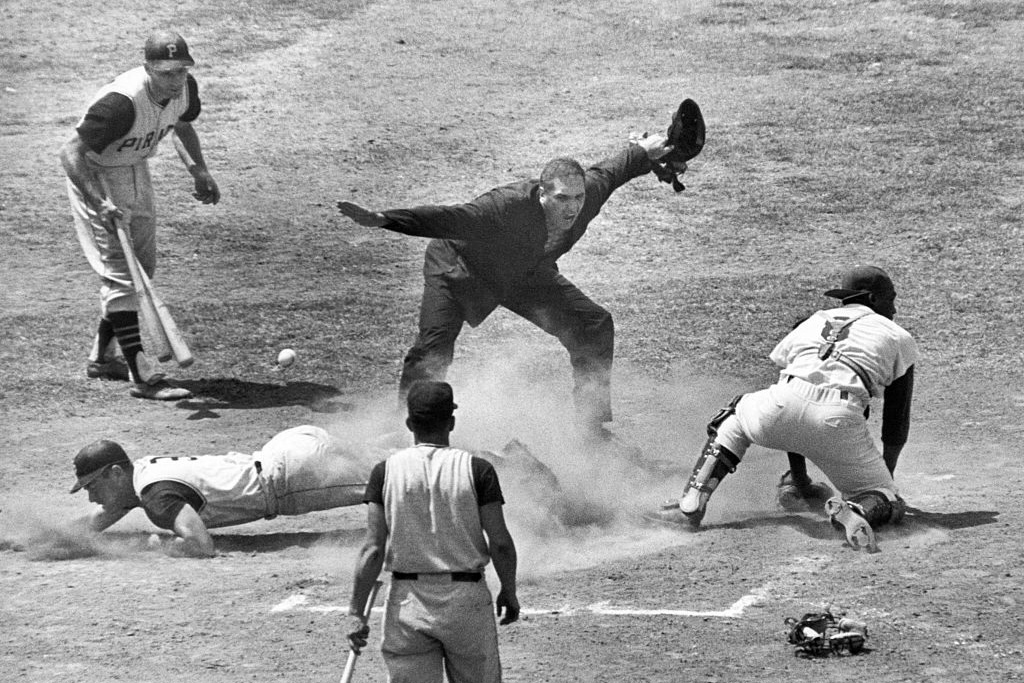
Major League Baseball has been de-charmed – dehumanized – by grotesque rule changes (a runner mysteriously materializes on second base during extra innings); and potential rule changes (a “Golden at-Bat” permitting a hitter to bat out of order); and the increasing subordination of humans to machines (robo-umps and instant replays). For Yogi’s sake, even catchers now signal the type of pitch they wish the hurler to throw not by wiggling fingers but rather via keypads and wireless receivers.
To grouse about this is to be dismissed as an old man yelling at clouds, but goddammit, some clouds deserve to be yelled at. After all, cumulonimbi carry the rain that washes out games. One might hope that the rot at the top, whose avatar is the execrable commissioner of MLB, Rob Manfred, brainstormer of the Golden at-Bat and pitiless executioner in 2021 of 40 of Minor League Baseball’s 160 teams, does not seep into the grassroots, but the evidence is as blunt as a fastball to the face.

Since 2019, the number of kids who play baseball or softball has fallen by about 20 percent for those six to 12 years of age and about 15 percent for those aged 13 to 17. The purest form of youth baseball – self-organized sandlot play, no adults present – has virtually disappeared. Every day I walk past the ballfields on which I played from dawn to dusk, with a break for lunch, for all the summers of my boyhood, and they are as vacant as Kristi Noem’s comely noggin.
What is lost? Friendships, time outdoors, neighborhood camaraderie… and social maturation. In sandlot play, you had to resolve disputes – strike or ball? safe or out? – on your own; there was no umpire, human or robotic, to lay down the law. Seldom did these disagreements result in fistfights or headlocks. It was only a game, after all, and none of us possessed missiles we could casually lob at the opposing team.
Our small city once had an octet of neighborhood parks, each of which fielded ballclubs in the summer. These fostered local loyalties, homeboy spirit and a sense of adventure, as we’d ride our bikes across town to exotic outlands. The parks survive, but the park program does not. Grass grows where children once rounded the bases.
From ages nine to 12 we also played Little League – organized by adults, yes, but a little more competitive, and the uniforms were fun. Twelve teams comprised our league in the 1970s. Last year, the number of players was less than half that of a half-century ago.
Travel teams have picked up some of the slack. This is a troubling anti-localist development; rather than have little Colton or Chase play ball – make friends – with the kids in his town, parents pay an often tidy sum so the lad can be driven to other towns, other counties, even other states to play relatively high-pressure tilts against strangers. You don’t ride your bike to those games.
I suppose this is all part and rotten parcel of the “Retreat from Human” that our tech overlords are orchestrating. So baseballers, this spring and summer, do something that won’t compute. Sponsor a Little League team. Go to a high-school game. Hackers, have at the robo-umps. And catchers, give your pitchers the finger.



Comments