In his interview in this week’s magazine, Robert Jenrick claims one of the reasons he defected to Reform is that the Conservative party is aiming for a ‘60 seat strategy’ which will leave the Tories grubbing around for votes in the ‘posh’ parts of Southern England – and even then only in the seats where the Lib Dems aren’t hoovering up anti-Labour protest votes.
Now, leaked accounts of the strategy circulating among Tory MPs have been passed to The Spectator detailing exactly how it would work. Three core groups of voters have been identified by the party’s strategists, led by Stephen Gilbert. These are described as ‘Potential Conservatives’, ‘persuasion voters’ and ‘tactical voters’.
Key voters
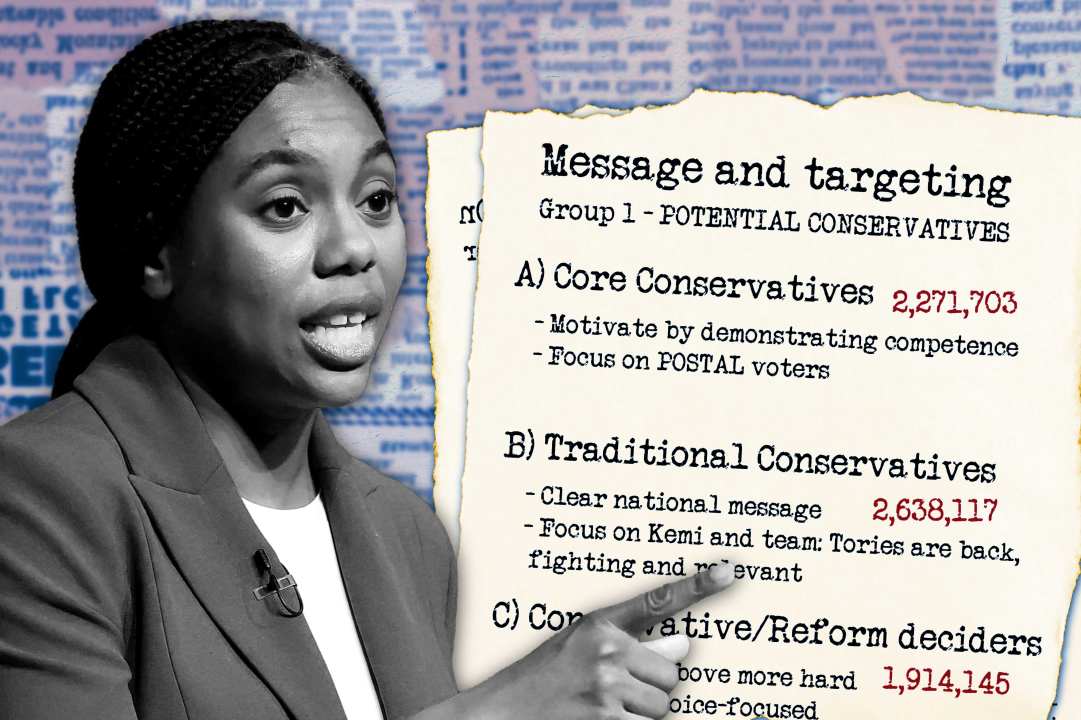
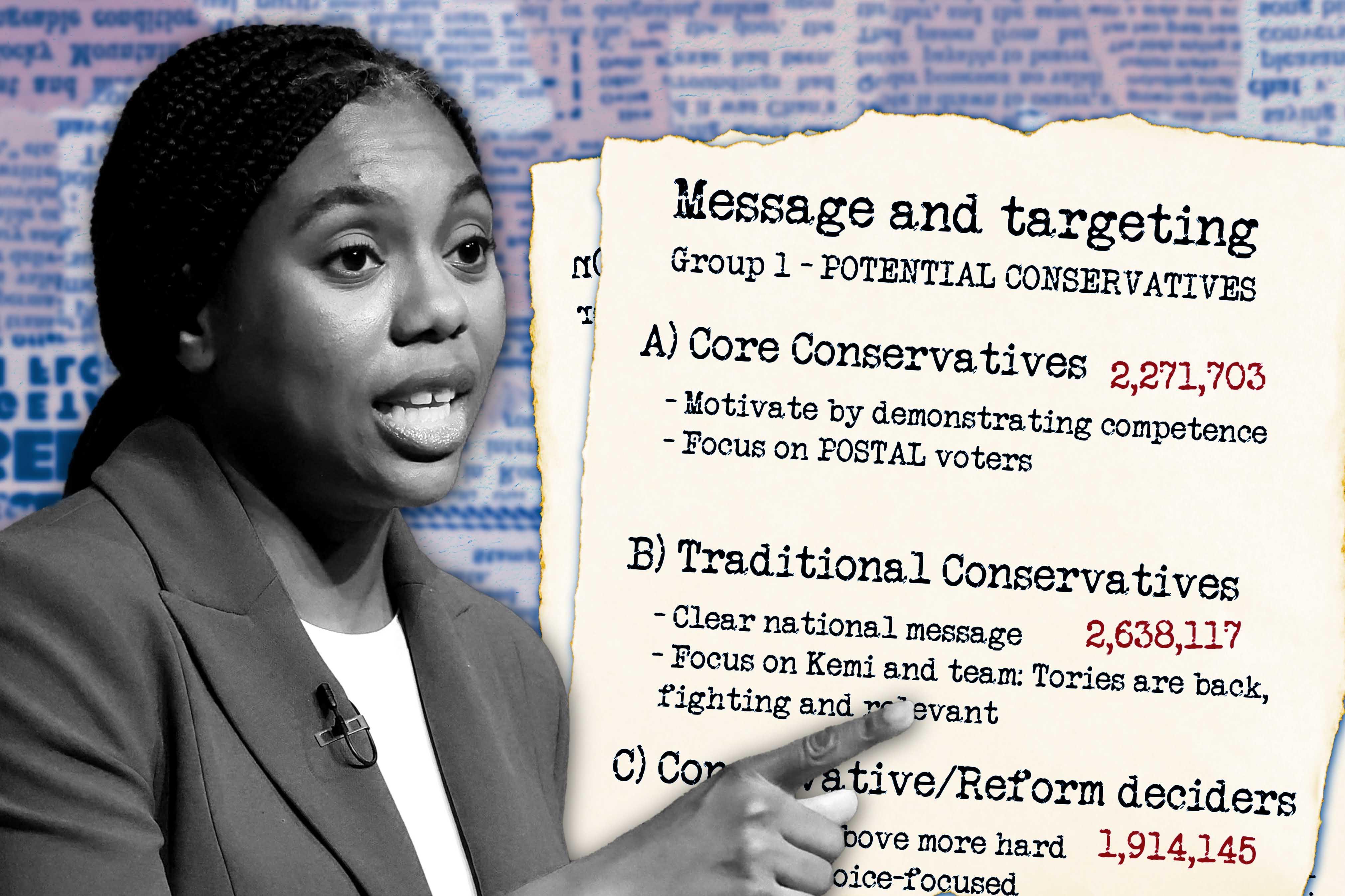
Central to Jenrick’s interpretation of the Badenoch-Gilbert strategy are the ‘Potential Conservatives’, since these are the votes the Tories are most likely to secure. This group breaks down into three sub-groups. The first are 2.2 million ‘core Conservatives’, motivated by competence and positivity and targeted mainly by postal votes. Then there are 2.6 million ‘traditional Conservatives’, who need a national message on the party’s values. Local relevance and a focus on Kemi Badenoch’s team play best with them.

Both groups will include a lot of elderly voters since the only demographic where the Tories lead is with the over-75s. The key to Jenrick’s concerns is that some ‘core conservatives’, with a small ‘c’, are likely to be found in seats in the home counties and the south, where the Lib Dems provide an alternative option for those who will never vote Labour but crave a stable government and fiscal prudence.
Taken together, the potential total of current Conservative voters, if there was an election tomorrow, is 4.8 million, down from 6.8 million at the last general election. Badenoch’s senior advisers are adamant that they do not have a ‘60 seat strategy’ and did not discuss a target seats list with MPs at a recent away day for the party – that is Jenrick’s interpretation of what her approach means. But however you cut it, that suggests the Conservatives are currently on course to lose a substantial number of their remaining 117 seats. To do better than that, Badenoch is going to have to win back some votes from Reform or switch those who are leaning towards the other parties.
To get back to 2024 levels of Tory support, Badenoch will need the 1.9 million ‘Conservative/Reform voters’, who the Tories need to persuade to vote for them on ‘this occasion’. Previously leaked polling from Stack Data Strategy suggests that only around half of this group would even consider returning to the Tories.
There is a further problem. The Tories expect Labour’s 2029 election messaging to be ‘stick with the plan’ while Reform will stress ‘change’. The Tory plan, according to MPs, is to deploy the negative argument, summarised by one MP as ‘Stop x, y, z’. However, party strategists have told MPs that the key cohort of ‘Conservative/Reform’ voters is very resistant to anti-Reform or anti-Farage messaging and also ‘need to believe the Conservatives can win’, which at the moment looks very unlikely.
Persuasion voters
Some form of ‘Stop Farage’ messaging might, however, help win over ‘persuasion voters’, who break down into three sub-groups: 447,000 swing voters in Liberal Democrat/Conservative seats; 1.8 million swing voters in Labour seats; and 293,000 ‘London persuasion voters’, who are more susceptible to a focus on the cost of the Ulez charge and Sadiq Khan’s performance as mayor. These groups are likely to approve of a focus on high streets, economic competence and family homes. Tory strategists calculate that ‘tactical voters’ can be won by a focus on the Tories’ competitiveness with Reform and a message about lending votes.
Hesitations
Internal polling suggests voters remain hesitant to return to the Tories for a variety of reasons. Among them include a failure to realise the benefits of Brexit, the ‘Boriswave’, which saw an explosion in mass migration, the Truss government’s mini-Budget, and cost of living failures. They also have questions about party unity and the Conservatives’ ability to deliver.
To address these hesitations, Conservatives on the doorstep are advised to use a number of tested responses. These include stressing that the party has learned from its mistakes, is willing to stand up for the people of this country, and is offering bold, clear, moral arguments. A ‘realistic but optimistic’ tone is advised, with those canvassing advised not to ‘shoot from the hip’.
The advice from Gilbert and others is to concede and move on, refashioning the conversation around a distinctive stance on the economy, fiscal rules and values. Senior sources in Tory high command say this is only the case on issues like migration where they have admitted error in the past. Party spokesmen are advised to advertise Badenoch’s flagship conference policy on cutting stamp duty as proof of the last of these. This will evolve the framing to the wider framing of a ‘stronger economy, stronger country’.
Economy
The economy lies at the heart of the current Tory electoral strategy. Currently, a three-pronged approach is being used to establish credibility: not conceding fiscal responsibility; showing where the money is coming from; and demonstrating that any tax and spend commitments are fully costed. Received orthodoxy must be challenged, and the party must be willing to offer a detailed plan and be open about choices and trade-offs. The state is too large and unable to do what it is meant to do. Badenoch’s team stress that the three pillars of their economic message are: cut spending, cut tax and back business.
Conservative strategists advise that the party does not claim that Britain is broken
The moral case underpinning the Tory economic approach stresses the importance of being on the side of, and rewarding, those who contribute. Their doorstep script argues that it is only through this stronger economy that a stronger country – united, harmonious and fair – can be built.
Is Britain broken?
Supplementing this economic offer is a cultural push too. Kemi Badenoch is expected to announce a programme on citizenship shortly. This will stress how with the rights of citizenship comes responsibility. A key focus will be extremism and intolerance blighting British communities and dividing groups from one another. However, while there are deep-rooted societal issues, Conservative strategists advise that the party does not claim that Britain is broken.
This was a huge point of contention with Jenrick, who argued vociferously in a recent shadow cabinet meeting that Britain is broken and that most voters agree – particularly those who have switched to Reform. He claims that fewer than a third of his Conservative colleagues at the time agreed with him. Badenoch’s allies respond that one slide at the away day made the more nuanced point that ‘Britain is not broken beyond repair’, which they say implies it is somewhat broken, but there is clearly a difference of emphasis.
Differentiation from other parties
Tory strategists advise painting Labour as the ‘Party of welfare street’. Reform, meanwhile ,should be depicted as radical yet unreliable, unready for government and offering unrealistic promises. Conservatives are advised to attack Nigel Farage’s party for having a weak team and shaky trustworthiness on security. A senior Badenoch ally said they would also target Reform as a ‘one man band’ with ‘left-wing ideas’ which is committed to ‘more welfare spending’.
Mark McInnes, the chief executive of CCHQ, has previous experience of multi-party politics in Scotland. His advice is that the British electoral map has changed. Voters are now not reliable and much softer than before. The approach in future is to identify high potential voter segments and engage them, not to chase blocs unlikely to ever vote Tory.
While Badenoch’s team will argue that there is the potential in all these target voters to win around 7.5 million votes in 2029, a significant uptick on 2024, Jenrick is right to argue that, at the moment, Tory support is at a level which will lead to a significant number of lost seats. He also seems to have a point when he says that by running a ‘stop Starmer’ or ‘stop Farage’ campaign, Badenoch seems to be prioritising winning over the ‘persuasion voters’ rather than the Tory-Reform switchers.
A senior Tory source denied this, saying the party is going after all potential switchers and is not solely targeting its efforts in the South or at affluent voters. They make the point that while Badenoch’s personal ratings are well above her party’s – and could eventually help the latter rise – Starmer’s personal ratings are a drag anchor on Labour’s prospects. This source also said the Tories are ‘competitive’ in Newark and looking forward to pouring resources into a campaign to oust Jenrick.
‘As Nigel Farage says, Robert Jenrick is a total fraud and no one should trust a word he says,’ the source said. ‘Jenrick will never be able to escape the fact he stabbed his colleagues, friends and the voters of Newark in the back for his own personal ambition. He’s Nigel Farage’s problem now.’
Listen to Tim Shipman and James Heale on Coffee House Shots:



Comments