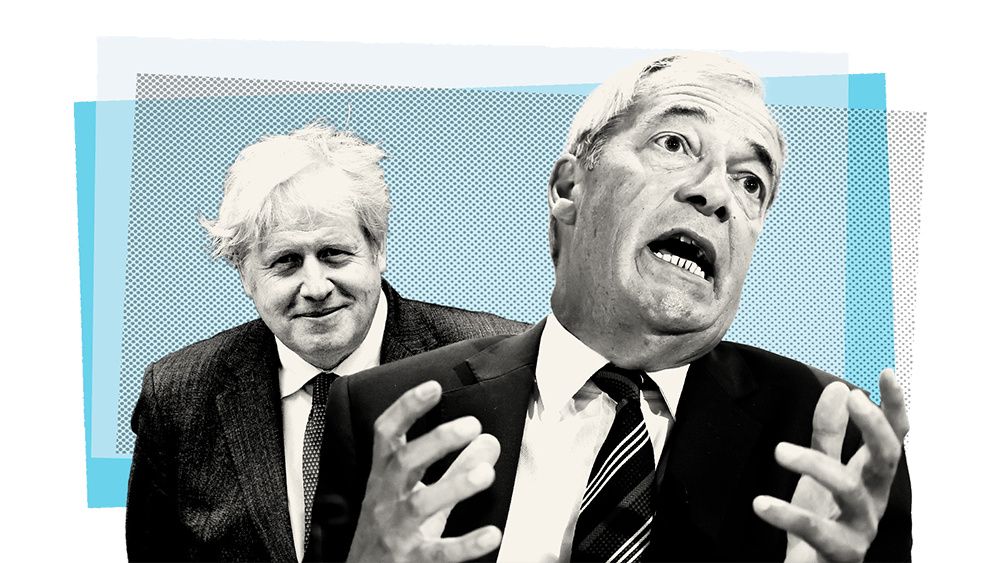


The man from Reform had barely sat down at our table at the French bistro when he leant forward conspiratorially and asked: ‘What’s Boris up to?’
The suspicion that Boris Johnson, Britain’s 55th premier, must be up to something is a familiar one. For the first time in several years, however, the question is interesting. And the fact that Reform is raising it gives a small insight into the current state of politics.
The query came just hours after Johnson had taken to Instagram to mark the tenth anniversary of the Brexit referendum, the defining moment of his career and of our politics since. The 17.4 million voters who backed the Leave campaign were right to do so, he said, before going on to hail the freedoms of Brexit. He then gave a speech to a dinner at the right-wing Arc conference, followed by an interview on GB News, the channel most viewed by the voters that the Tories and Reform are fighting over.
Reform high command is convinced that Johnson, along with Kemi Badenoch, is egging on Rupert Lowe
It is not surprising that Johnson should make a public intervention on such an occasion, but given that his Instagram presence is usually limited to appearances on his wife Carrie’s posts, riding bikes and playing with their four children, the method was notable. Since Johnson’s departure from No. 10, his primary goal has been ‘to put hay in the loft’, as his allies put it.
Whoever coined the phrase ‘Boriswave’ for the soaring of net migration to more than 900,000 on Johnson’s watch has probably sunk any chance Johnson has of leading his party or the country again. But those close to him say he is beginning to feel the pull of the political game.
Multiple witnesses say he is driven by his ‘hatred’ of Farage. When the Conservatives opened their new headquarters at Castle Lane in Victoria, shortly after Andy Burnham beat Reform in the Makerfield by-election, Johnson let rip in a speech: ‘Is it not wonderful, poetic, beautiful to see Reform now being devoured, haemorrhaging votes on the right to this party called Restore, which sounds like a sort of hair loss potion or something?’ Reform high command is convinced that Johnson, along with Kemi Badenoch, is egging on Rupert Lowe, the leader of Restore, to kill Farage’s momentum.
Friends of Johnson say that he has privately made the case that Farage comes with a ‘whiff of sulphur’, a view he thinks has been justified by the Reform leader’s somewhat petulant response to questions about the undeclared £5 million gift from crypto billionaire Christopher Harborne.
One close ally says: ‘Boris has made a lot of money and has a nice life, but he really hates Farage. He’s in touch with Kemi and I think you’ll see him campaigning properly at the next election. He doesn’t want Farage to be prime minister.’ During the 2024 general election campaign, a reluctant Johnson had to be coaxed to do one event for Rishi Sunak, whose resignation had triggered his downfall. He even complained to a friend in the car on the way: ‘Why should I help that c***?’ A more hands-on Boris in 2029 could make the difference in seats where a handful of votes will decide the result.
Another longstanding friend says: ‘He does absolutely hate Nigel and that has been exacerbated by Reform’s personal attacks on him. His main attack line is that they are a bunch of Kremlin crawlies.’ Johnson has a close affinity with the Ukrainian cause and privately questions what he sees as Farage’s Trumpian admiration for Vladimir Putin – something Reform sources fiercely deny and which Farage has publicly repudiated.
He is also exercised by Reform’s failure to appoint a shadow defence secretary at a time when military spending is a hot button issue. At a recent Spectator security conference, Reform’s defence policy was outlined by Danny Kruger, who is in charge of preparing Reform for government, but some think Farage is holding out for a retired general to take the position before the next election.
Johnson and Badenoch speak semi–regularly and had lunch together a couple of months ago. However, she is more regularly in touch with David Cameron, who has been ‘very helpful’ in sharpening her performances at PMQs, and Iain Duncan Smith, who remains in the Commons. Senior Tories say Johnson likes to share ‘framing advice’ on big picture positioning and messaging. One of his ‘obsessions’ is Labour’s ‘tax doom loop’, a formulation Badenoch has echoed, criticising the way tax rises have crushed growth and necessitated more tax rises.
It would be wrong to say that senior Reform figures are quaking in their boots about moves to Bring Back Boris, but their curiosity highlights a nervousness in the party at present. Momentum in the polls has stalled and Farage seems angry about any scrutiny of the £5 million gift. His party is an awkward collection of Farage long marchers, anti-establishment radicals, Tory retreads and new-right intellectuals. In times of stress, the fault lines show. Widespread tactical voting against Reform by voters who also seem to detect a whiff of sulphur has cost the party several by-elections. Farage’s pledge to destroy the Tories has not (so far) come to pass.
The dislike between Johnson and Farage is mutual. ‘Nigel feels Boris has never given him the thanks and respect he deserves for that landslide [in 2019],’ says one confidant. As Brexit party leader, Farage stood down half his candidates, assisting the Tories to a majority of 80. Conservatives say that if he had stood down the other half, they would have had a majority of 120.
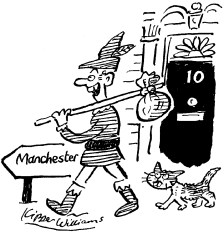
It is not just within the battle on the right where Johnson seems relevant once more. Burnham’s plan to send more money and power to the regions is a rebranded form of Johnson’s old ‘levelling up’ agenda. As he ponders whether to make Ed Miliband his chancellor, Burnham might also think carefully about Johnson’s experience of having an intellectually superior character who wanted his job living next door.
Both Burnham and Johnson want to make inroads into the coalition which delivered the 2019 landslide. Polling by More in Common shows that the Tories retain 42 per cent of Johnson’s 2019 coalition. Reform has 40 per cent, Labour just 7 per cent. Even if Johnson was only able to shift a few per cent of them in his old party’s direction we may look back on his re-emergence as a significant moment in this parliament.



Comments