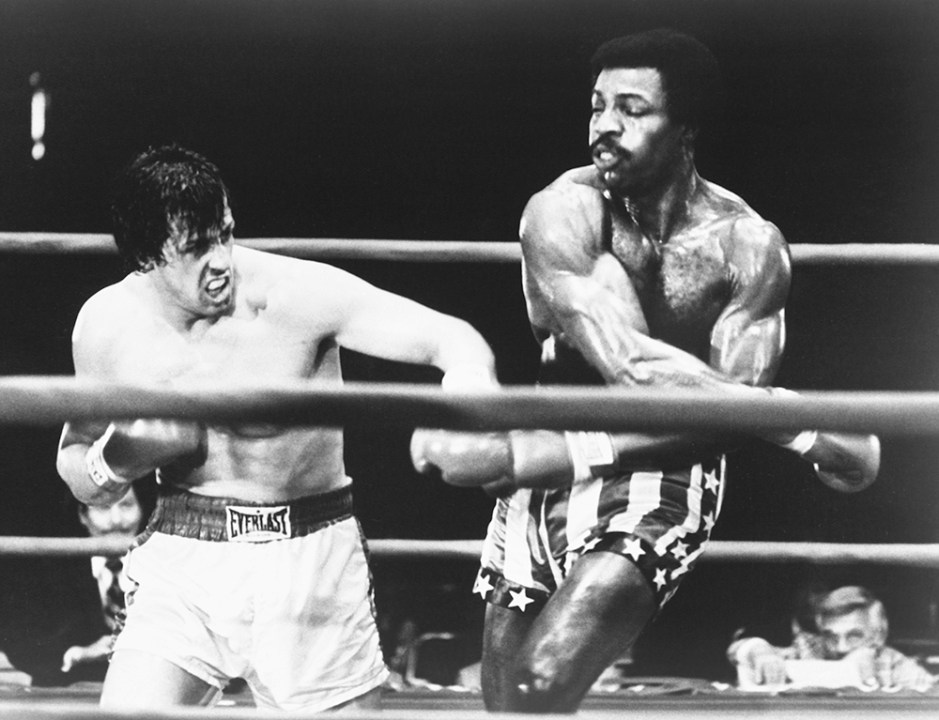
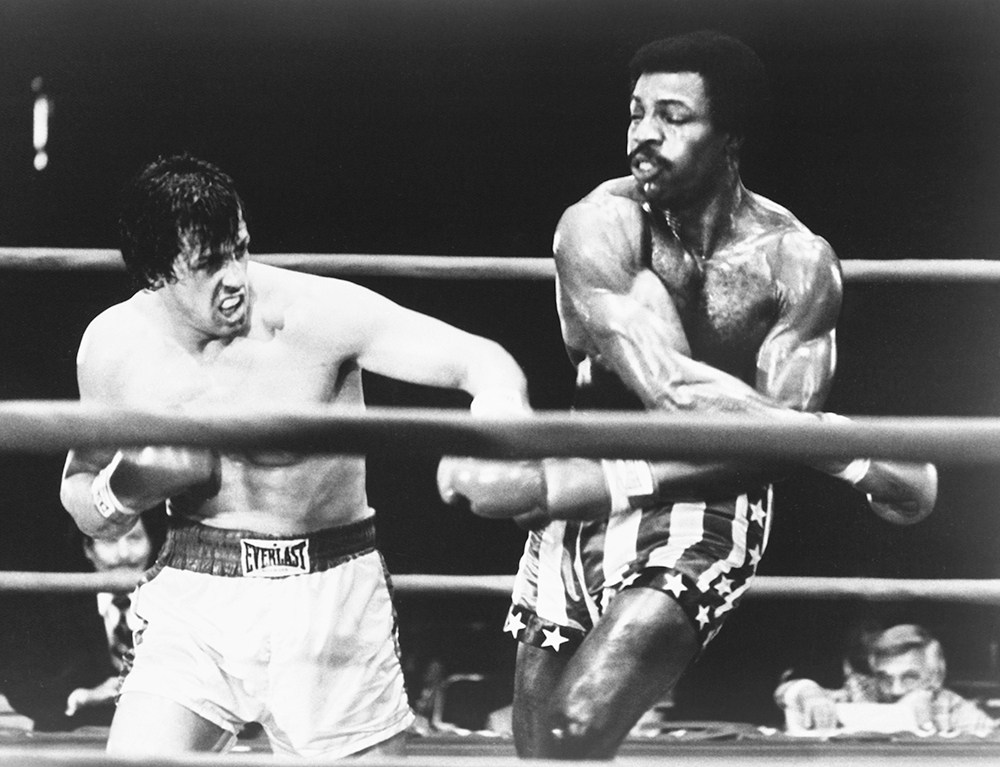
There shouldn’t be a major problem when it comes to adapting Sylvester Stallone’s recently published memoir The Steps into a big-screen biopic. Almost alone of his kind in the Hollywood pantheon, Stallone’s life already resembles the plot of one quite successful film, which I can never see without noting the happy likeness – I mean, of course, Rocky. It’s no wonder an acclaimed film, I Play Rocky (that Stallone has disassociated himself from) has recently premiered. The young Stallone may not have had his famous alter ego’s distinctive rolling gait and grunting speech (though he could come close), but the essential points of similarity are all there.
In the early 1970s, Stallone was an unknown actor trying to make it in New York. He took a role in a softcore porn romp called The Party at Kitty and Stud’s, which is pretty much what it sounds like, as well as an off-Broadway play named Score, which uneasily resembled banned Arabian erotica as interpreted by Woody Allen, and ran for 23 performances. (These were notable only for the sound of the audience’s derisive laughter, punctuated by the bullet-crack of their hastily vacated seats.) He found minor success with 1974’s greaser-streetgang comedy The Lords of Flatbush, but he was still broke. Most of his characters at the time were billed in the credits, if at all, as “first thug” or “second thug.”
In the winter of 1975, broke and desperate, Stallone wrote a screenplay purely so that he could have something in which to star. He may not have been Molière, but he knew how to tell a story – particularly one that involved a gutsy neighborhood kid who pulls himself up by his bootstraps, sticks by his best girl and acquires a kind of winning meathead philosophy in the process.
Perhaps Rocky succeeded because it provided a degree of relief from a world that had gone wrong
His Rocky screenplay, which was completed in three days flat, was good enough that United Artists offered him $300,000 to buy the script and make it with a Burt Reynolds or Nick Nolte in the lead. Stallone, who was then sharing a one-room studio with his pregnant wife, Sasha, and their dog, with all of $80 to his name, told them that he was the star or they couldn’t have it. The size of the studio payoff increased, but Stallone stood firm: if they didn’t cast him, he’d walk.
You know the rest. Stallone got the part. Rocky was shot for $900,000, released in November 1976, and it hung over American skies like a prolonged red, white and blue firework display for the remainder of that bicentennial year. Oscar gold and box-office windfalls followed, dried up after some questionable career choices, then returned when The Expendables reintroduced Stallone as a sort of wisecracking elder statesman not wholly dissimilar to his sometime friend and macho-man rival Arnold Schwarzenegger.
Without delving too far into the briar patch of psychology, perhaps one of the reasons Rocky succeeded was that it provided a degree of relief from a world that had gone wrong. The years immediately leading up to the movie’s release had seen America brought to a virtual civil war by Watergate and the ignominious departure of White House aides accused of perjury, deception, and obstruction of justice, culminating in Richard Nixon’s resignation.
Rocky’s essential message of perseverance and redemption was akin to Gerald Ford’s assurances that our long national nightmare was over. Or maybe it was more like Jimmy Carter, the peanut farmer whose defeat of Ford at the polls just 18 days before the film’s release seemed to echo the point that the United States remained a place where a rank outsider armed with the right stuff could go all the way to the top. In any event, many of the audiences watching Rocky started the film merely clapping and cheering, before the dominant noise in the theater changed from one of sustained applause to one of frenzied hollering. Clearly, it resonated. Admittedly, it seems unlikely that many Americans would have decided to drive out to their nearest multiplex over the winter of 1976-77 and pay $2.50 to see Rocky, or for that matter any other film, because of its supposed allegorical insights into their culture. But it would be fair to say that Stallone’s pugilistic morality tale, with its central theme of persistence against the odds, struck a chord.
As mentioned, Stallone himself was intimately acquainted with some of the fictional Rocky’s circumstances in life. He was born in the Hell’s Kitchen neighborhood of New York in 1946, when the place still deserved its nickname, to a dotty astrologer mother named Kitty and her hairdresser husband Frank, a failed singer with a violent temper. What a pair. It turned out that Kitty already had an existing husband she hadn’t quite gotten around to divorcing, and Frank did not take this development too well when he discovered it. There was drinking and there was fighting – and after that, there was more drinking. Between the ages of three and six, Sylvester – or “Sly” – was farmed out to live in a flea-ridden New York boarding house that doubled up as a knocking shop for prostitutes servicing visiting sailors. With a certain inevitability Stallone’s parents later divorced, and he spent the rest of his childhood shuttling between them without much enthusiasm for his company on their parts. A guidance counselor remarked of him at the time he left school: “This boy is suited only for manual work.” He added the rather specific advice that he seek employment as an “assistant electrician, primarily in the area of elevator operations.”
In March 1977, Kitty brusquely declined her son’s invitation to join him at the Academy Awards ceremony where Rocky triumphed as Best Picture. No one heard from Frank at the time, although he later sent in a screenplay he’d written, for the attention of the film’s producers. Its proposed title was “Rocky II.”
Highbrow critics have always been dubious both about Stallone’s American Dream movie and his professional track record as a whole. This is the man who’s won an impressive ten Razzie awards for Worst Actor or Worst Supporting Actor, not to mention the career-capping bauble, in 2000, of Worst Actor of the Century. But set against the likes of a Rambo III or a Judge Dredd there’s a standout film such as 1981’s Nighthawks, for the most part a routine urban thriller but one in which Stallone gives a compelling less-is-more performance as a weary undercover cop. Even Janet Maslin of the New York Times, not one of Stallone’s natural cheerleaders, praised his “calm and effective” presence in the film, while no less a judge than Roger Ebert once told me that he believed Stallone to be “unbeatable when he ditched the loincloth and did that stolid-righteous character of his, like Gary Cooper on steroids.”
Highbrow critics have always been dubious about Stallone’s professional track record
Speaking of which, you could do worse than to revisit 1997’s Cop Land. Stallone plays the part of one Freddy Heflin, an overweight, dull-witted lawman who rediscovers his moral compass. Robert De Niro, and seemingly most of the rest of the cast of Goodfellas, are on display, giving it their usual tough-guy shtick. But it’s the lumbering Stallone, a simpleton with a soul, who steals the show. It’s a curious thing that an action star who could get audiences on their feet by belting his opponent to a standstill in Rocky, or by knocking an attack helicopter out of the air with a rock in First Blood, could so fully embody the role of a sympathetic sad sack, and in so doing settle, for all time, the question of whether or not he can really act.
Rocky turns 50 this month, and Stallone has released his memoir The Steps to celebrate the fact. There are some striking passages in the book about the author’s childhood, but the basic narrative is framed by his entry into the ranks of struggling New York actors to his Oscar-night triumph less than a decade later. If you’re looking for salacious tabloid gossip – or for that matter, information on what it’s like to be one of Donald Trump’s three so-called special ambassadors to Hollywood – The Steps may not be for you.
At heart, it’s a dryly observed before-and-after study of a young man striving for success in the film business, enhanced by some vivid period detail and halfway plausible reimagined dialogue, as opposed to one of those histrionic celebrity fan letters to self. It’s the print equivalent of Cop Land, in other words: both a character study of a man with a drooping mouth and slurred speech who beat the odds to become a Hollywood superstar, and an engaging social history of a time when we were more innocent than we are now.




Comments