
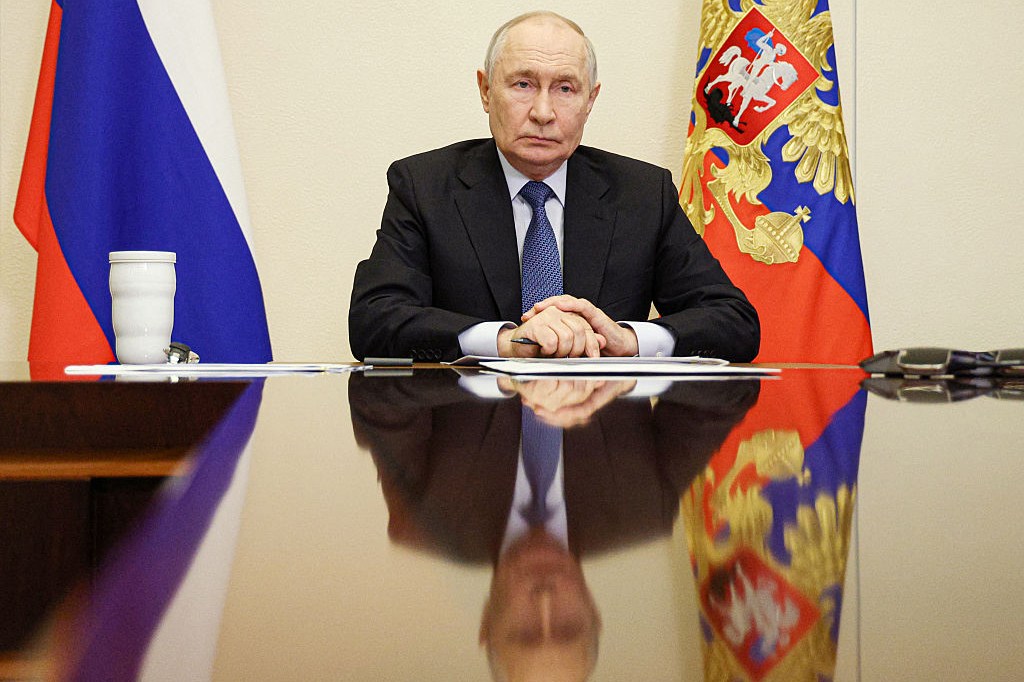
Secretary of State Marco Rubio has today announced that the US has invited Vladimir Putin to an upcoming G20 summit in Miami, giving the Russian leader “an opportunity to engage not just with Trump, but with other world leaders.” In one sense, the invitation is an olive branch to Moscow from Washington, so far the only Western nation willing to engage in peace talks with Putin. On the other, it’s a poisoned chalice that the Kremlin has already signaled that Putin will probably not accept.
For one, the summit will be held on Trump’s home turf – quite literally, as the venue is the Trump-owned Doral golf resort near Miami. When they met on a US Air Force base in Anchorage, Alaska, last year the two leaders were on more-or-less neutral ground. But in Miami, Putin would literally be a guest under Trump’s roof, fraught with the danger of petty protocol disses to which the Russian leader is morbidly sensitive.
Then there’s the other G20 leaders, who are likely to make up for their inability to actually stop the Ukraine war or compel Russia to compromise by fomenting some acts of symbolic disrespect. In August, for instance, when Russian Finance Minister Anton Siluanov turned up last month at a G20 finance meeting in Asheville, North Carolina, his fellow ministers refused to talk to him or share a group photograph.
Then there is the Zelensky problem. In recent days Volodymyr Zelensky, in New York for the UN General Assembly, has called for a three-way meeting with Putin and Trump in Miami – something that Kremlin spokesman Dmitry Peskov has categorically rejected as “impossible.” The Kremlin’s line remains that Putin would meet Zelensky only in Moscow, which Kyiv rejects.
More likely, Trump and Putin could meet at the Asia-Pacific Economic Cooperation forum, or APEC, in Shenzhen, China, on November 18 and 19. Here, Putin will be on the turf of his ally, Xi Jinping, with the protocol tables turned on Trump – which is the reason that Putin has confirmed his attendance but Trump so far has not.
Matters of status anxiety aside, the more important question is what Putin and Trump could actually constructively discuss. This afternoon Rubio spent nearly an hour in face-to-face talks in New York with Russian Foreign Minister Sergei Lavrov, the latest of at least 20 calls and meetings between the two since 2025, so far with no concrete results. Trump’s son-in-law Jared Kushner and his envoy Steve Witkoff also returned from back-to-back visits to Moscow and Kyiv empty-handed except for some vague talk of mutually-profitable business deals with Russia. A recent trip by CIA Director John Ratcliffe also ended with Putin pulling out of an in-person meeting – though both men were within a few hundred feet of each other in the Kremlin – and again no breakthrough. The Kremlin remains resolutely stuck to its 2022 demands for Kyiv to cede all of Donbas, guarantee its future neutrality and curb the size of its military.
Peacemakers are, proverbially, blessed. But Trump also has a more urgent material agenda in stopping the Ukraine war – or at least preventing the escalating missile and drone war which has seen serious damage inflicted to Russia’s oil refinery capacity and devastation wrought on Ukraine’s logistics warehouses, ports, railways and energy infrastructure, including refineries and gas stations. The problem for Trump – and more urgently for Europe – is a worldwide shortage of diesel caused by the twin storms of his war on Iran and Ukraine’s campaign against Russian refineries.
In recent weeks Trump has repeatedly blamed high fuel prices on the Ukraine war – omitting to mention Iran – and has also called for an “energy ceasefire” where Moscow and Kyiv cease and desist from battering each other’s refineries and export terminals. Zelensky has said he will agree – as long as Russia also stops all missile attacks on the rest of his country’s infrastructure too. Peskov also called Trump’s energy ceasefire call “a very good idea” – but, fatefully, added that the question was linked to a broader lifting of sanctions on Russia’s energy sector. The Kremlin, in other words, sees opportunity in Trump’s desperation to avoid an oil shock caused by his campaign against Iran.
The EU, for its part, has been adamant about not opening any talks with Putin and would prefer that the Russian leader remain an international pariah. However these same European leaders have banned the import of Russian diesel, as well as diesel produced from Russian oil at Indian and Turkish refineries. But Trump has signaled an imminent ban on the export of US-produced diesel, of which the EU is the major customer. The result is likely to be a perfect storm of spiking European transport costs and with them, new heights of the continent’s cost-of living crisis and dangerous knock-on effects for upcoming elections.
Thus political anger in the US over prices at the pump and a coming EU fuel-price crunch have unexpectedly dealt Putin a fresh handful of diplomatic cards to play, even as his army bleeds men it can barely replace, and his economy creaks under the pressure of war spending and Ukrainian attacks. Europe claims to remain resolutely against even speaking to Putin – yet cannot afford to keep Kyiv adequately supplied with the ammo and cash it needs to fight on. And the Trump administration appears keener than ever to throw Kyiv’s interests under the bus just as long as Putin opens up the energy export spigots again.



Comments