On Monday and Tuesday, a so-called “mega dinghy” made its way across the English Channel from the coast of Normandy. Originating from the town of Vierville-sur-Mer, near Omaha Beach, the inflatable represented what many Brits would see as a direct reversal of Operation Overlord, which began on D-Day.
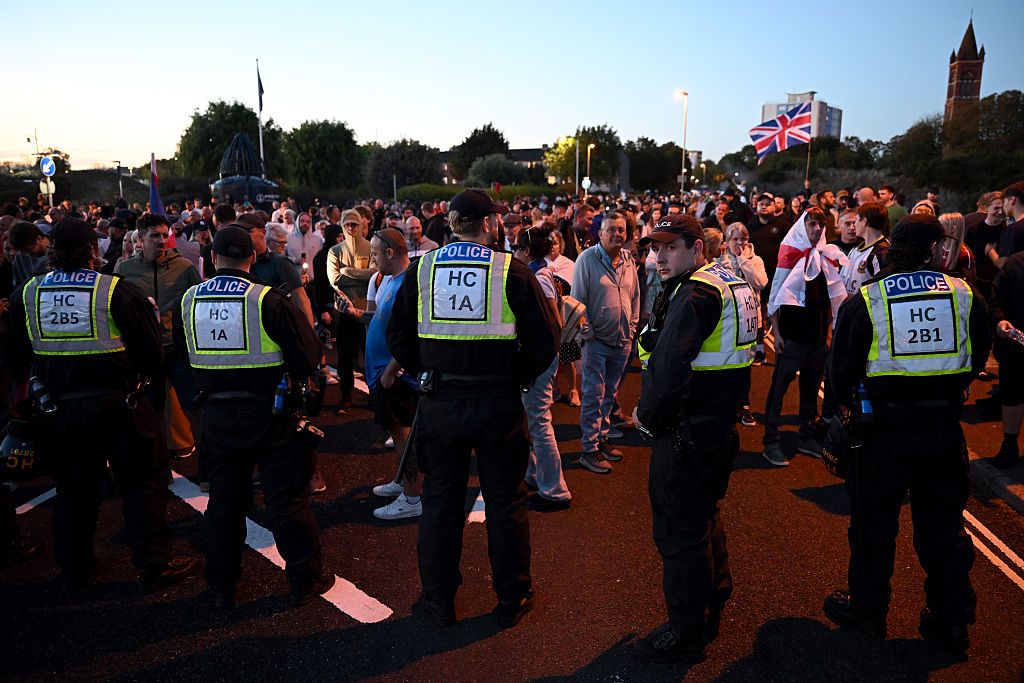
The prospect of around 60 illegal migrants landing on our shores, many of whom will likely come from countries with much higher rates of violent crime, was not exactly welcomed in the area. Hundreds of people poured out onto the streets of Gosport, where the RNLI was expected to bring its passengers ashore after scooping them up in English waters. The protesters confronted police lines from around 6:30 on Tuesday evening, some wearing masks, chanting “send them back” and “shame on you.” Some reports suggested they’d rather let the migrants drown than be allowed to land. Six people were eventually arrested following some small clashes with the authorities.
New energy has shifted towards stopping migrants from entering Britain in the first place
Over the next two hours, it became clear that no migrant would be making the landing at Gosport. Hampshire’s Police and Crime Commissioner Hannah Jones urged Border Force, who had transferred the migrants onto HMS Vigilant, to send them 150 miles down the coast to disembark at Dover instead. “The burden on the police to deal with the arrival and potential protest activity is unsustainable,” Jones instructed. The RNLI and Border Force were so concerned about the response on the ground that they appeared to have turned off their location-tracking at points, to prevent a potential mob with pitchforks catching up with them. After the police informed the angry demonstrators that there would be no landing that evening, the most farcical images of the evening followed. Buses that had been ready to ship the Gosport arrivals to their new taxpayer-funded lodgings were escorted out of Hampshire in a massive police convoy far more suited to a visiting head of state than coaches with zero passengers.

What this shows is that we have now reached a third stage in Britain’s anti-migrant protests that have been developing since the Southport riots of 2024. Following the brutal murder of three girls by Axel Rudukubana, the north-west town set itself ablaze in a frenzy of violence. The violence then spread out further across the country. But it was just that, a frenzy, with crowds attacking police stations and mosques. Within a week, the rage fizzled out.
Last summer brought something different. I traveled around the country, reporting directly on spontaneous and community-driven protests against migrant hotels, often sparked by some sex crime committed by a “resident,” such as we saw at the Bell Hotel in Epping. What was crucial about this development was that communities organized themselves with a specific goal of shutting down a hotel, and that people who’d never engaged in politics before were out on the streets, week after week. Networks of people ready to defend their homes and their families from a visible threat were created as a result.
This appeared to be the model for anti-immigration grassroots politics: start a protest about a new migrant hotel or, in the case of Piddington, a former military base ready to house every Afghan on the planet, and create a serious political pressure point. Crucially though, these protests were reactive.
Now it seems that “proactive” is the word of the day for “concerned patriots” when it comes to immigration protests.
As we saw in Portsmouth earlier this month, new energy has shifted towards stopping migrants from entering Britain in the first place. Earlier this month, hundreds of masked activists from “Patriot Platform” and other protesters gathered to prevent a migrant boat carrying 120 passengers from landing in Portsmouth. Last night’s events confirm that this was not a one-off occurrence.
As Hampshire Police noted, members of the public had been “closely following the activity” of the migrant vessel. There was no need for organizers to plan a demonstration. A boat was arriving, and an existing network of protesters activated in response.
All of this feels rather Northern Irish to me. Not in terms of the levels of violence, but in the normalization of community mobilization. You don’t even need a figurehead for this, although anti-immigration protester Danny Tommo has been claiming that mantle recently. (He even allegedly stabbed last night’s dinghy in the Channel after the migrants had been picked up.) Anyone can log onto their phone and track what’s happening at sea, and eruptions across various social channels then mobilize demonstrators to meet a boat before it arrives.
Two years ago, people rioted following the Southport attacks. Last year, people organized protests in response to migrant hotels opening. Today, people are starting to intervene before a landing even takes place. After decades of successive governments failing to tackle immigration, some appear to be taking matters into their own hands.






Comments