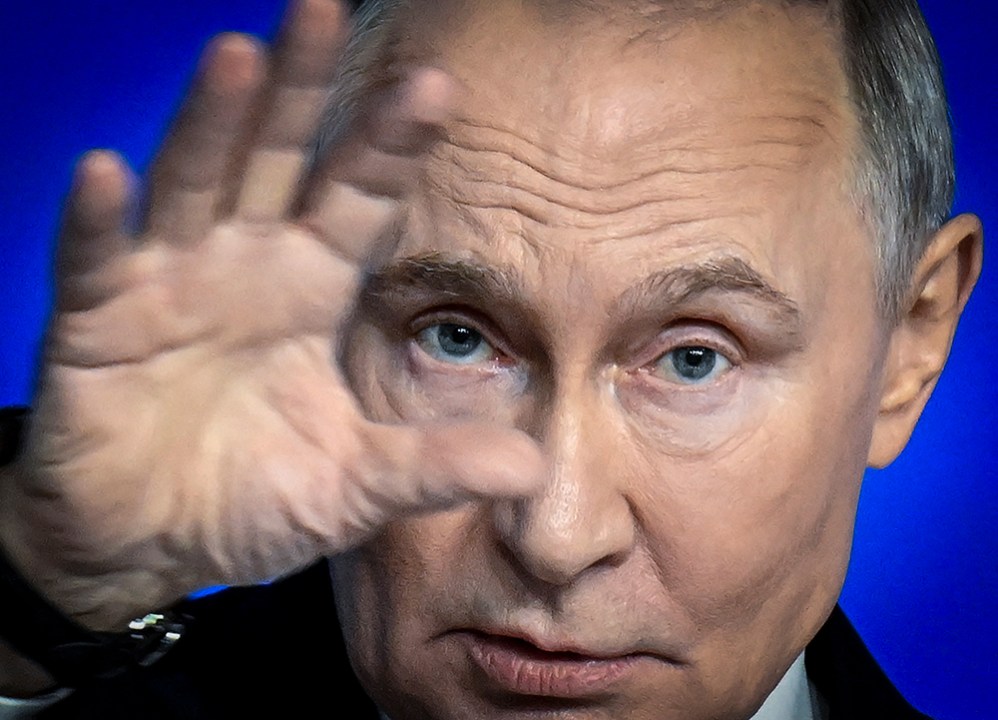

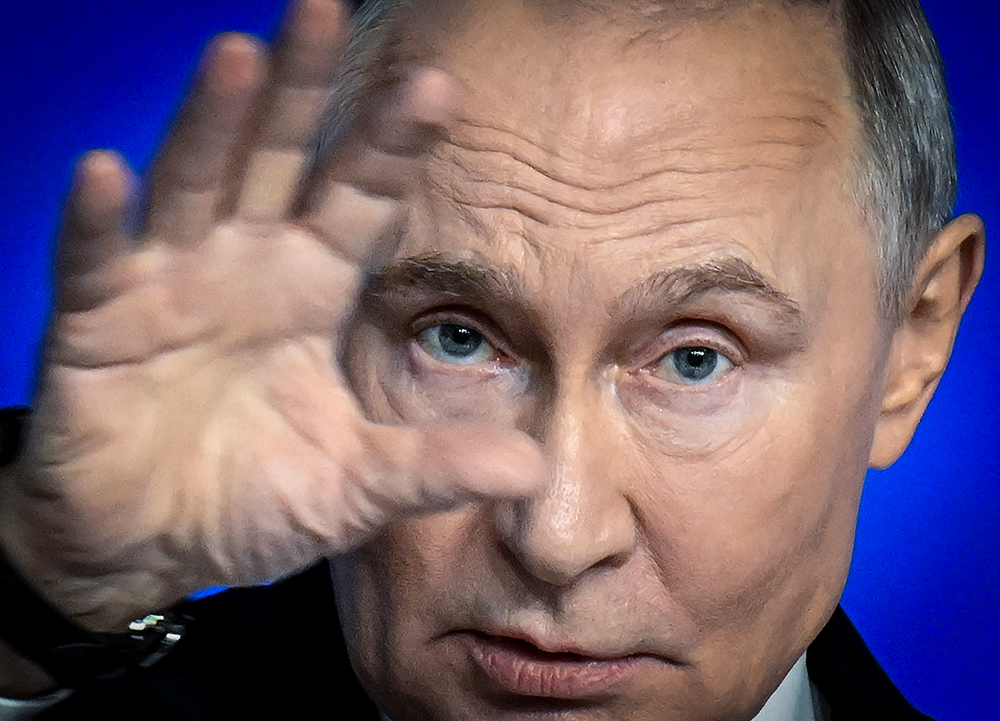
As dark clouds of burning oil billow like thunderheads on the skyline of Moscow and black rain falls across the capital, why does Vladimir Putin fail to see that something fundamental is changing in the dynamic of his war? Why, when Donald Trump effectively agreed to hand over every inch of the Ukrainian territory Russia has captured and offered the Kremlin an easy off-ramp studded with juicy business deals, did Putin refuse? And why, for that matter, did the Russian President choose to launch his full-scale invasion of Ukraine in the first place?
One answer is that Tsar Vladimir is mad, so blinded by his imperialist ambitions that he deliberately chooses to ignore the reality of a crashing economy, half a million dead fellow countrymen and a war that is obviously unwinnable. But a better – and actually more frightening – answer is not insanity but rather that Putin lives in a parallel reality, a sealed bubble of disinformation where all the data he receives confirms the wisdom of his choices.
Putin does not use a smartphone or computer and has said he believes the internet is a CIA invention
That doubt-proof echo-chamber that Putin has constructed around himself is not just a story of the paranoid caprice of an elderly ruler. It is the most serious barrier to peace in Ukraine. It is also a structural problem with no obvious solution. What does it matter that Ukraine continues to massacre tens of thousands of Russian meat-assault soldiers, systematically blows up oil refineries and armaments plants deep inside Russia and cuts off Crimea with devastatingly effective medium-range drone attacks if the men Putin trusts most continue to fill his ears with stories that victory is at hand? Putin is the only man who can stop the war with a word. But the supposed facts on which he makes his decisions are curated by a cabal of military generals and elderly KGB veterans who have a deep vested interest in continuing the war.
Some of Russia’s self-styled patriotic military bloggers and social media influencers claim, even as they catastrophise about Ukraine’s deep strikes and moan about army corruption, that good Tsar Vladimir is surrounded by evil boyars. ‘Vladimir Vladimirovich, I appeal to you personally because it seems that you are being misinformed about the real situation in the country,’ said socialite Viktoria Bonya in an emotional video post earlier this year that triggered a deluge of hitherto unheard-of criticism from Russian elite figures. Bonya is right about Putin’s ignorance. But Putin is not the victim but rather the architect of his own isolation, a process aided by willing cronies keen to monopolise their influence on Russia’s only true decision-maker.
Putin’s inner circle is a black box and only a handful of people – mostly old KGB friends from his postings in Dresden and St Petersburg and a handful of businessmen cronies from the early 1990s – know what goes on inside it. But what is abundantly clear is that access for outsiders to that inner sanctum has been tightening and narrowing for years. Back in the 2010s, ‘Whenever there was a problem, Putin would always handle it personally,’ recalls a long-serving Russian senator who used to see Putin more or less monthly before the Covid pandemic. ‘After that moment, he retreated into isolation and never came out. People I know who used to see him all the time have not been allowed access to the First Person since the beginning of the war.’ A senior European intelligence official who has been following Putin for years and personally arranged meetings and phone calls between him and his own head of state notes: ‘It was clear [in the run-up to the 2022 invasion] that Putin was operating in a different reality, even on the level of basic facts… We would speak of something everyone knows to be true, and Putin would just deny it, saying, “No, that is not the case.”’
Most comparisons of Putin to Stalin are hyperbolic, but there is one specific sense in which the two rulers are disconcertingly similar. Like Stalin, Putin values loyalty above all else, trusts only men whom he has known for decades, eliminates friends and allies who dare to dissent and, most importantly, does not tolerate anyone who brings him news that contradicts his own world view. The functional result for both was a catastrophic self-reinforcing vicious circle of disinformation.

Filipp Golikov, Stalin’s head of military intelligence, whose five predecessors in the job had all been shot, systematically weeded out intelligence from at least 19 sources that Hitler was about to invade the USSR. In Putin’s case, sycophants such as Ukrainian oligarch Viktor Medvedchuk – the leading candidate to replace Volodymyr Zelensky as a pro-Moscow puppet – assured him that installing a new government in Kyiv would be easy. Sergei Beseda, the FSB’s Fifth General Directorate head, informed Putin that vast bribes had been paid to top Ukrainian generals and politicians to roll over for Moscow. Valery Gerasimov, veteran chief of the general staff, came up with a feasible-sounding airborne decapitation strike plan for effecting a massive military-backed putsch in Kyiv. Putin started the war on Ukraine because he was told he could easily win it (though neither Putin nor anyone in the Kremlin actually said it would take three days – that was US chairman of the joint chiefs of staff General Mark Milley).
Bad information leads to bad decisions and the only antidote to both is people in the leader’s inner circle who can push back. But over the years Putin has systematically sacked people, including personal friends, who dared to dissent, starting with his trusted finance minister Alexei Kudrin in 2011 and more recently with the demotion of Dmitry Kozak, the Ukrainian-born adviser who was once Putin’s most respected point man on Ukrainian affairs, in September last year. The handful of men who are left with regular access to Putin’s ear all take as their credo that it is ‘not career-enhancing to challenge his judgments’, according to the former CIA director and ambassador to Moscow William Burns.
Crucially, on operational military matters Putin appears to listen most of all to Gerasimov, his chief of the general staff since 2012. ‘Putin’s very much under the influence of the military, who are really good at stringing him along,’ a senior former Russian official recently told the Financial Times. ‘He understands that, but he really believes them and lets them do it. If I were listening to Gerasimov’s reports three times a day from dawn until dusk, I’d perceive reality differently too.’
There are no chinks in the armour through which truth can penetrate. Famously, Putin does not use a smartphone or a computer and has said that he believes the internet is a CIA invention. Dmitry Skorobutov, former editor-in-chief of the flagship Vesti evening news bulletin, recently revealed that since mass protests against Putin in 2011, a specially edited version of the nightly news was prepared personally for him. ‘We had instruction on what news to leave in this bulletin, what to add, what to embellish, so that Putin would then be shown an ideal picture of the beautiful Russia of today,’ he said.
Putin almost never appears in public. His televised meetings with supposedly ‘ordinary’ citizens at factory walkabouts and meetings with war veterans are staffed by a team of professional extras from the Federal Guard Service. Internet wags have identified a dozen of these multitalented actors who appear, appropriately costumed, as labourers, engineers, soldiers and happy citizens. Last month in Kazan, Putin seemed to make a true public appearance, his first in seven months, and spoke for a few seconds to members of a carefully selected small crowd. ‘Filming Putin is nothing like covering a news story and everything like working on a film set,’ says a veteran member of the Kremlin press pool. ‘Every shot is pre-arranged, every question is vetted… God forbid that something unexpected should happen in Putin’s world.’
Outside Putin’s information bunker, it’s clear to a wide section of the elite that the war is a disaster
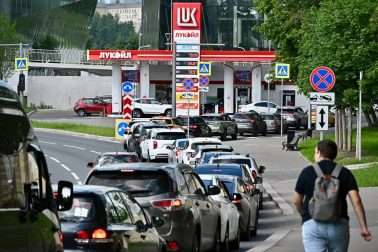
Russians – even pro-war Russian officials in senior positions in the Kremlin – are not idiots. Outside Putin’s information bunker, it’s clear to a wide section of the political elite that the war is a disaster. ‘Everyone is tired of the war,’ a top government official recently told Farida Rustamova, one of Russia’s best-connected political journalists. ‘Nothing is happening. Everything seems to be stuck in some kind of jelly, going neither forward nor backward. Our advances are being more than offset by [Ukrainian] drone strikes.’ Deepening economic difficulties, the failure of negotiations with Washington, intensifying wartime repression, a lack of progress at the front and fears about mobilisation have all made it increasingly difficult to justify the war. For the population at large, spectacular Ukrainian attacks on Russian cities – including the biggest-ever strike on Moscow last month which set an oil refinery ablaze – are exposing the Kremlin narrative of victory as a lie and bringing the war home to a population accustomed to ignoring it.
The challenge for those in power who are becoming convinced that the war must end is how to communicate that to Putin. Last month a policy document drafted by the office of the Kremlin deputy chief of staff Sergei Kiriyenko was leaked to the press. The working paper set out a detailed plan for a postwar Russia, complete with talking points for state TV on why the war was worth it and a strategy for dealing with people who might disagree, such as patriotic bloggers and returning veterans (nutshell version: jail disobedient bloggers, throw money at the veterans). The most interesting thing about the paper, however, was the fact that it was leaked at all – a great rarity. Kiriyenko is ‘obviously out on manoeuvres, trying to convince his colleagues that the war can be ended and everything will be all right’, says a former Russian minister.
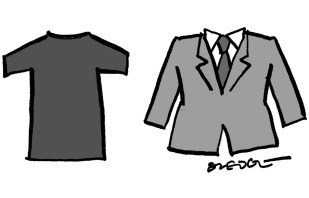
Many Kremlinologists have attempted to get inside Putin’s head. But it may be that there is less to him than meets the eye. He is not a 5D chess player, he is an inveterate fence-sitter. He is not a gambler, but a bully who picks fights only with weak opponents he believes he can steamroller.
William Burns, who had a series of meetings with Putin in Moscow on the eve of the war, believes Putin is a typical post-Soviet septuagenarian everyman, a bundle of banal resentments and complexes: ‘A combustible combination of grievance and ambition and insecurity all wrapped up together.’ Burns came away with the impression of a man utterly sealed inside his own convictions. ‘He was utterly unapologetic,’ Burns recalled. ‘He made no effort to deny it.’
Most dangerously, according to Burns, Putin remains convinced that time is on his side in Ukraine and that if he only presses on the Ukrainians will eventually collapse. He also appears to believe that he has convinced the White House of the same. If that were indeed the case, Putin’s choice to fight on would not be a crazy imperial fantasy but a logical, rational strategic choice. Russia’s problem, and Ukraine’s tragedy, is that Putin lives in an empire of lies, surrounded by a court of cynics who feed his delusions of victory.
Comments