There are 34 disputed territories in and around Europe. In some cases, two or more nations claim the same patch of land. In others, separatist governments demand their own sovereignty. Many of these disputes have a quaint, eccentric interest: Italy and France struggling over the summit of Mont Blanc; or Britain, Ireland, Denmark and Iceland arguing over the barren islet of Rockall. But a few of them – such as Cyprus, Kosovo, Nagorno-Karabakh and Transnistria – provide more urgent political challenges.
As Hannah Lucinda Smith argues, these places are Petri dishes – experiments in populism, nationalism and covert conflict that are being repeated across the continent. Her book Hinterlands explores several of these blind spots in most people’s mental map of Europe. An experienced foreign correspondent, she explains how certain powers – above all, Russia and Turkey – are jostling for influence in the continent’s overlooked corners. And she argues that these ‘broader global power shifts have pulled Europe into a continent-wide conflict’.

Her hinterlands have several features in common:
Oil, weapons, technology, nuclear capabilities and the means to build and reconstruct. They are also, to a greater or lesser degree, cut off from the international banking system, and they are at war, whether outright or unconventionally, with the West.
The widespread use of sanctions following Putin’s invasion of Ukraine has only intensified the isolation of many of these territories. For example, northern Cyprus has become a favourite place for Russians, and more recently Iranians, to park their money in property developments.
Smith has an excellent eye for overlooked stories. She describes how Trasnistria and Abkhazia became crypto-mining hubs, thanks to subsidised energy, disused factories and an educated but underemployed Gen-Z workforce; how a youth camp in Crimea for the children of the Soviet elite was restored, following the Russia annexation of Crimea, even hosting President Assad’s children during their summer holiday in 2018; and how Eurasian goitered gazelles have been revived in Azerbaijan, with a growing population in the recaptured Karabakh lowlands – the uncultivated plains offering perfect grazing territory, given that the animals are too light to set off the landmines.
The author is also attuned to some of the absurdities of soft power. When visiting Sarajevo, she stopped off at the ice rink where Torvill and Dean scored a perfect ten in the 1984 Winter Olympics. Now a conference venue, it was hosting a rally for President Erdogan. Crowds of Turks, many of whom had never lived in Turkey, had been bussed in from Germany, Austria and the Netherlands. But as soon as Erdogan stepped on to the stage they broke into chants of ‘Allahu Akbar’.
Some of the book’s most interesting passages trace the hidden webs of money and influence that tie together the Levant, the Caucasus and the Balkans. In the latter, Turkey has encouraged tourism and trade links among Muslim communities, as well as opening language schools. At the same time, Putin is funding separatist movements among the Serbs in Bosnia to keep the region divided. For Smith, this resembles the years before the first world war when minor regional disputes became potential flashpoints for the Great Powers.
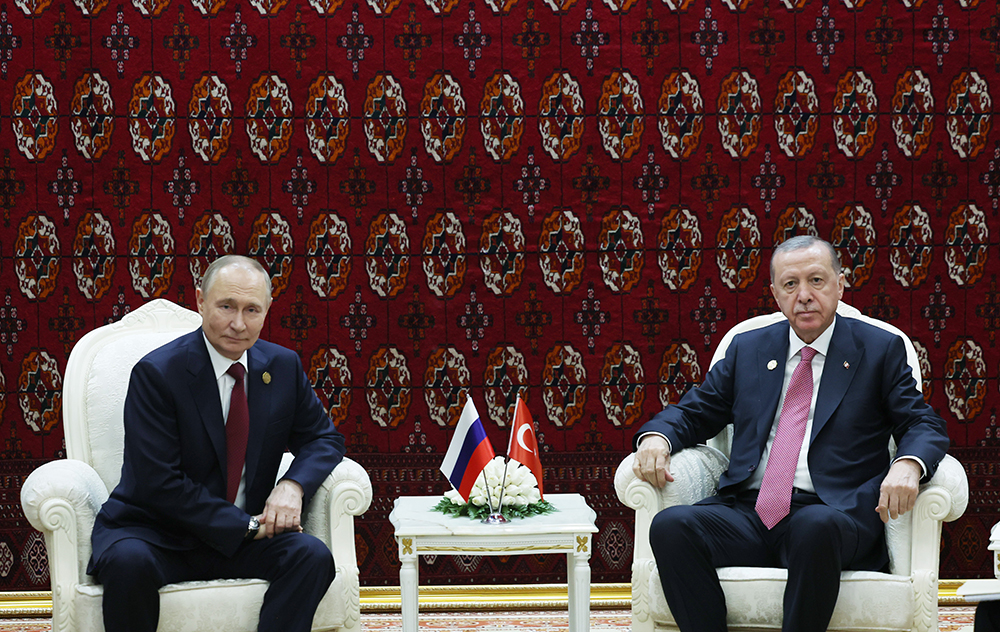
Several themes emerge over the course of the book. One is the surprising spread of the Syrian civil war beyond the Middle East. For instance, ‘some 355 Kosovan nationals travelled to fight alongside Isis and other rebel groups in Syria… the most of any country in the world per capita’. Another is the enduring importance of religious identity. The building of churches, monasteries and mosques has become a significant expression of patronage, fealty and ethnic identity. But perhaps the most crucial theme is the rivalry between Putin and Erdogan. It is a riddling relationship, at times marked by flattery and cooperation, at others by outright hostility – over Syria, Ukraine, the Caucasus and the Balkans. As Smith makes clear: ‘Both men nurture the ambition to turn their countries into major powers with the ability to set the course of global events and to end the era of American hegemony.’
Donald Trump only complicates this situation. Despite his well-publicised wish for Europe to pay its way on defence, he is keen to cash in on development opportunities. In the capital of the former Yugoslavia, his son-in-law Jared Kushner led a project to turn the derelict former Ministry of Defence building into a luxury development called Trump Tower Belgrade. According to Smith: ‘The investment would be both symbolic and tie the US President financially to the Serbian regime.’ But last December it was dropped, due to widespread opposition as well as a scandal over forged documents that removed the building’s heritage status. The website still advertises properties for sale.




Comments