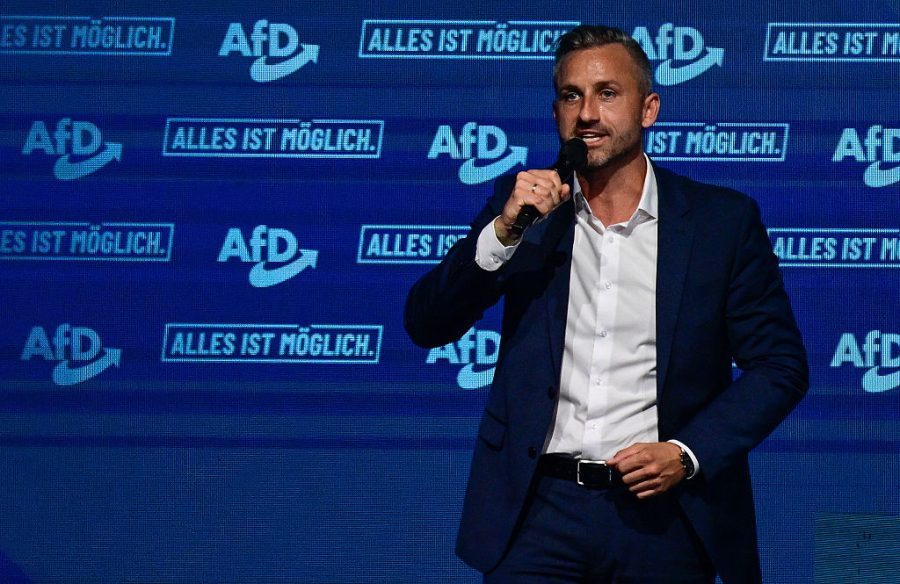
A state election in an eastern German territory with only 1.8 million eligible voters could prove pivotal for Europe’s largest economy. Tomorrow, the people of Saxony-Anhalt will go to the ballot boxes and, as things stand, mark their papers primarily for the Alternative for Germany (AfD). The party is currently leading the polls at between 40 and 43 per cent.
Its frontrunner, Ulrich Siegmund, a sporty entrepreneur in his mid-30s, is running a campaign not unlike that of Péter Magyar in Hungary a couple of months ago. Siegmund intends to portray himself as a man of the people and has held well-attended rallies where people can see him riding an old Simson moped, a relic of GDR times which is still widely popular in Germany’s east.
Siegmund’s crowd and his policies, of course, differ from those of Magyar and the historically established parties in Germany. While the AfD’s party programme covers all areas of legislation, surveys show that voters continue to support them based predominantly on their stance on immigration. Even during the ongoing campaigning in Saxony-Anhalt, it has been noticeable that the AfD has not necessarily always addressed the pressing issues on the ground, most notably the structural deficiencies of a primarily rural state.
Siegmund is well aware that certain positions on Russia have, in the past, been costly to the party
The party’s central message focuses on immigration and, through that, seemingly captures a lot of votes. Saxony-Anhalt hosts 193,000 immigrants without a German passport. The numbers are comparatively small in the rural areas of the state. But by putting the emphasis on immigration, the AfD has managed to mirror the fears and dissatisfaction of considerable parts of the rural population.
Just like any other election, winning is not just about specific legislative proposals but about capturing the emotions of the electorate. Siegmund has done that better than his competitors, even though Sven Schulze, Saxony-Anhalt’s incumbent minister-president of the Christian Democratic Union (CDU), arguably won a recent one-on-one television debate against him.
It would be incorrect to label the AfD as the party of protest voters. That may have been the case in the early days of the party, but its voter base has grown tenfold in recent years. The AfD suffered significant losses in state elections in 2020 and 2021 when it appeared more radicalised and had muddy positions on the war in Ukraine. Having learned from the mistakes of the pandemic years, the turning point came in 2023 when the AfD won 14.6 per cent of the votes in Bavaria and 18.4 per cent in Hessen.
Ever since these two state elections, the AfD has improved its results at every vote, including Germany’s general election in February last year, winning 20.8 per cent of the votes. The result was eye-opening in the sense that the AfD didn’t rely on certain demographics or voters with specific socioeconomic profiles. In every age group, the AfD scored at least 11 per cent, with the smallest shares of votes from people born between 1991 and 2007. Meanwhile, the AfD dominated in the age group of Germans born in 1955 and before.
It only seems natural that, given its strong stance on immigration and social conservatism, the AfD would attract older voters in both parts of Germany. And those voters often consider themselves conservative but by no means right-wing or extremist. According to a poll following the state election in Brandenburg in 2024, 81 per cent of AfD voters stated the party was positioned in the political centre. Only 10 per cent said that a strong AfD would endanger democracy and the constitutional state. What’s more, 52 per cent of the voters supported the AfD out of conviction and not to punish the mainstream party.
AfD voters often think of themselves as being positioned in the centre of the political landscape, while all the other parties see them on the far right. At the same time, the ‘State Offices for the Protection of the Constitution’ (Verfassungsschutz) in Brandenburg and Saxony-Anhalt consider the AfD an enemy of the constitution.
The party has connections to right-wing organisations and experienced internal battles between a radical and a more moderate wing. But that hasn’t prevented the AfD from cementing its voter base. In the east of Germany, the makeup of AfD’s supporters includes a lot of middle- and working-class people who will push Siegmund to first place tomorrow.
Siegmund, meanwhile, is trying to make sure no radicals within his party could threaten his success this weekend. The AfD thought leader Hans-Thomas Tillschneider has been viewed as a future state minister for science and education, but some of his proposals have become fodder for Siegmund’s opponents. Most notably, Tillschneider’s suggestion of abolishing compulsory schooling has turned out to be a burden for the party. Moreover, Tillschneider has close ties to Russia and Vladimir Putin and has made multiple trips to Russia in the past few years. A planned journey to the Donbas region in 2022 was stopped by the AfD’s leadership at the last moment.
Siegmund is well aware that certain positions on Russia have, in the past, been costly to the party. Hence, he has wanted to make sure that his current lead is not hurt by anything in the final stretch to the ballot box.
Whether the AfD will win 40 per cent or more tomorrow to allow them to, for the first time in German history, lead a state government, remains to be seen. What may end up happening is that the CDU, as the second strongest party in the state, is able to form a minority government with the Social Democrats and Greens and rely on the support of the Left (Die Linke) for legislative initiatives. The SPD governed in Saxony-Anhalt from 1994 to 2002 with a minority government and the support of the PDS, the predecessor of today’s Left. It was called the ‘Magdeburg model’, named after the state’s capital.
But this time around, a minority government might only strengthen AfD’s position. This would particularly be the case within the former east Germany, where another state election, this time in Mecklenburg–Western Pomerania, will be held later this month.





Comments