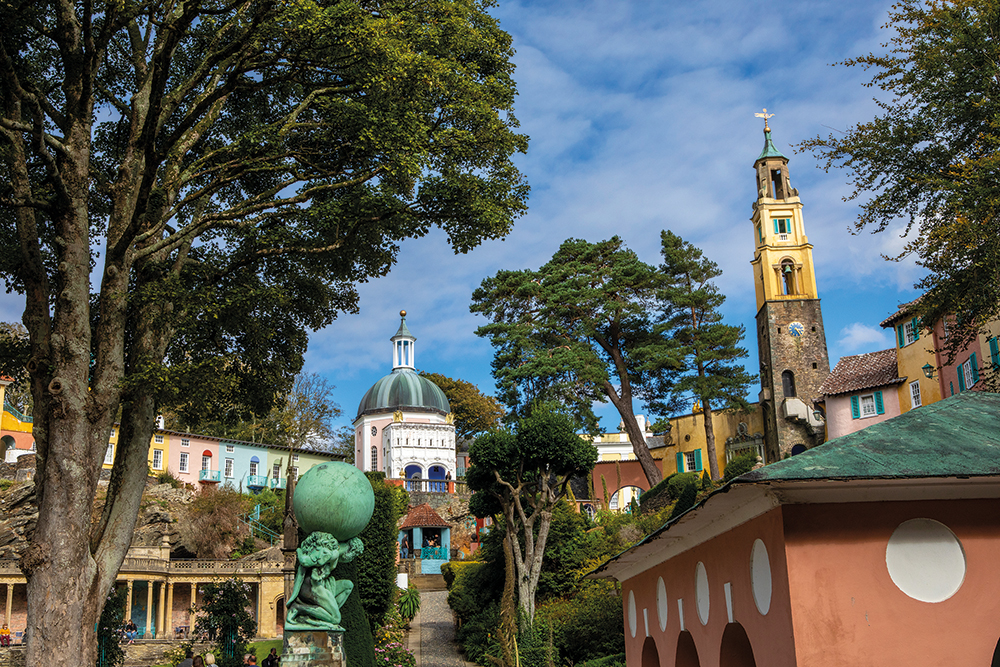
The only answer to the question ‘What connects Brian Epstein, Frank Lloyd Wright, Portofino and Stevenage?’ is ‘Portmeirion’, a conceptualised village on the north Wales coast. You could call it a folly, except it is living, not dead; and it exerts a lasting fascination. Traditional modernists deplore its flamboyant historicism – ‘retro-kitsch whimsy’ – but Jan Morris, a neighbour, said that only prigs and bores are truly hostile.
Portmeirion needs a lot of explaining, as Sarah Baylis does in this first independent study of an enchanting project. It is well-researched, but not an academic reference book nor a continuous narrative. Instead, it is an eclectic album of comment and recollection, and thus perfectly sympathetic to its subject.
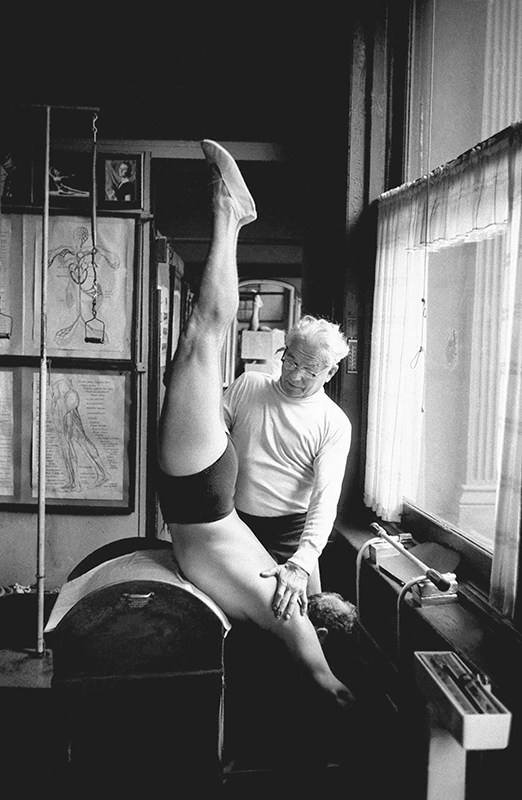
The name nods to the Ligurian fishing village resort. ‘Meirion’ is a bardic-era Welsh name that gave the English Merionethshire, although that is not how it is spelt in Welsh. Lloyd Wright, of proud Welsh descent, was a visitor and admirer. Epstein stayed often and George Harrison celebrated his 50th birthday there. In 1946, Portmeirion’s designer, Clough Williams-Ellis (always known as ‘Clough’), became chairman of Stevenage new town, an altogether different sort of planned community which led to a very different future.
Clough was from the gentry class in this most ancient part of Wales, but had established himself as a successful architect in London, working in a confident and accomplished Arts and Crafts style. One of his projects was the ‘Hundred Guinea Cottage’, which predicted what we would call affordable housing. He was very well-connected. Indeed, his father-in-law, John St Loe Strachey, was editor of The Spectator from 1887 to 1925. But the land of his fathers drew him back.
Beginning with a hotel, work began on Portmeirion in 1926 when Clough was 42. Progress was continuous, a mixture of whimsical invention, slow accretion and opportunistic salvage. Here and there you will find a rescued Norman Shaw chimneypiece, a Gothic colonnade hauled over the mountains from Bristol, a porte-cochère from a demolished house in the Alun Valley and a barrel-vaulted ceiling with plaster decorations of the Labours of Hercules scavenged from a demolished house near Wraig Sam (Wrexham).
The site on the Dwyryd estuary, facing Harlech, is spectacular: clever juxtapositions of buildings make the micro-urban composition appear larger than reality. It is cheerful propaganda, unusual in those parts. The poet R.S. Thomas said there are some parts of Wales where the only concession to gaiety is a striped burial shroud. In his 1862 epic Wild Wales, George Borrow described the sloughs and mires of the area. In a nearby village, Sydney Curnow Vosper painted his infamous ‘Salem’, a pitiless portrait of chilly Welsh chapel piety, cheap prints of which can still be found in the pound shops of neighbouring Portmadoc.
But there’s none of that at Portmeirion, which became a cosmopolitan party place. Augustus John had been painting in the region since the beginning of the century and acquired a cottage there in 1936. Aldous Huxley visited. With its palette of antipasti colours, the village presents like a Hockney painting. Indeed, Baylis’s book includes a photograph of the artist with Clough in 1977. As in a Hockney, tricks of perspective always draw the eye. The whole suggests a twinkly-eyed Osbert Lancaster cartoon.
Yet there is often a default creepiness to such forced jollity. And the sinister aftertaste was recognised by the producers of The Prisoner, who chose Portmeirion as the setting for the television psychodrama, which began production in 1966. Incarcerated in this Welsh Portofino, the impeccably Sixties-cool Patrick McGoohan – which was the lead actor’s name, not his number – sensed the dark weirdness behind the terracotta and cobalt render. Ironically, the series was in black-and-white.
The whole village suggests a twinkly-eyed Osbert Lancaster cartoon
The Portmeirion Hotel opened in 1926, and two years later Clough published England and the Octopus, a complaint about London’s suburban tentacles strangling the countryside. With his yellow wool stockings, plus-fours, stocks and generous tweeds, Clough’s disdain for bungalows reads today as patrician, but he declared himself to be an admirer of Soviet new towns. And he argued for planning controls long before such things passed into legislation. Additionally, he predicted the now urgently fashionable creative reuse, or what he called ‘structural resurrection’.
Of course, it’s opposed to both conventional and progressive architectural theory to build something so incongruously at odds with the traditions and materials of its site. I mean, domes and campaniles? In Wales? But, like Venice, Portmeirion defies cynicism. Although it influenced King Charles’s Poundbury and the exclusive resort of Seaside in Florida, it is not so much for imitation as for inspiration.
To the prigs and bores, Portmeirion is as evanescent as Prospero’s dream. But at a time when a weak government is muddling through poorly considered planning legislation and daft building regulations, the place reminds us that charm, colour, imagination, courage, the human touch and idiosyncrasy should always be part of building design. If it’s architecture as theatre not as dogma, what’s wrong with that? Clough called it ‘my love affair with life’. When every developer – government or private – can say the same of every project, civilisation will seem a little more secure. Maybe that’s a dream, but let’s hope our revels are not ended.
Baylis’s literary style does not quite achieve the elan of her subject. Nor does the graphic design reflect Portmeirion’s eccentric vigour. But this is an inspirational book.




Comments