

The forces arranged in favour of banning social media for under-16s are powerful and wide-ranging. The unlikely alliance includes the leader of the Tory party, more than 60 Labour MPs, Big Suze from Peep Show and the patron saint of all bad ideas – His Majesty King Charles III.
It seems probable that when amendment 94A of the Children’s Wellbeing and Schools Bill is voted on, it will receive support from all these quarters, as well as from Sir Keir Starmer, who has, true to form, launched a consultation on the issue. A handful of mental health charities will tell him that he must really get on with banning social media for teenagers, which he will then promptly and politely do.
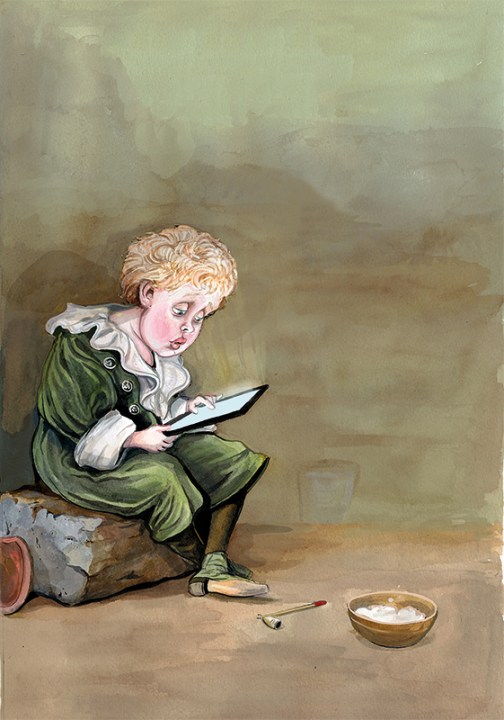
Generation after generation, parents have been less willing to let their children live independently
It’s no surprise that these various tentacles of the Establishment have concluded that young people should be deprived of a liberty for their own good. ’Twas ever thus. What is surprising is how few people in public life are prepared to make a case against this authoritarian imposition.
After all, there has been no shortage of people willing to fight digital ID on the grounds that people should not have to prove who they are to go about their lives. Apart from a handful of commentators, very few people seem to be aware of the fact that a ban on social media access for under-16s will necessitate the same ‘papers please’ society that compulsory digital ID would.
The legislation, as drafted, will require proof of identity for websites which fit the Online Safety Act’s definition of ‘user-to-user platforms’. That applies to a large swath of the internet, including messaging services such as WhatsApp and contributing to online libraries including Wikipedia.
Is it wise to establish a precedent whereby the state can restrict our access to these platforms? It may just be teenagers being blocked for now, but there are no lengths that politicians such as Starmer will not go to in their Manichean struggle against the ‘far-right’. In Australia, the country which we are copying the social media ban from, the government is concurrently passing legislation that will drastically lower the threshold for criminally offensive speech and introducing sentences of up to five years in prison for it.
Most popular
Steven Edginton
Invented claims of lynchings and racist violence are irresponsible — and dangerous

In Britain, it is less than seven months since the Online Safety Act came into effect and the legislation has already led to the censorship of articles critical of migration policies. Now the government is threatening to ban Elon Musk’s X because of AI-generated bikini pictures. It is extraordinary that the Tory party, nominally committed to preserving free speech, has decided to support social media restriction when the government is engaged in an orgy of authoritarianism.
And for what gain? The evidence that social media is causing mental health issues in children is flimsy at best. Indeed, one of the studies cited in the proposed amendment says directly that there is ‘no clear evidence’ of a causal relationship between social media use and the psychological wellbeing of children. The most comprehensive study conducted, which looked at 12,000 nine- to 12-year-olds in the US, found no evidence of screen time affecting their cognition.
In lieu of any hard evidence, the advocates of online restrictionism instead rely on nostalgia for a kind of childhood that has not existed in Britain for many decades. A childhood of roaming the countryside from dawn until dusk building campfires and tying knots, or sheltering from the rain in mahogany libraries, engrossed in the exploits of Jennings and Darbishire. A world of tree-climbing and lashings of ginger beer that has been destroyed by evil online algorithms.
Most parents raising children today, of course, did not grow up in that idyll. They were raised by traditional media, mostly television, in front of which they whiled away years of their life in a passive stupor. Older parents, born in the 1960s and 1970s, will have been subject to the worst period of post-war education experiments, the ‘child-centred’ education which treated academic attainment as evidence of class treachery.
So it is no surprise that, though they moan about declining reading rates, few read for pleasure. The generation reared on Jim’ll Fix It know more about the inner lives of celebrities and the royal family than they know about the life of Nelson or the works of Shakespeare.
Many millennial parents – the loudest advocates for the ban – were raised by helicopter parents who did not let them leave their house on their own until they were adolescents, an experience they are passing on to their children. The average age at which today’s parents say they allow their children to play outside unaccompanied is 11. The NSPCC’s official guidance is that children should not be left alone at home or allowed to walk to school alone until the age of 12.
The truth about childhood in modern Britain is that it is by historical standards a prison, not because of the internet, but because of parents. Generation after generation, parents have been less willing to let their children live independently.
The internet can be a force for good in young people’s lives. It is a haven for children who do not fit in. Children from families with abusive tendencies or cultlike religious backgrounds can find other perspectives online. Several charities use social media to reach children who are suffering, a lifeline this legislation will make illegal.
I am very glad that I was able to use Wikipedia from a young age, since it is more effective than any library at providing access to the combined sum of human knowledge.
It is reasonable for children to seek an alternative to the education provided by modern schools or the entertainment provided by modern TV. These institutions spew endless streams of dreck about intersectionality and social justice. Who in their right mind would not want to escape this hell?
Have some sympathy for these teenagers, many of whom have already had years stolen from their lives by lockdown, and who are now being told by the same adults that they must be deprived of their liberties yet again. Speak out against it while you can.





Comments