
Kemi Badenoch’s travails with Nigel Farage’s Reform UK party have taken me back to the politics of the 1980s and the Social Democratic party’s challenge to Labour at the time. Like Reform now, the SDP sought to replace one of the main incumbent parties of British politics, but the SDP’s case went beyond finishing off Labour. Like Farage now, they argued that the whole two-party system was ailing, that neither was capable of providing a political home for millions of voters who felt unrepresented by them, and that each was, in their own way, so stuck in their furrows that only a new party could give Britain the leadership it needed.
The project did not end in success despite this initial message at one point commanding 50 per cent in the polls. So what are the lessons for Reform from the experience of the SDP in the 1980s?
Farage might reflect on how, as the SDP gained ground, the party’s appeal brought Labour to its senses
One difference is that the SDP had a deep bench of competence and ability which Reform cannot boast – but, nonetheless, a similar tailwind exists for Reform in the failure in government of the party they are seeking to replace.
Labour’s preceding decade was one of low investment and productivity accompanied by rising taxation and barely controlled public spending, culminating in the hugely unpopular trade union Winter of Discontent. Indeed, Labour’s premier at the time, James Callaghan, signalled a dramatic clean break from postwar Keynesian economic thinking when he said it was no longer possible for Britain to spend its way out of recession.
Farage has so far offered nothing like as acute a diagnosis of Britain’s economic predicament but, as with the SDP, he does have a decade of failed (Tory) government to draw on. He will overlook his own role in the main cause of Britain’s turmoil – Brexit– but no doubt he will be unrelenting in his condemnation of the Tory government’s indecision and policy confusion that followed it. This will be grist to Keir Starmer’s mill, and Labour will welcome this growing bitterness and division on the right as a relief from their own troubles.

Farage will do everything he can to deepen public disapproval of the Conservatives, just as the SDP had to vindicate their own replacement of Labour by pointing to the damage done by economic mismanagement, union power and the subsequent lurch left.
How far Farage succeeds in using the Tories’ record to undermine them will depend on Badenoch’s guile in distancing herself from the government in which she served, and on whether she is successful in devising a markedly different Conservative prospectus for the future.
She has to do this in relation to the economy more than in any other area of policy. Economic performance is becoming the litmus test of Starmer’s government and, on current indicators, economic recovery and public trust are looking hard to win back. But this will not automatically create advantage for the Tories unless the public is convinced they have a viable set of alternative policies to reignite Britain’s animal spirits so as to revive business and investor confidence.
Farage faces a further risk in his attempt to displace the Tories, and this is an image of extremism and divisiveness in the eyes of voters which the SDP patently did not have. In emulating Donald Trump’s populist campaign handbook, Farage has been careful to distance himself from what the public see as the US President’s excesses, for example the cruel language and police actions associated with the deportations of illegal immigrants and his threats over Greenland. Regardless, many voters see Reform as being well to the right of the Conservatives, and there are swaths of right-leaning voters who might be tempted by Reform but for whom the risk may seem too great.
This raises fundamental questions for Farage’s chosen path. If he is seen as someone who genuinely wants to disrupt a political system that a majority of the electorate believe is not delivering for them, and has effective ideas to do so, he could become a winner. Millions of voters on left and right feel let down, angry and in need of an alternative way forward for the country and their families. Business as usual no longer works for them. Politicians skirting around issues alienate them. Therein lies Farage’s appeal. But there is a difference between being viewed as a disruptor and being seen as an extremist.
Badenoch’s hope will be that Farage is seen as an extremist as well as a one-man band with few new ideas. This leads to another important lesson for Reform. The SDP won the confidence of the ‘small c’ conservative middle class who just want to see things run competently. As much as people might want disruption and major overhaul of a broken ‘business as usual’, they don’t want clowns in charge. Reform will need to demonstrate that they are recruiting substance, talent and ministerial experience, and are not just a repository of useless Tory has-beens.
Farage might also reflect on how, as the SDP gained ground, the party’s appeal brought Labour to its senses. As Labour’s campaign director at the time, I didn’t hesitate to use the SDP threat as a stick with which to beat my own party when it was resistant to change. Discredited policies of nationalisation, hostility to the EU, sky-high levels of public spending and taxation were jettisoned. It was not enough to win an immediate election but it was sufficient to stymie the SDP’s appeal. There did not seem to be the same need for it any more.
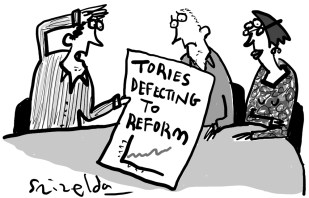
So will Reform have the same galvanising effect on Badenoch’s Conservatives and enable them to win back support? She will need to present not just a more credible economic alternative to Labour but a safer alternative to Reform, demonstrating that she has learned from the mistakes of the last government and contrasting her party with Reform’s lack of moderation.
Disruption is one thing – madcap divisiveness is another. Will Farage succeed in navigating between the two? On such questions, along with the perception of basic competence, will rest many voters’ choice between the two parties on the right – and, in turn, the decision about whether they want one of them to replace Labour.






Comments