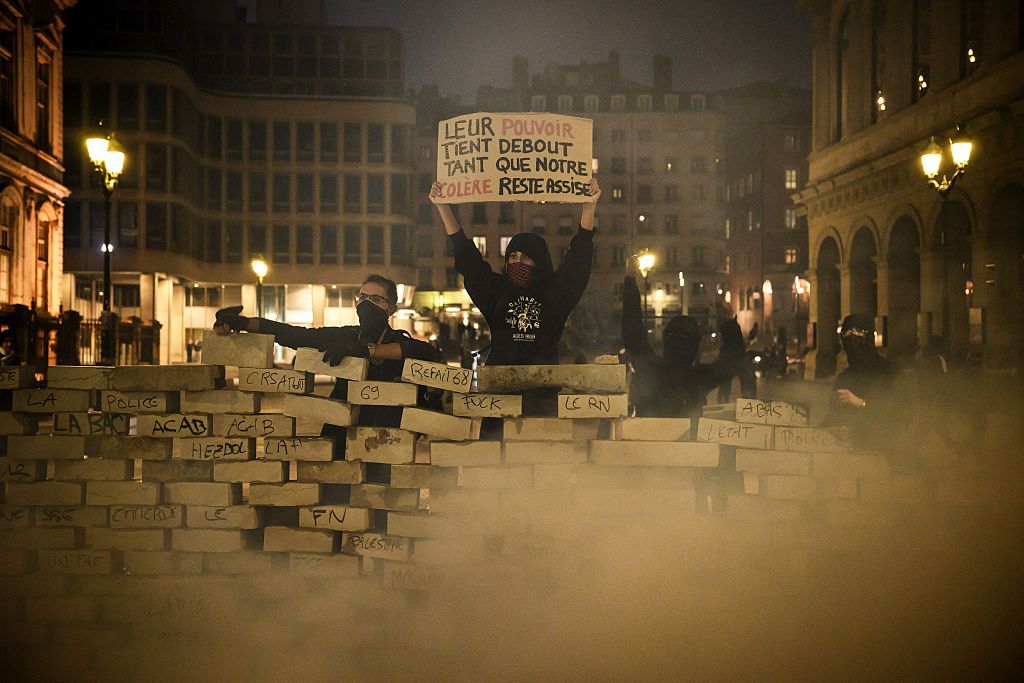
It’s the third week of the student-led protests in Lyon, and the second that my university has been blockaded “in solidarity.” When clouds of tear gas drift onto my street on Saturday, it’s an almost routine sight. My neighbor across the road is sitting by his window, eating potato chips, pointing out some of the more family-friendly placards to his toddler. Smartly dressed shoppers move through the crowds with scarves as improvised gas masks. I decide to make myself some porridge.
I am interrupted by a series of heavy thuds. Out of my window I see a group of balaclava-clad men taking turns to launch themselves at my neighbor’s front door. It eventually gives way, and they rush into his stairwell. The toddler begins to cry.
Time to leave. I decide to take my chances on the street, in the anonymous crowd, rather than sit waiting in my apartment. But I hesitate over what to bring. How long will this go on? Will the building be intact when I returned? All the while, the street fills with people, and the explosions grow ever louder. I pack a backpack with my laptop and a change of clothes, then head downstairs.
Outside, the promised mass of lycéens, university students, and gilets jaunes occupy the neighborhood. Several placards call for an end to violence, usually that of the police. One of the younger participants’ signs deems this the May ’68 of the “6-7 generation.” A middle-aged gilet jaune offers a simpler message: “Macron explosion.” Others have brought no placards at all. They carry metal poles or colorful tubes of fireworks.
This is a manifestation sauvage – an unauthorized protest – and the crowd knows it. Someone has flipped a recycling bin, and people stand around the pile of bottles, handing them out to any willing recipient. Further up the street, a group dressed entirely in black swarm a construction site and drag its materials into a barricade. One pauses to smash each window of the site’s digger.

I approach an old man standing on the sidelines. He has come prepared, his face covered by an N-95 mask. I ask if he’d ever seen a protest like this. “La violence est la violence,” he shrugs. “They’re a minority.”
Despite all the activity around us, the majority are doing very little. Already, several protesters have set down their placards and are deep in their phones. I’m struck by how much of the gathering seems centered around simply being there, or rather being seen to be there. In one of the occupied city squares, three girls in ski goggles record themselves dancing in a circle. When tear gas interrupts them, they regroup in another corner of the square and start again.
As the destruction escalates, so does the enthusiasm for filming it. At a nearby Hugo Boss store, protesters rush phone-first to document the looting. Some pose for pics amid the chaos. “Let’s go!” a young cameraman yelps, in English, on seeing the building ablaze. Five floors of residential apartments sit above the burning shop.
Any sense of common purpose has long since left this crowd. Here are thousands of self-absorbed individuals, each performing to their own invisible audience.
The police remain on the fringes, forming a perimeter within which the rioters could move unchecked. A well-aimed volley of tear gas, or the arrival of a water cannon, might briefly allow an advance. But faced with the sheer mass of people, the officers struggle to hold much ground and soon retreat to their vans.
This back-and-forth goes on for hours. For the more active rioters, looting seems almost secondary to their running battles with the police. I watch dozens climb scaffolding and launch stones at the lines below. From that height, a direct hit could kill.
By nightfall, authorities have lost control of my neighborhood. Shop windows have been smashed and the plywood boards torn apart. Broken glass litters the pavement. Spent tear gas canisters and dismembered mannequins, stripped of their clothing, lie among the shards.
The looters are out in force, many traveling on e-scooters. Every so often, a group cuts through the darkness with an electric whirr, backpacks bulging with stolen goods. One man has a bag of red lingerie slung over his shoulder.
A squad of riot police occasionally emerges, batons raised, to clear a street. But they remain hopelessly outnumbered and outpaced. The mob creeps back in behind them as soon as the police move on. The only real deterrents are the local shopkeepers, some of whom stand guard long into the night.
I don’t make it home until the small hours of the morning. Outside my front door, a trash-fueled fire is crackling away. The couple upstairs are leaning out of their window, pouring water onto the flames. It doesn’t seem to be working.
I exchange a few words with a young man lingering outside. When I tell him I’m British, he perks up. “You don’t see this in England!’ he exclaims. I nod. It’s only when we part, and he climbs through the broken window of the shop opposite, that I realize he hadn’t meant it as a criticism.




Comments