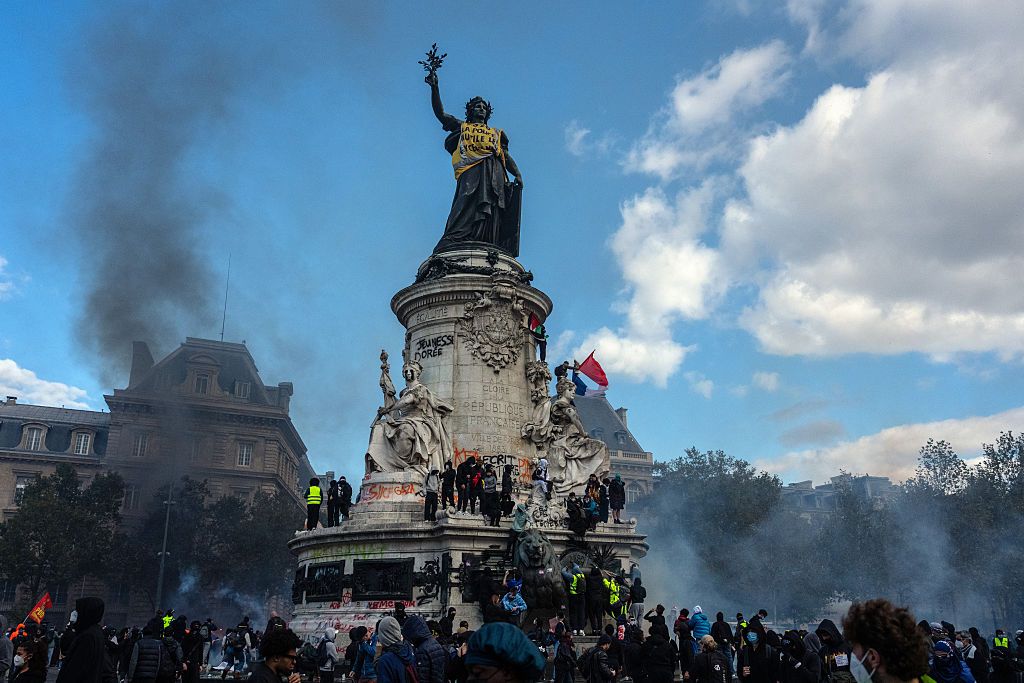
May 1958. After 12 years, France’s Fourth Republic was ungovernable, with cabinets lasting barely seven months on average. Four years of worsening war in Algeria culminated in the army’s Algiers putsch of 13 May, demanding stronger political authority.
General de Gaulle – Resistance hero, France’s saviour in 1944 and now the army commanders’ choice – stepped forward. Exploiting the insurrection, he demanded the premiership, temporary rule by decree and six months to draft a constitution for approval by referendum rather than parliament. President René Coty agreed. On 1 June, de Gaulle became the Fourth Republic’s last prime minister; six months later, he was the Fifth’s first president. The new settlement deliberately strengthened the executive, replacing unstable parliamentary government with a presidency able to claim direct popular legitimacy.
Could deep civil unrest, a severe financial crisis, or both, before the 2027 presidential election tempt Emmanuel Macron to invoke this precedent?
Could deep civil unrest, a severe financial crisis, or both, before the 2027 presidential election tempt Emmanuel Macron to invoke that precedent? Nationwide protests have brought 2,400 arrests, 1,000 injured police officers and more than half a million demonstrators out on the streets. Insured losses from looting and damage exceed €1 billion, already above the €730 million cost of the 2023 riots. In a televised address, a strained Macron expressed ‘anger and shame’; the next day, his prime minister refused to rule out a state of emergency. With the Fifth Republic appearing more imperilled than during 1968 – when unrest was cushioned by strong growth and sound finances – could insurrection, paralysis, financial pressure and rhetoric of national rescue justify exceptional powers under Article 16, a Macronist Sixth Republic and a third mandate otherwise constitutionally barred?
Beyond political paralysis and moribund public finances – both largely of Macron’s making – lies a deeper malaise: a sense of national decline amid rising taxes and deteriorating services. France’s elites increasingly fear the system no longer works for them and may even turn against them. No centrist candidate seems likely to reach the presidential run-off in six months; most polls suggest a contest between far-left Jean-Luc Mélenchon (on 18 per cent) and national populist Marine Le Pen (35 per cent). That prospect wounds French amour propre and alarms an establishment hostile to both candidates’ politics and costly economic programmes. Meanwhile, international bond markets may abandon France as it prepares to issue €340 billion of debt.
Then there is the EU. France’s governing elites, Macron foremost among them, are deeply Europhile. With both likely run-off candidates Eurosceptic, damage limitation is already under way before April 2027. The European Commission fears an RN victory: Le Pen has promised to halve France’s annual net EU contribution from €10 billion to €5 billion. Macron recently urged the EU to conclude its 2028-34 budget, binding his successor for years. Yet a flight from French debt could make the Commission and ECB France’s lenders of last resort.
Enter Emmanuel Macron, risk-taker par excellence. In this scenario, the former banker discreetly consults European leaders and financial institutions, while sounding out France’s principal constitutional bodies – the Constitutional Council and Court of Auditors, whose presidents he appointed – about an emergency settlement.
Macron’s terms would echo 1958: temporary power to rule by decree and stabilise the public finances; six months to draft a Sixth Republic constitution; and a referendum, presented as a direct appeal to the nation, that would also permit a third consecutive presidential mandate.
The route would be neither simple nor clearly lawful. Article 16 permits exceptional presidential powers only when the Republic’s institutions, national independence, territorial integrity or international commitments face a grave and immediate threat, and the regular functioning of public authorities is interrupted. It was designed as a last resort, not a device for constitutional self-extension. Any attempt to use emergency rule to redesign the Republic – and reset presidential term limits – would therefore provoke fierce legal and political resistance.
The differences from 1958 are stark. De Gaulle stood outside a discredited party system and commanded immense historical authority and support among the public and armed forces, despite elite distrust. He could present himself as an arbiter above faction. Macron would instead be seeking rescue from a crisis many voters blame on him, making any appeal to national salvation look more self-interested. His support would lie chiefly among political, administrative, European and financial elites – not necessarily the electorate, and still less the army.
At his press conference of 19 May 1958, challenged about his return to power, de Gaulle replied with a Gallic shrug: ‘Why should I, at 67, begin a career as a dictator?’ Addressed to a 48-year-old Macron, the question would carry a different charge.




Comments