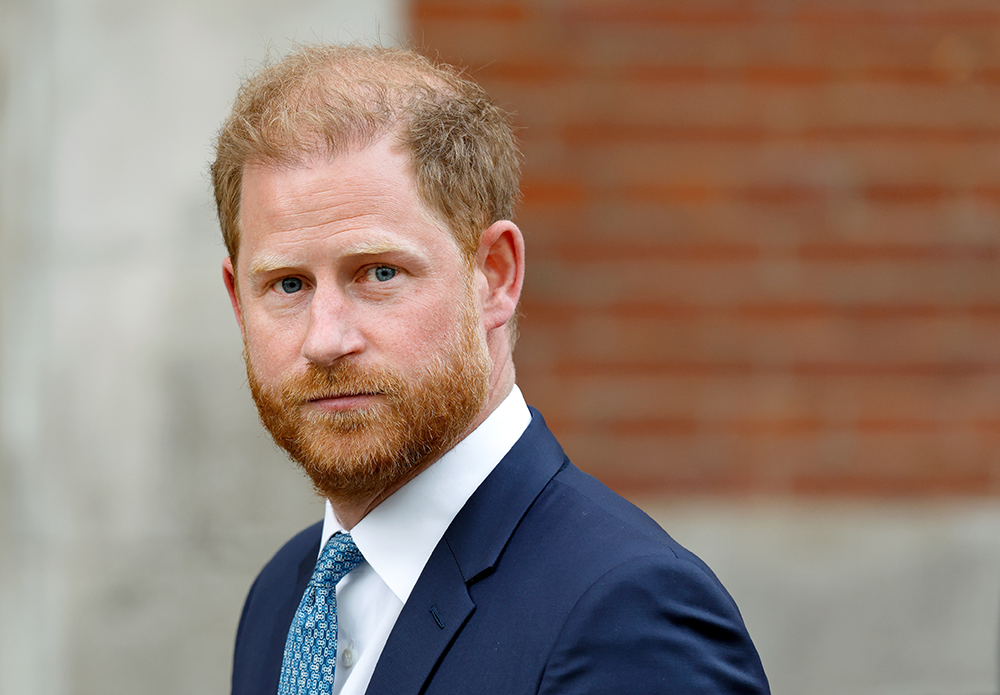
Don’t ever sue anyone! That’s what I would have told Prince Harry, Elton John and their fellow claimants, on the hook for a £34.4 million bill after losing their disastrous privacy case against the Daily Mail and Mail on Sunday.
I trained as a libel barrister in 5 Raymond Buildings, the same chambers as Sir Matthew Nicklin, the judge in the case, and David ‘Orange Sherbet’ Sherborne, Prince Harry’s lawyer. In every libel case I saw as a pupil barrister, I thought it was crazy to sue. Clients risked fortunes for the possibility of minor moral victories.
The barristers were certainly affable and bright. Sherborne got a First in Classics from New College, Oxford; Nicklin a First in Law from Newcastle. But, still, it isn’t worth risking millions to avenge an insult.
If it’s a battle between walking away with wounded pride or the possibility of losing a fortune, do the former
And it isn’t just a single barrister you’ll be paying for if you’re misguided enough to sue. Any potential litigant should visit the public gallery in the Royal Courts of Justice – and count the number of people you’ll be paying for if you lose.
You might well pay for a KC and his junior (an extremely well-paid barrister). There’ll be one or two solicitors, at least. Like Prince Harry, you’ll pay for the opposing lawyers and court costs, if you lose. The meter quickly ticks up to tens of thousands of pounds a day.
Then there’s the agonising mental cost. Look at how Prince Harry the happy-go-lucky army helicopter pilot morphed into a furious, furrowed-browed gloomy guts. That’s what happens to serial litigants. Weeks, months, years wasted on pre-trial hearings, waiting for judgments, contemplating ever-mounting bills. Who wouldn’t go half-mad with rage and worry?
When I was made redundant by a newspaper 20 years ago, I got the best-ever legal advice from the lawyer I was provided with – free – by the paper. ‘Take the redundo,’ he said. ‘Yes, you might get more if you contest it. But you might lose. And you’ll have to pay me. And you’ll go through months of misery and anger, waiting for a judgment.’
I took the money and ran. Some brave colleagues did sue – and sometimes got twice as much as they would have if they’d taken the first offer. But it was a long-drawn-out process and they paid a greater emotional toll than me, even though they won.
There’s an old line that it takes as long to get over a divorce as your marriage lasted. The same goes for going to law. Harry will suffer post-trial angst for months.
It isn’t just in libel cases that you should avoid court. An unmarried family lawyer once told me: ‘If I get married, I’ll never get divorced, however horrible my husband is. I’d never pay someone the ludicrous amount people pay me.’
There will be crucial civil cases where there is no choice but to fight. But Harry and co had no financial need to sue. If it’s a battle between walking away with a little wounded pride or the possibility of losing a fortune, do the former.
If you’re charged with a criminal offence, by all means hire the best barrister, if you can afford it. How pleased the late Jeremy Thorpe must have been with George Carman QC, when Thorpe was acquitted of conspiracy to murder Norman Scott in 1979 – worth every penny of Carman’s mammoth fee.
In 1999, I shadowed Carman, defending Mohamed Al Fayed against Neil Hamilton, the former MP. Fayed had accused Hamilton of taking cash for questions in parliament. Carman was lightning-quick in court, leaping from meticulously prepared cross-examination to improvised, dazzling follow-up questions. Hamilton duly lost and was made bankrupt.
Hamilton’s fellow Tory MP Jonathan Aitken should have followed the ‘don’t sue’ rule. Instead, he embarked on a catastrophic 1997 libel action against the Guardian and Granada TV, which had accused him of misconduct in government.
By wielding ‘the simple sword of truth and the trusty shield of British fair play’, he was jailed for seven months for perjury, and bankrupted by legal fees. Yet another Conservative MP, Andrew Mitchell, lost around £3 million in his calamitous ‘plebgate’ libel action. Only last year, influencer Mohammed Hijab lost his libel action against The Spectator’s Douglas Murray. His bill is around £850,000.
Even when you win, it often isn’t worth it. When Sunday Times editor Andrew Neil sued Sunday Telegraph editor Peregrine Worsthorne in 1990 for accusing him of demeaning his position in his romantic life, he won only £1,000. Perry declared: ‘Let this case teach all editors a lesson: don’t sue.’ The libel court is the graveyard of reputations and a surer route to penury than addiction to heroin or gambling.
George Gale, The Spectator’s editor from 1970 to 1973, echoed the sentiment: ‘Never resign on a point of principle – and never sue.’





Comments