
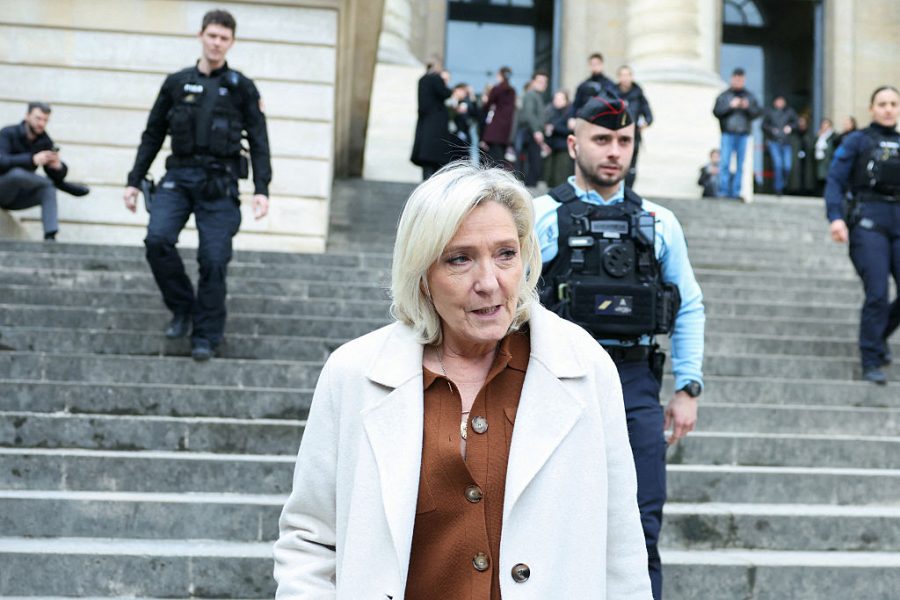
Marine Le Pen returned to court this week to contest her conviction last spring for misusing EU funds. Convicted of diverting more than €4 million (£3.5 million) meant for Brussels affairs in order to pay her staff, the leader of the National Rally was fined €100,000 (£86,600) and disqualified from politics for five years with immediate effect.
The appeal will last a month and the verdict is expected in June. If Le Pen is successful, she will be able to run in next year’s presidential election; if she fails to overturn or drastically reduce the sentence, her protégé, 30-year-old Jordan Bardella, will represent the National Rally.
Le Pen struck a more conciliatory tone when she addressed the court at the start of the appeal. Gone was the bullish denial of her initial trial, replaced instead by a softer defence. ‘I wish to state at the outset that, if any offence was committed, I want the court to understand that we had absolutely no sense of doing anything wrong whatsoever,’ she announced.
She and the other ten members of her party, all of whom are appealing their sentences, pointed a finger at Brussels. ‘The European parliament did not warn us of anything, as it could have done,’ explained Le Pen, who insisted that ‘I firmly believe we never concealed anything.’
Le Pen’s party will emerge stronger from the appeal, whatever the verdict
In other words, blame Brussels. It’s a clever line of defence, at least with voters, to accuse the EU of ineptness. The union has never been so despised by the French as it is now, a result of the recent ‘Mercosur’ trade agreement with South America that will be great for the German car industry and disastrous for French farmers. The German president of the European Commission, Ursula von der Leyen, will sign the deal in Paraguay on Saturday.
Le Pen’s party will emerge stronger from the appeal, whatever the verdict. If she is banned, then she will end her political career as a martyr; not just in the eyes of her 10 million-plus voters, but the country at large.

A poll this week reported that 64 per cent of people believe the judiciary is no longer impartial. Who can blame them when, in 2024, one of the profession’s largest unions – representing a third of judges – issued a statement on the eve of the parliamentary election calling on ‘all magistrates, as well as all those involved in the judicial system, to mobilise against the rise to power of the far right’.
In the event that Bardella replaces Le Pen as the presidential candidate, the National Rally will lose little. He lacks the experience of his mentor but he has huge appeal among the under-35s and is also more popular with the urban middle classes, who worry about Le Pen’s left-wing economics. If Le Pen does win her appeal, she will be able to boast that she beat ‘Le Blob’ and her victory will underline her credentials as the anti-system candidate.
These days in France it pays to be anti-system. A poll this week by a prominent current affairs magazine reported that Bardella and Le Pen are the most popular political figures (both with an approval rating of 38 per cent). Le Pen’s niece, the MEP Marion Marechal, was ranked third with 28 per cent. Politicians seen as belonging to the centrist system that has ruled France for half a century didn’t fare well in the poll. Emmanuel Macron’s approval rating was 15 per cent.
Le Blob probably believed that Le Pen’s conviction for malfeasance would derail the National Rally train. On the contrary, their ideas have never been so en vogue, particularly when it comes to addressing mass immigration and rampant insecurity. A poll conducted at the start of the year by the Le Monde newspaper found that 42 per cent of the French support Le Pen’s political manifesto.
On the question of who is the biggest danger to democracy in France, 70 per cent replied Jean-Luc Mélenchon, the leader of the left-wing La France Insoumise party. Eric Zemmour of the right-wing Reconquest (65 per cent) was perceived as the second biggest menace, followed by Macron on 56 per cent. Fewer than half of respondents namechecked Le Pen.
The results of the poll must have been a bitter pill to swallow for a progressive newspaper such as Le Monde. For years they have waged a relentless war against Le Pen and her party, depicting them as far-right demagogues.
A minority of Le Pen’s voters may identify as far-right but the vast majority are men and women who have simply reached the end of their tether. They open their newspapers (probably not Le Monde) and switch on their televisions and what do they see? They see a country in freefall, economically, diplomatically and socially. So far this year, a 15-year-old girl has allegedly been raped by an Algerian under a deportation order, a Jew assaulted in the Paris metro and an innocent bystander shot dead in a drug shootout in Marseille.
This is why nothing is going to dent the popularity of the National Rally between now and next year’s election. The French people are turning their back on an ‘elite’ that they now understand is nothing of the sort.






Comments