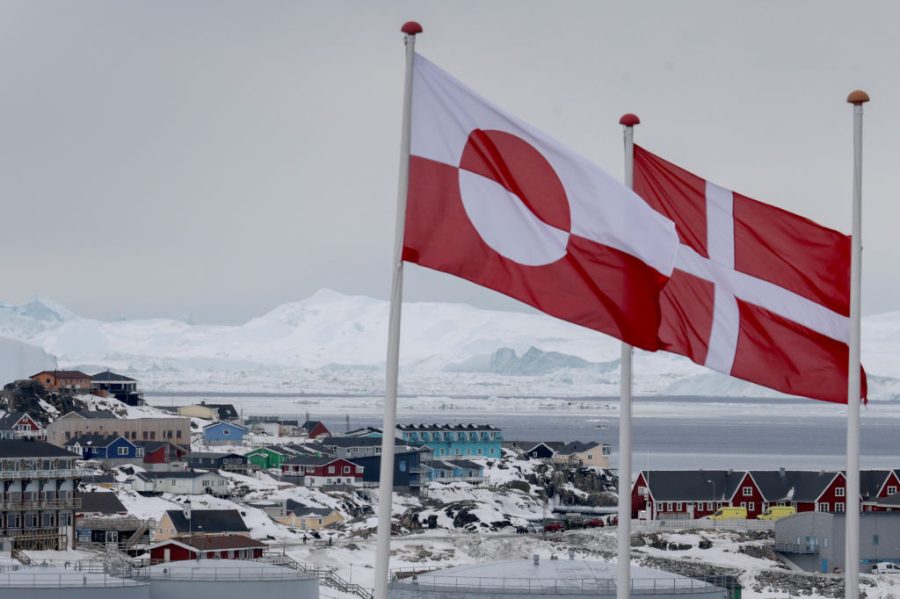
Remember when the President of the United States casually enquired about purchasing Greenland in 2019? The world scoffed. Denmark, a nation whose greatest geopolitical aspiration usually involves a decent bridge or tunnel, emitted a collective gasp of ‘Oh no, he didn’t’. It was all very quickly dismissed with a chuckle as just another example of Donald Trump’s fantasy of embiggening America.
But fast forward seven years, and the laughter is stuck in Copenhagen’s throat. This is because the Arctic, far from being a frozen curiosity, is rapidly becoming the next great theatre of global power. Trump, with his signature sledgehammer, may well have been years ahead of the curve in a way that few, at the moment, quite appreciate.
Greenland suddenly becomes not just real estate but the fulcrum of a new global trade artery
A declared interest: I’m a Dane and a proud one at that (our bridges really are magnificent). By rights, I should be decrying Trump’s offer to buy up a part of our beloved lingdom with all the affronted fury of my Viking ancestors. But I also happen to work in an industry the Vikings would have recognised for all its land-claiming, world-defining, realpolitik-ing dominance: oil. And it’s this that makes me uniquely positioned to witness Denmark’s recurring geopolitical irony: we’ve simply been a victim of our own success. In developing the world’s best bio- and electro-fuels, we’ve changed the tradewinds and are losing our power in the process.
While environmentalists lament the melting of the Arctic, pragmatists on every continent have been eyeing the thinning ice with avarice. The fabled Northern Sea Route, a shortcut from Asia to Europe shaving weeks off voyages through the Suez canal, is no longer a pipedream but is fast becoming an imminent reality, driven by breakthrough tech and global instability.
Consider the technical hurdles, once insurmountable. Shipping in the Arctic isn’t just about ice; it’s about the cold. Heavy fuel oil (HFO), the viscous lifeblood of global trade, becomes a stubborn sludge and even a solid at cold temperatures. Up there, it’s about as useful as a Lego teapot.

Specialist vessels already use marine gas oil (MGO) with superior cold properties. But here’s the real game-changer that Copenhagen didn’t see coming, despite pouring billions into developing the stuff: methanol. While HFO congeals, and MGO is hardly better, methanol remains pourable down to a staggering -98°C. But its frigid resilience isn’t its only revolution. Methanol combustion produces virtually zero black carbon – the sooty, heat-absorbing particles that would accelerate melt. This isn’t just good for polar bears; it’s good for business, mitigating a major environmental cost and enabling the route.
The vessels themselves are also no longer an issue. Again, as Copenhagen knows, ‘ice-class’ ships, capable of carving ice, are standard for delivering essentials to frozen Nordic outposts every winter. Scaling this for container ships is no marvel; it’s capital investment and capacity, deliverable in years. The Danish shipping giant Maersk is already in the process of converting its fleet to methanol-capable vessels. These ships are already sailing, but their meaning seems to have passed by the Danish state.
So, we have the melting ice, the ships, and critically, the fuel. The final push? Classic oil industry economics, ever sharpened by conflict. Red Sea chaos, recently forcing ships around the Cape of Good Hope has injected unparalleled urgency into the Arctic shortcut. Ship owners, staring down the barrel of spiralling insurance premiums and weeks of lost time, now have an overwhelming incentive to brave the North.
The implications are as breathtaking as the Arctic’s icy air. Shortened China-Europe transit times will redraw trade maps in a way that defies our mercantile mindsets, impacting supply chains and port dominance. And this is where Donald Trump’s whimsical fascination with Greenland takes on a more prescient and oily black hue.
The implications are as breathtaking as the Arctic’s icy air
Greenland, the vast, resource-rich jewel of the Arctic, suddenly becomes not just real estate but the fulcrum of a new global trade artery. Yes, its mineral wealth, once protected by ice, becomes more accessible and viable. But once you understand its power as a shipping route, you see it’s less Greenland’s land and airspace than its sea that matters most. The irony is this: it’s the pioneering methanol engine technology developed in Copenhagen by Everllence (formerly MAN B&W) that may end up being the undoing of Denmark’s own sovereign interests in Greenland by accelerating the territory’s geopolitical significance in a methanol-fuelled Arctic.
This isn’t, in fact, the first time a world leader has seen what’s happened in Denmark and used it to shape the world order. Back in 1911, the Selandia, the first commercial ship running on oil instead of coal, departed Copenhagen for London on its maiden voyage. A young Winston Churchill, then first lord of the Admiralty, immediately saw the future in the speed of the Danish ship freed from coal. He converted the Royal Navy’s ships and won the first world war at sea, powered by oil.
Trump’s 2019 query about buying Greenland was once mocked as the eccentric ramblings of a Manhattan property mogul who measured nations in square footage. Now it seems less a gaffe and more a crude recognition of a strategic prize.
As the ice recedes and ships follow, the scramble for influence, resources, and control in the High North will make the Red Sea a mere prelude to a grander, colder geopolitical drama. The world dismissed Trump’s Greenland ambition; soon Denmark and its prime minister, Mette Frederiksen, may regret not having done a deal with the White House Viking while there was still a deal to be done.





Comments