
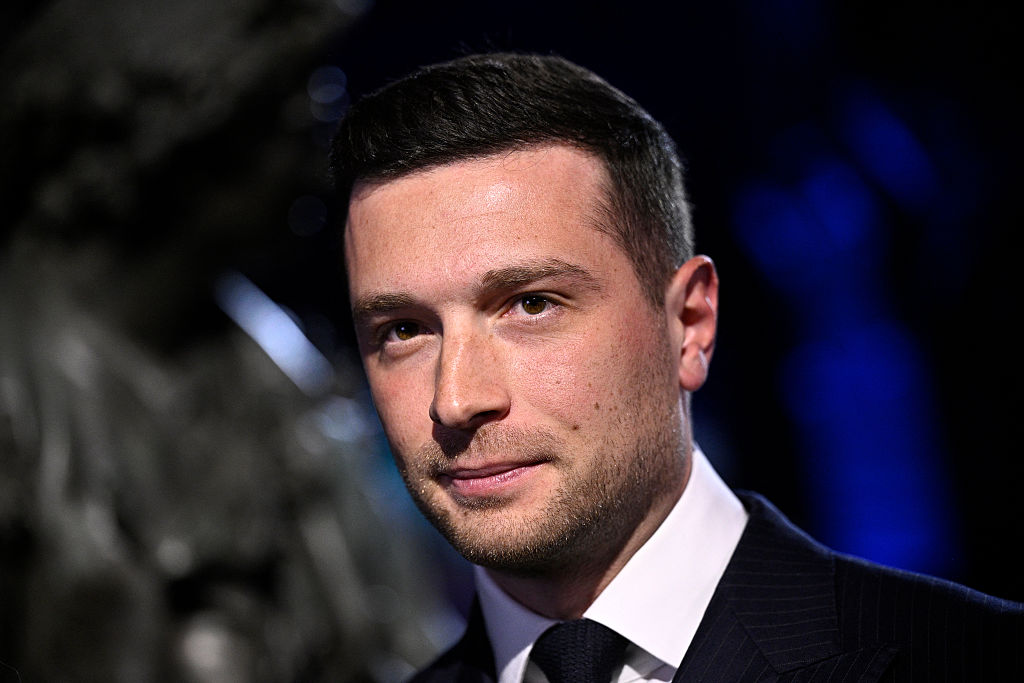
Marine Le Pen returned to a court in Paris on Tuesday as her appeal began against her five-year ban from political life.
The leader of the National Rally was disqualified in March last year after she was found guilty of misusing €4 million ($4.6 million) of funds from the European Union. She claims she is the victim of a political witch-hunt, a view supported by President Donald Trump and Vice President J.D Vance.
The appeal will last a month and the verdict is expected in June. If Le Pen is successful she will be able to run in the presidential election in April 2027. If she fails, however, it will be her protege, 30-year-old Jordan Bardella, who will represent the National Rally.
Bardella went to London last month, where he lunched with Nigel Farage, paid his respects at the statue of Charles de Gaulle outside his wartime residence and gave an interview to the BBC.
In that interview, Bardella said he broadly agreed with Trump’s gloomy assessment of the direction Europe is headed. He is less enthusiastic about America’s intervention in Venezuela, and their eyeing up of Greenland. It was, he said this week, “a return to imperial ambition” in which “the law of the strongest trumps respect of international rules.”
Bardella made his remarks at a press conference to mark the start of a new year. When he gave the floor to the assembled press corps, the first question concerned not Trump or Le Pen but Steve Bannon. Bardella snorted with derision when he heard the name and he must have known what was to come. The journalist wanted to know what he had to say to Bannon’s recent accusation in a French TV interview that he was a “total lightweight.”
Bardella replied that he was astonished a French broadcaster had given airtime to a man with “daft” ideas who had given a Nazi salute on stage. Where Bannon is concerned, added Bardella with a thin smile, it’s not so much the “Monroe Doctrine” as the “Doctrine Poivrot.”
Poivrot means “drunkard.” It was the latest salvo in a feud that began last February. Bardella was invited to address CPAC in Washington, an event he viewed as the first step in building a transatlantic bridge with American conservatives.
It went horribly wrong. Bardella flew home early after Bannon was accused of making a Nazi salute on stage. Bannon laughed off the charge, saying he had done no such thing, he was merely waving to the audience. He said that the fact Bardella had fled proved he was “a boy, not a man,” and as such he was “unworthy to lead France.” It didn’t help Bardella’s standing that the Italian Prime Minister stayed in Washington and gave a speech which underlined her status as the Trump administration’s best European buddy.
The emerging feud between Bardella and Bannon, who is often portrayed in the international media as an architect of right-wing populism in Europe, is indicative of a growing divide between America First nationalism and the growing patriotic fronts of Britain and France. Nigel Farage, a friend and admirer of Trump’s, has been distancing himself and his party from the White House in recent months, and even said earlier this month that the US capture of Venezuela’s Nicolás Maduro was “contrary to international law” – though, he added, that “may be a good thing.” Le Pen, for her part, has never been comfortable with the excesses of Trumpism. And it was notable that Trump did not invite her or Bardella to his inauguration. But he did ask Éric Zemmour, the more radical but less popular leader of the Reconquête party. Zemmour had no doubt that Trump was justified in snatching Maduro, telling his French critics to pipe down. “The duty of a statesman is to make his country strong so that it will not be attacked,” tweeted Zemmour.
Italy’s Brothers of Italy, led by Meloni, and Germany’s AfD, by contrast, continue to cultivate ties with Trumpworld. Bannon holds no formal role in the White House, yet it would probably have been better for Bardella if he had risen above his latest barb, which rather proved Bannon’s point that he is too boyish to run a country like France. He’s also behind the times: Bannon has been sober since 1998.
Furthermore, by resorting to the “Nazi” smear, Bardella is guilty of the same cheap insults as his opponents. “If you’re not left-wing in their eyes, you’re automatically a fascist, a far-right Nazi,” Bardella said in November, not long after he’d been likened to a Nazi. “This rhetoric is insupportable.”
Still, Bardella remains as popular as ever among right-wing French voters. At the weekend a Sunday newspaper in France ran a feature explaining that two-thirds of voters want a coalition in next year’s presidential and parliamentary elections. Whether they are National Rally voters, followers of Zemmour’s Reconquete or loyal to the center-right Republican party, all believe that a coalition offers the best chance of ending 15 years of Socialist governance. Macron may claim to be a centrist, but he was a member of Francois Hollande’s Socialist government from 2014 to 2016 and he was a party member in his younger days.
Right-wing voters were also asked who they believed would be the most effective leader of a right-wing coalition. Thirty-eight percent backed Bardella, 22 percent said Le Pen and 12 percent plumped for Bruno Retailleau of the Republicans. Le Pen is opposed to any form of coalition because she believes her party can win on its own. Bardella, however, like Zemmour and some Republicans, is more open to the idea. It may also be because he is genuinely right-wing, whereas Le Pen’s economic views are decidedly left-wing.
Bardella is inexperienced compared with Marine Le Pen, but he’s not the one in court this week. He’s fresh-faced and untainted by scandal or by a last name. For many French voters, it’s better a lightweight than a Le Pen.



Comments