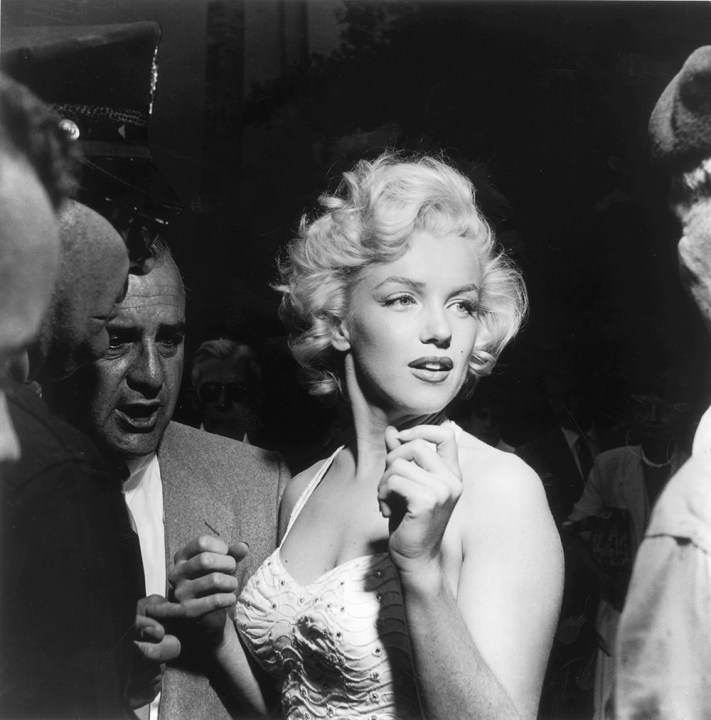

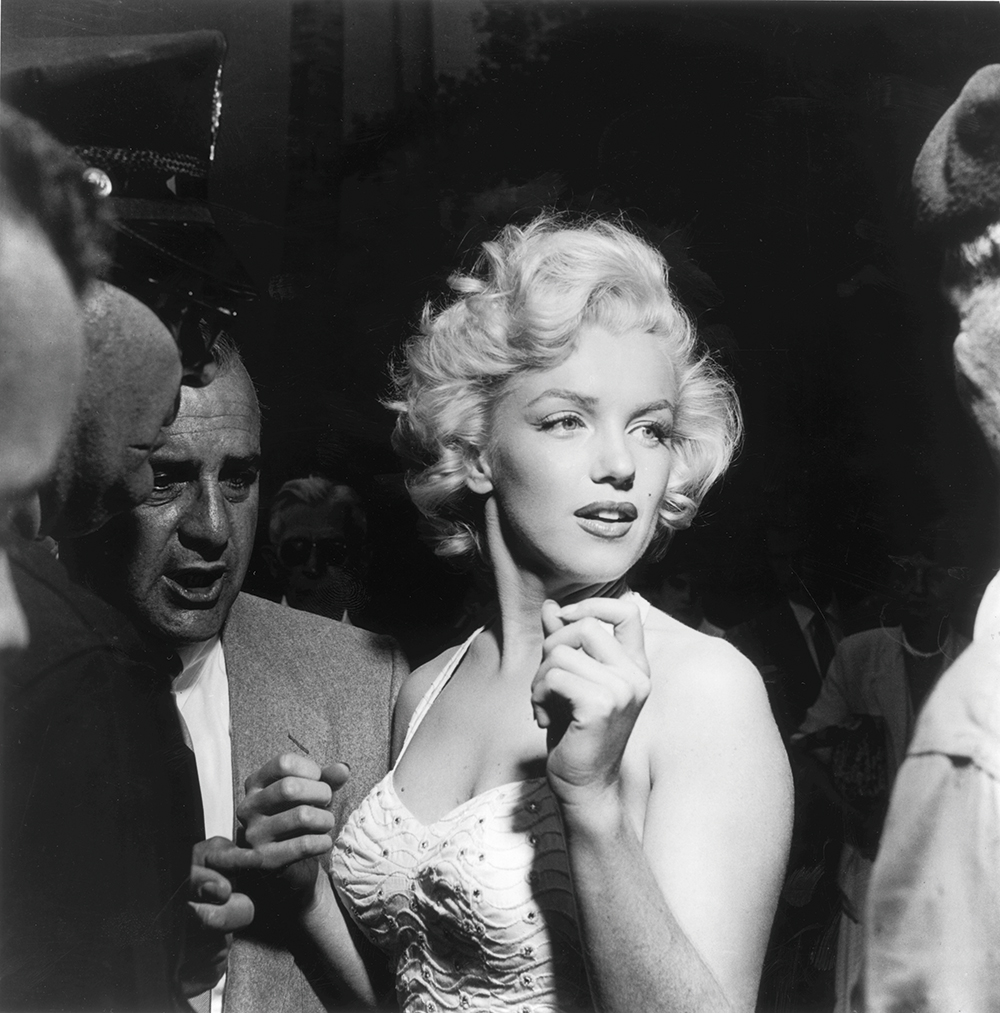
The year 1959 was a particularly productive but especially depressing year for Sylvia Plath. She toured the length of America, attended a series of stimulating literary seminars and wrote some of her most beloved verse. While outwardly active and energetic, her diary reveals she was struggling all the time to sustain her few fleeting fits of happiness. One entry in October describes a vivid dream she had, in which Marilyn Monroe appeared as a kind of fairy godmother. Monroe gave Plath a manicure and promised her a “new, flowering life,” before wishing her well and inviting the troubled poet over for Christmas. The image of Monroe clearly consoled her. Plath was hardly the only poet to be mesmerized by Monroe’s outward magnificence and fascinated by her perturbing private tragedies.
The telling of her life story sounds more like a fantasy than a matter of record
Monroe was uniquely suited to be a literary muse, thanks to her otherworldly demeanor and tragic life. In fact, heaps of poems have been written in her honor – although few are worthy of her. We live in the age of the image, not the lyric, and few images are as widespread as Marilyn’s. So perhaps the pile of shoddy poems and mounds of tawdry odes is the quality we are due. But can the word reveal something about the woman that the image cannot?
At least a couple of anthologies of verse on our ebullient blonde bombshell have been published. These are often filled with a quagmire of clumsily penned fan lyrics and frivolous free verses written by obscure academics. But distinguished rhymesters such as Delmore Schwartz, Edwin Morgan, Sharon Olds, Charles Bukowski, John Berryman and Florence Ogawa all wrote about or alluded to Monroe. In his posthumously published “Love and Marilyn Monroe,” Schwartz celebrates “the primitive pure and powerful and pink and grey private sensibilities,” her “delight in womanhood and manhood.” He toasts “the birth of a new Venus among us” and states that “a nation haunted by Puritanism owes her homage and / gratitude.” It’s perhaps not Schwartz’s greatest poem, but it approves the uniqueness of its subject with eloquent enthusiasm.

Schwartz sang a happy song in Monroe’s honor, but many poems written about Norma Jeane zoom in on the morbid scene of her untimely death. Her corpse pops up, Ophelia-like, from poem to poem. Bukowski scribbled a lamentation titled “for marilyn m.,” reminding the reader that no matter how immortal any of us appears to be, we will all be forgotten, then perhaps remembered, then forgotten again, like Ozymandias, or “like a flower dried and thrown away, / we forget, we remember, / we wait.” He concludes, lovingly, “child, child, child / I raise my drink a full minute / and smile.”
Showing morbid interest as well was the Scottish poet Edwin Morgan, who published a short ode to the actress’s theatrical demise. Dramatic and dark, his effort includes intriguing insights into Monroe’s acute vulnerability and spiritual nudity in the public eye: “the great cameras / and lights / became an inquisition and a torment… / the drive-in admirers should become / a blur of incomprehension and pain.” This accompanies the terrifying assertion “that Death should seem the only protector.” Morgan’s tone is ruminative and pained and echoed in Olds’s “Death of Marylin Monroe.” This plaintive verse focuses on “the ambulance men” who came to retrieve her body, “lifted it, heavy as iron / onto the stretcher, / tried to close the mouth, / closed the eyes, / tied the arms to the side.” Morbidness as much as beauty colors the mythology of Monroe. It is an unavoidable, compelling contrast of qualities, a contrast that offered these poets the animating tension their dramatic impulses wanted to indulge.
But in reading these poems we realize something more sinister than that distressing contrast: Monroe’s suicide wasn’t her first death. The first time she died was when she achieved her apotheosis in the public eye, her transformation from movie star to demideity. In many poems penned about her, this shattering of selfhood is explored and her image is cruelly commodified and plasticized. She is sometimes described as “not a woman” at all. As the poet Ernesto Cardenal puts it in “Prayer for Marilyn,” she is often seen as nothing more than “the one they trained for sex.”
What all these poems do – intentionally or not – is plant Monroe in a long, storied tradition of theatrical muses. Virgil wrote of the actress Cytheris in his tenth eclogue. Dryden wrote riveting epilogues with the pretty, witty Nell Gwyn in mind. Rochester composed red-blooded yet philosophically rich poems about the beautiful Elizabeth Barry (albeit without naming her explicitly). Torquato Tasso wrote sweet, understated sonnets for the actress and poetess Isabella Andreini. And the inimitable Sarah Siddons was the subject of passionate sonnets by Samuel Taylor Coleridge. Our admiring poets perform an invaluable task: they transform enthusiasm of the moment into an abiding appreciation.
Decades after her death, Monroe remains the arch-muse of America. No one has come close to knocking her off her lonely plinth in the pantheon of American culture. That tousled bundle of vanilla-blonde hair, that silky, seductive voice, that blindingly bright smile – all combine to produce a presence without compare. “She’s up there with Coca-Cola, Christ, Mickey Mouse and Michael Jackson,” as one old Hollywood insider reportedly put it.
The telling of her life story sounds more like a fantasy than a matter of record and resembles mythology more than history. Probably because legions of fans, biographers, artists and poets have pumped their reflections and fascinations into her posthumous fame for decades. But that odd otherworldliness which still colors the glow of her reputation emanated as much from her character as from the eyes of her admirers.
The old adage holds that a picture is worth a thousand words. That’s true and images of Monroe attest to this. But in fewer than a thousand words, many of Monroe’s poets present her with all her complexities – philosophical, emotional, psychological – in a way that no image can.



Comments