Poetry

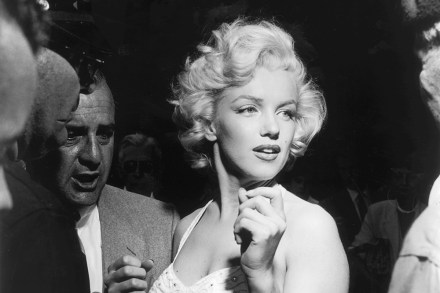
Marilyn Monroe, poetic muse

The year 1959 was a particularly productive but especially depressing year for Sylvia Plath. She toured the length of America, attended a series of stimulating literary seminars and wrote some of her most beloved verse. While outwardly active and energetic, her diary reveals she was struggling all the time to sustain her few fleeting fits of happiness. One entry in October describes a vivid dream she had, in which Marilyn Monroe appeared as a kind of fairy godmother. Monroe gave Plath a manicure and promised her a “new, flowering life,” before wishing her well and inviting the troubled poet over for Christmas. The image of Monroe clearly consoled her. Plath was hardly the only poet to be mesmerized by Monroe’s outward magnificence and fascinated by her perturbing private tragedies.

Why Goethe matters

Johann Wolfgang von Goethe bears one of the most famous names in world literature, though he is largely unread by English-speakers. He is most closely associated with the novel and dramatic form, so many would be surprised to know that he primarily spoke of himself, for much of a long life that spanned from 1749 to 1832, as a scientist. He was a pioneering exponent of the science of evolution, and in two wonderful poems, The Metamorphosis of Plants and The Metamorphosis of Animals, he explored his belief that nature evolves from simpler, earlier life forms. This, rather incredibly, was seventy or eighty years before Charles Darwin began to write.

Goethe

The Exchange will delight anyone seeking an impossible story made possible

“I have been instructed to tell you that what you are proposing is entirely impossible. Nevertheless, in Iran, even the totally impossible becomes possible at times.” Such was the mysterious riddle that confronted the English art dealer Oliver Hoare as he sat across from an Iranian contact in Paris in 1992. He had just presented a madcap plan: to reunite the state of Iran with one of its most prized but long-lost manuscripts.   The Shahnameh of Shah Tahmasp is an illustrated epic poem comprising 50,000 rhyming couplets. Completed in the mid-sixteenth century, this “book of Kings” is one of the most exquisite examples of Islamic art and poetry ever to have been produced.

books

The Spectator’s 2022 Books of the Year

William Boyd Writing effective comedy is very difficult. True comic genius, the ability to create a unique tone of voice — deadpan, perfectly timed, self-deprecating, abjuring all whimsy (the British disease) and grandstanding — is extremely rare. One thinks of S.J. Perelman, Peter de Vries, the Grossmiths and P.G. Wodehouse amongst very few others. One name that can be added to this tiny and exclusive club is Theo Fennell who has published, this year, his memoir I Fear For This Boy: Some Chapters of Accidents (Bloomsbury, $35). It relates incidents in Fennell’s life where everything that could go wronnd Catholic Churches as he veered between them.

Blake Butler: ‘I don’t want this story to end as “Molly killed herself”’

A recent controversy rocked the literary world when coverage of author Blake Butler’s memoir, Molly, about his late wife, notable poet Molly Brodak, hit tabloids and spun for the worst. The coverage sparked debate over the ethics of writing about relationships, as online attackers made accusations that the widower weaponized Brodak’s private life and exploited her death for fame or revenge.   Claims gained ground that it was a “shameless cash grab,” “literary revenge porn,” or that it shouldn’t have been published due to privacy concerns, since the memoir reveals Butler’s discovery of his late wife’s affairs after her passing.

blake butler

How Wilfred Owen became a poet

Here is the opening of a sonnet written by Wilfred Owen in the spring of 1911: “Three colors have I known the Deep to wear;/ ’Tis well today that Purple grandeurs gloom.” Owen was eighteen and had just been on a pilgrimage to Teignmouth in England, where his hero John Keats had once stayed. The kindest thing to say about this poem is that it is heavy with the influence of Keats. Six years later, in a seaside hotel requisitioned by the army and waiting to be sent back to the Western Front, he begins a poem like this: “Sit on the bed. I’m blind, and three parts shell.” This looks so simple. The monosyllables carry the meter without fuss; “shell” here means both munitions and protection.

Owen

The great late Yeats

The 1923 Nobel Prize in Literature was awarded to William Butler Yeats “for his always inspired poetry, which in a highly artistic form gives expression to the spirit of a whole nation.” Informed of the prize late on the night of November 14 by the editor of the Irish Times, the fifty-eight-year-old Yeats and his wife George sat up taking telephone calls and telegrams for a couple of hours. Then, according to Yeats’s sister Lily, the couple went down to the kitchen and cooked some sausages before going to bed. The next day, the Yeatses went out and began spending some of the check Yeats would receive in December.

yeats

Poet laureate can’t define a ‘ban’

Amanda Gorman, the young female poet who read at Joe Biden's inauguration lamented on Tuesday night that her poem had been banned by a Florida school library. “Just found out my inaugural poem 'The Hill We Climb' has been banned from an elementary school in Miami-Dade County because it causes "confusion and indoctrination,” America's first National Youth Poet Laureate tweeted.  The poem, however, was never banned. Instead, according to the Miami-Dade school district, “The Hill We Climb” was moved from the elementary section of the library to the middle-school section.  “It was determined at the school that ‘The Hill We Climb’ is better suited for middle-school students and, it was shelved in the middle-school section of the media center.

amanda gorman

Ernest Hilbert weathers the storms of life and fatherhood

Storm Swimmer, Ernest Hilbert’s fifth collection of poems and winner of the 2022 Vassar Miller Prize in Poetry, is obsessed with bodies of water, especially the ocean. Even before the book begins, Hilbert declares this preoccupation through three sea-based epigraphs, running a wide gamut from Apollonius of Rhodes to Rachel Carson and Iris Murdoch. Over the forty-four formally various and adept poems that comprise this ninety-page, seven-section text, Hilbert engages repeatedly with different aspects of the oceanic to dazzling effect. Often he effects our encounter with the sea through the experiences of the swimmer, who almost always is a struggling figure. Sometimes — as in the case of the title poem — he must contend with the weather: “Without the sun the sea is tangled steel.

Hilbert

T.S. Eliot’s The Waste Land at 100

In the United States a century ago, a single poet dominated the literary sphere. He was not only the recipient of the first ever Pulitzer Prize for Poetry — which he would win twice more during the course of an internationally distinguished career — but would be nominated for the Nobel Prize for Literature on four separate occasions. He was beloved by presidents, described by one admirer as “more artful than Hardy and more coy than Frost” and found himself one of the bestselling writers in America. His reputation seemed assured forever.

waste land

The unfortunate misogyny of Philip Larkin

Philip Larkin — whose centenary was this week — was a misogynist. A “casual, habitual racist and an easy misogynist,” according to the literary critic Lisa Jardine. Alan Bennet, Britain’s favorite playwright and supposedly a friend of Larkin’s, even described the poet as looking “like a rapist.” Not content with one insult, he even compared him to the necrophiliac serial killer John Christie. Tough review, that one. The sheer number of reviews, essays, and articles which decry Larkin’s character and attitudes — “a porn-addled, two-timing, racist misogynist” reads the headline for one — seem to suggest this is a settled judgment. And, indeed, the evidence is all but damning.

philip larkin

Americans should be proud of their Poet Laureates

It isn’t often I’ll say this — and, in fact, I hope this is the only time — but as a Brit, I’m jealous of you Americans. It isn’t the fact that you have a notionally more functional government than us, or even that you have unrestrained access to things like Pop Tarts and peanut butter cups. No, the answer lies, as it always does, in poetry. Over on this side of the Atlantic, we’ve had a Poet Laureate since 1668 — when John Dryden was given a position in the royal household by Charles II. We could claim to have had one even earlier, given that the versifier, playwright, and scribbler Ben Jonson was given a pension by James I in England way back in 1616.

Lost in translation

Picture the scene: a twenty-something college student, desperately trying to impress a girl he’s met for a date. He's early, but that isn’t a problem as it gives him a chance to sit nonchalantly with his ever-so-artfully-battered paperback. It’s Rimbaud’s Collected Poems: intellectual, sensual, rebellious — everything he wants to be perceived as. He props the book up so that the poet’s name is visible and waits for his delicate intellectualism to be applauded. The only thing missing from this tableau is the name of the poems’ translator, assuming that the student isn’t pretentious enough to be carrying around the original French. A smaller name on the fragile paperback, the translator is generally unmentioned, forgotten, and obscured.

translation

A quiet delight

What would you do if you looked out of your window expecting to see the neighbor’s cat, and instead were presented with a groundhog in its place, “waddle-thieving” your tomatoes and “taking such/ pleasure in the watery bites”? Ada Limón’s speaker, in the opening poem of her new collection, The Hurting Kind, is not angry at this “all muscle and bristle” tomato-thief. The groundhog is an embodiment of all she cannot have: an animal, natural freedom that inspires her to ask, “Why am I not allowed/ delight?” ...A stranger writes to request my thoughts on suffering. Barbed wire pulled out of the mouth, as if demanding that I kneel to the trap of coiled spikes used in warfare and fencing.

limón

The energetic and tragic Keats

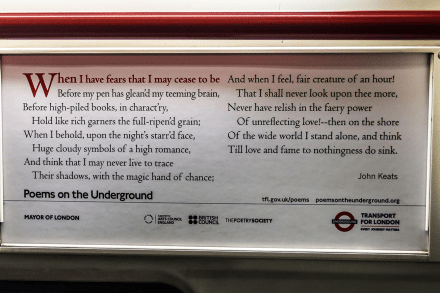
When John Keats wrote “On First Looking into Chapman’s Homer,” he had just returned from a long evening at the home of a childhood friend, Charles Cowden Clarke. Charles Clarke was the son of the headmaster of Clarke’s Academy, where Keats had gone to school. A week earlier, Clarke had introduced Keats to one of his heroes, Leigh Hunt, editor of the independent Examiner (Hunt was imprisoned for two years for printing that the Prince Regent was “a fat Adonis at forty”), friend of William Hazlitt and Charles Lamb, and literary kingmaker. Hunt despised what he viewed as the overly ornate poetry of Alexander Pope, preferring instead Chaucer’s earthy Old English and the directness of Shakespeare and Milton.

Bob Dylan’s and T.S. Eliot’s search for truth

The fact that the master songwriter Bob Dylan is a fan of a literary allusion should come as no surprise. This is the man who, in his autobiography Chronicles Vol. 1, declared that reading the French symbolist poet Arthur Rimbaud made “bells [go] off.” (Incidentally, it was Suze Rotolo, his first love whom he so cruelly lambasted in “Ballad of Plain D,” who introduced him to the poet. One feels that Dylan should have paid her a little more retrospective credit than the all-but-bitter love songs on The Freewheelin’ Bob Dylan.

Robert B. Shaw sees things as they are

What Remains to Be Said: New and Selected Poems by Robert B. Shaw, Pinyon, 2022, 312 pages Robert B. Shaw is one of those quietly accomplished poets who publishes a slim volume of exacting and beautiful poems every eight years or so. One thinks of his teacher at Harvard, Robert Fitzgerald, as a model in this regard, or the late Amy Clampitt, or Shaw’s more prolific contemporary Frederick Turner. Shaw’s observational verse progresses by accumulation of detail or plot and aims to unify meaning and music. His most recent volume, What Remains to Be Said: New and Selected Poems, collects poems from all of his seven previous books and includes 28 new poems.

Ocean Vuong’s immature poetry

Time is a Mother — Ocean Vuong’s second poetry collection — should have been a scene-stealer, a much-awaited literary event of the type normally reserved for a J.K. Rowling. The collection has been talked about in the breathy, excited terms not normally associated with poetry — the least glitzy of the literary genres — and in a way not heard of since the blockbuster release of Ted Hughes’s Birthday Letters (1998). Vuong, rightly, won the T.S. Eliot prize in 2017 with Night Sky With Exit Wounds. The collection had flashes of brilliance and was a mark of a young poet making his way in the world. It also won the Forward Prize for best first collection, and, in 2019, Vuong was awarded a MacArthur “genius” grant.

Don’t cancel John Donne’s poetry

All the way across the Atlantic, the British literary world has been seized by John Donne fever. Katherine Rundell’s biography of the metaphysical priest-poet has led to excitable chattering about his life and work. The book, Super-Infinite: The Transformations of John Donne, will be released in the US in September — a significant enough delay as to make the Declaration of Independence look like a mistake. Aside from radically different publication dates (again: would you rather have lower taxes and freedom from George III, or a brilliant Donne biography?), the specter of the far-off American continent has long since loomed large in Donne studies.

Wallace Stevens and the magic of stuff

Writers have all sorts of hobbies. Tolstoy liked to play chess. Dostoevsky, as everyone knows, loved to gamble. Nabokov collected butterflies; Hemingway, wives. Eugene O’Neill’s favorite pastime was drinking. Flannery O’Connor, of course, loved birds. Emily Dickinson loved to bake. T.S. Eliot was an avid sailor. As a young man he regularly sailed along the shore of Cape Ann. One summer, Eliot and some friends sailed from Marblehead, Massachusetts to Mt. Desert Rock in a 19-foot knockabout in the fog and rough seas. It was a journey of well over 150 nautical miles and could have easily ended in disaster. The sea, of course, appears again and again in Eliot’s poetry.