Sunday brought particularly disagreeable news for the twelve of us who read The Observer. The Maldon sea salt I have spent years sprinkling over my estate-grown winter greens turns out to be partly German. I had always imagined the salt being coaxed from the waters of the Blackwater Estuary by methods scarcely altered in centuries.
I can picture it perfectly: there would be great shallow pans, tended by men whose fathers and grandfathers had worked the same tides. Low, black-weatherboarded sheds crouching at the edge of the saltings, their roofs scarcely visible above the reeds. Beyond them, the great tidal reaches of the Blackwater, creeks snaking through acres of glistening mud, curlews crying somewhere in the sea mist, the distant spire of a medieval church rising above the flat, waterlogged fields.
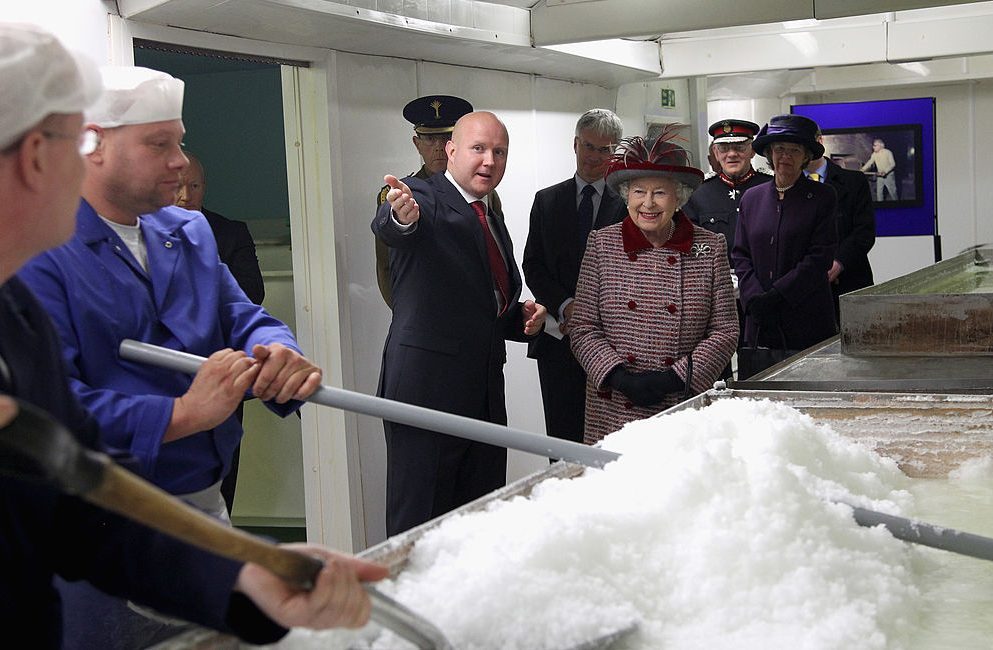
It turns out that Maldon has been importing rock salt from the German mining giant K+S
Instead, it turns out that Maldon has been importing rock salt from the German mining giant K+S, delivered to its Essex factory by lorry in twelve-tonne loads, and dissolving it into seawater drawn from the estuary. Not Vaughan Williams or Ravilious, then, but sacks of industrial salt arriving on the back of an articulated lorry from some godforsaken Salzbergwerk in the wastelands of the Bundesrepublik.
Maldon insists that its product remains 100 per cent sea salt. The German rock salt, it explains, was itself seawater once, deposited by prehistoric oceans hundreds of millions of years ago. Even by the standards of modern food marketing, claiming a prehistoric ocean as a local supplier seems rather ambitious.
There is evidently money to be made in a good backstory. I was reminded of a Belarusian translator I once met on the night train from Berlin to Moscow. She carried her slippers in a supermarket bag and changed into them before we had even left Berlin. Over the course of the journey, she told me a succession of Soviet jokes. One concerned a man in Moscow who made his living selling jokes.
His name was Anatoly. Officially, he repaired typewriters for the Ministry of Agricultural Machinery. Unofficially, he conducted his business from a fourth-floor apartment near the Arbat. He specialised in jokes for weddings and the birthdays of senior Party officials. Political jokes cost extra. Jokes about Brezhnev cost considerably more, and customers were advised not to repeat them near windows.
One afternoon, the director of a provincial tractor factory arrived with a bottle of Armenian cognac. He needed something amusing for a banquet honouring a notoriously humourless Deputy Minister. Anatoly told him a joke. The director roared with laughter, knocking over a plate of pickled watermelon rind.
‘Excellent!’ he cried. ‘Where did you hear it?’
Anatoly explained that he had invented it that morning while waiting for a tram. The director was disappointed. He could hardly repeat a joke invented that morning. Suppose nobody laughed?

Anatoly thought for a moment. For ten roubles, he could say the joke had first been told at a meeting of the Writers’ Union in 1956. For twenty, it had been told privately to Khrushchev. For thirty, he could assure the director that Khrushchev had laughed.
The director was becoming interested. What could he get for fifty? For fifty roubles, Anatoly explained, Khrushchev had considered the joke so amusing that he had repeated it to Brezhnev himself. And had Brezhnev laughed? Not immediately, Anatoly replied. He had waited until Khrushchev fell from power. And for a hundred roubles? Anatoly extinguished his cigarette and unplugged the telephone. For a hundred roubles, he whispered, the joke had been personally banned by the Central Committee as a danger to the Soviet state.
The director was delighted. Could Anatoly provide documentation of the ban?
Naturally. An official document, with two stamps.
‘But the joke was never banned!’
‘Comrade,’ said Anatoly, gathering up the money, ‘in this country, what difference does that make?’
Modern Britain has taken this principle considerably further. We have developed an entire heritage-industrial complex, manufacturing not merely distinguished provenances but the buildings, interiors and landscapes that appear to substantiate them. The forgery has escaped the document and colonised the physical world.
Consider the modern cheesemonger. Everything has been arranged to suggest generations of rural hardship and honest family enterprise, although the proprietor was working in digital marketing until 2022. The butcher is no better, with his white tiles, striped aprons and earnest accounts of animals that enjoyed remarkably fulfilling lives before being slaughtered. These are not reconstructions of shops that ever existed. They are reconstructions of how we imagine shops ought once to have existed.
The slurry lagoons, refrigerated lorries, polytunnels and industrial sheds of modern agriculture have no place in this picture. Britain has replaced its picturesque peasants with marketing graduates and now employs the latter to invent touching stories about the former. The finished product is authenticity, and we pay handsomely for it.
Maldon is a minor masterpiece of the genre. Sold in every Co-op Express, it nevertheless comes wrapped in the usual romance of tidal creeks and ancestral craftsmanship. We know perfectly well it isn’t rare. Yet we still feel superior to the mug beside us at the checkout with his bottle of Saxa.
I am not entirely innocent in these matters. The Russian joke was not an old Soviet joke at all. It was, shall we say, a contemporary reinterpretation of the Soviet comic tradition. There was no Anatoly, no fourth-floor apartment near the Arbat, no Bulgarian cigarettes or pickled watermelon rind. I supplied the lot, excluding Sasha and her slippers, of course.
I hope nobody feels cheated. The joke, like the salt, is serviceable enough. Its origins may not be quite as advertised, but I assure you that the traditional character of the finished product remains entirely unaffected.






Comments