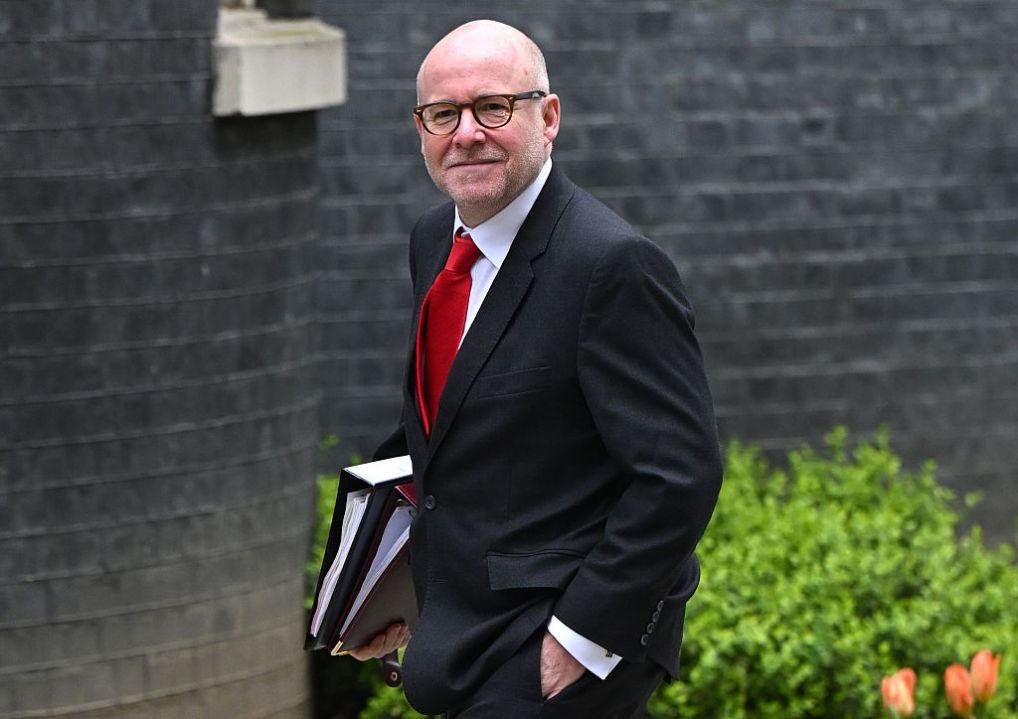
Lord Hermer, the Attorney General, has often been criticised during his two years in the role. For his decision to authorise Lucy Connolly’s prosecution, his angry denials that two-tier justice exists, his ‘fanatical devotion to international law’, being ‘dangerously wrong about the ECHR’, an apparent dislike for the British state and its soldiers, and for ludicrous hyperbole such as when he claimed that critics of the ECHR want migrants to drown. It’s been easy to picture him as a sinister figure, using domestic and international law to serve his politics rather than the interests of his people.
We are cursed with senior public officials who are not up to the task
But we have also been reminded this week that he is also, like much of our ruling class, a very silly and evidently incompetent man. For starters he published a bizarre video on his Instagram presenting ‘three reasons’ in favour of the ECHR –
Firstly, I believe that government protects people’s rights it doesn’t take them away from them. Secondly the rights in the ECHR are our rights, they’re fundamental rights, they’re your and our human rights. And thirdly. You know what, I think the world’s a better place when we come together with 45 other nations across the Europe (sic), united in our shared values[1].
It was an odd display. Presumably Hermer can think of more substantive arguments than this, so this performance must reflect what he thinks of the average voter. In any event, it was very unserious and did nothing for the dignity of Hermer’s person or his office.
Then on Friday we learned that the Attorney General has disgraced his office in a far more serious fashion. A judgment was published by the Court of Appeal, with Lady Carr of Walton-on-the Hill, the Lady Chief Justice of England and Wales, sitting alongside two other judges. It concerned the handling by the Crown Prosecution Service (CPS) and Attorney General of matters relating to the controversial case in which three teenage rapists were spared jail.
Immediately after the sentencing on 21st May, the CPS issued a formal written press release. Thanks to the court we now know that it contained ‘two material factual inaccuracies’ – ‘that the three boys had been convicted of “a knife-point rape” [and] that [the second victim] was “threatened with a knife and forced to leave her mobile phone and AirTag in a shop so that her movements could not be tracked”’. These were claims made by the second victim, but which were not accepted by the court. In sum, the court’s ‘factual findings’ did not correspond with those in the CPS press release.
It seems that the ‘draft press release was prepared…based on aspects of the prosecution case as advanced at trial’, but which were not accepted by the court. This draft was then ‘updated following sentencing to reflect the sentences but without amending the summary of facts’. Naturally, the press reported on the basis of the published press release.
What should have happened then is the CPS quickly issuing a new press release to correct the error. They did not. The case naturally attracted huge attention. On 26th May, the Attorney General submitted ‘three applications for permission to refer the sentences’ of the guilty boys. He published a video announcing he had done this. The court is clear that at this point Lord Hermer was ‘fully aware’ of the ‘factual findings’.
By 28th May, a barrister for one of the guilty boys emailed the CPS prosecution barrister saying:
The situation has got out of hand:
1. There is a Charge.Org petition calling for [the judge] to be investigated. It
already has over 100,000 signatures.
2. [A victim] has given an interview to the Times.
3. The press (even reputable publications) are routinely misstating the factual
basis for the sentence.
The CPS are in a unique situation to bring this to a stop. Please do all you can to
encourage them to release a statement.
[The judge] conducted this trial with utmost diligence and care, the personal
criticism of him is disgraceful. The failure of the national press (none of whom
attended the actual trial) to accurately report the basis of the sentence is causing
a significant reaction from politicians and the public at large…”
(As an aside, I would suggest that blaming the press for inaccurate reporting when we were relying on the information published by the CPS, in a situation where the judge’s sentencing remarks had not been published, is rather unreasonable)
In any event, the next day, counsel for another of the guilty boys emailed the Attorney General’s office, stating:
Dear Lord Hermer,
I wish to draw your attention to the following, which, I submit, should be met by
corrective statements by your office, or by the Moj:
1. There is a Charge.Org petition calling for [the judge] to be investigated. It
already has over 100,000 signatures. The Lord Chancellor is conspicuously silent
upon this concerning development, notwithstanding his constitutional duty to
protect the independence of the judiciary;
2. The press (even reputable publications) are routinely misstating the factual
basis for the sentence.
As HM’s Attorney General, you are in a unique position to correct misleading
press reporting.
The Attorney General did not reply. He told the court that he ‘was made aware of the contents of the email’ on the 3rd June. However, on the 29th of May, Lord Hermer did give an interview to Nick Robinson on Political Thinking, his podcast. He did not correct the reporting of the case. The judge’s sentencing remarks were not published until the 4th June. On 10th June, the CPS finally amended the press release, although it did not issue a new one, nor include a link to the sentencing remarks.
Understandably, the court has significant criticism for both Lord Hermer, and Stephen Parkinson, the Director of Public Prosecutions (DPP). It seems Parkinson has already apologised for ‘these serious failures’ to correct the record, which have been described as ‘egregious’ and ‘unacceptable’. The court is also unhappy with the ‘manner in which the corrections were eventually made’ – noting that the CPS should have done this ‘in a far more public way’.
As for the Attorney General? He was not ‘wise’ when he chose to ‘comment about’ the pending legal proceedings to review the guilty boys’ sentences. They are also concerned that on 26th and 29th May, Lord Hermer spoke publicly about the ‘gravity of the offending’ but did not correct inaccurate information which was being repeated, despite ‘emphasising that he had read the full details’.
The Attorney General’s explanation for this is that ‘he does not consider that it could be said that he was charged with, or failed to comply with, a duty to identify and therefore correct misinformation in the media in this case’ – not my job, guv, in other words.
The court did not find this argument convincing. While they accept that he is not under a ‘general duty to patrol the accuracy of press reporting’, in this case as he was a party to a case, and ‘chose to volunteer public comments on the gravity of the offending’, while professing ‘detailed knowledge of the facts’, the court reasonably concludes that Hermer had a duty to ‘ensure’ that what he ‘communicated [was] fair and accurate, correcting any widespread misreporting’ of which he was aware.
Throughout, Hermer’s defence seems to be that it wasn’t his job and he didn’t know. Reading the full judgment I am left with the very strong sense that this is an unserious man, unfit for the office he holds. If, as expected, Andy Burnham sacks him on Monday, then the new Prime Minister will have my praise for that at least. But serious questions also need to be asked of Parkinson, and his oversight of the CPS. We are, I’m afraid, cursed with senior public officials who are not up to the task. No wonder the nation struggles from crisis to crisis.






Comments