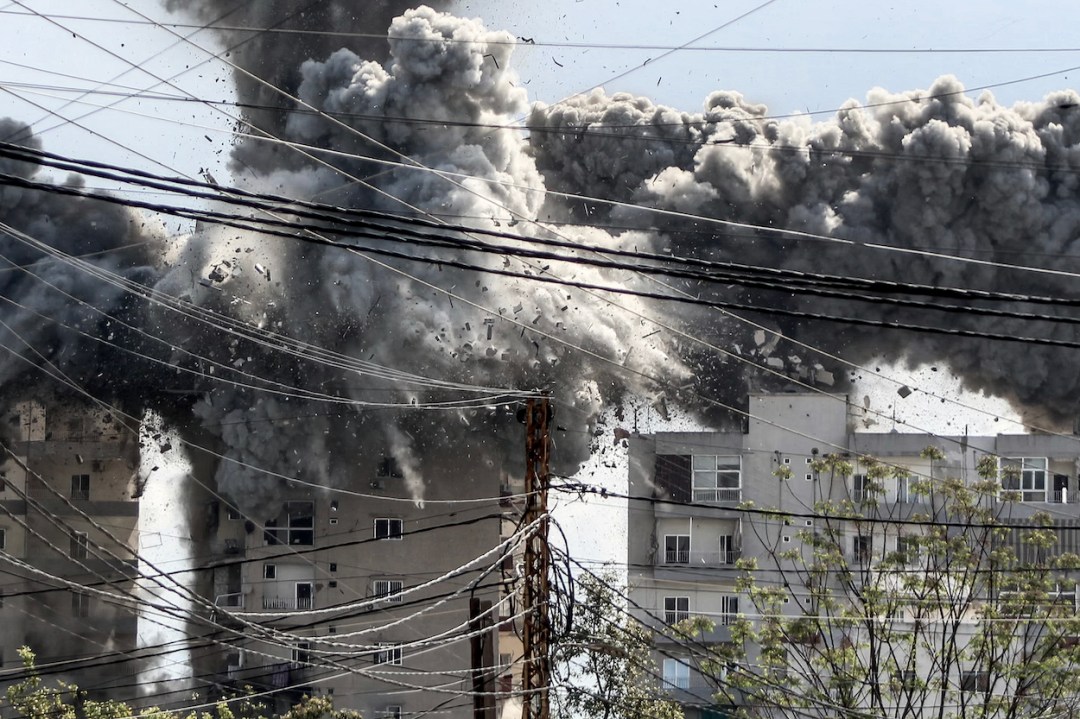
The current phase of the disaster rolling through the Middle East hinges on whether a ceasefire in Lebanon should be a prerequisite for a ceasefire in the Gulf and the reopening of the Strait of Hormuz. The foreign secretary, Yvette Cooper, has made it an explicit British government demand (more of a polite suggestion as countries without deployable armed forces can’t really make demands), that any ceasefire deal with Iran must include Lebanon to achieve an enduring peace. This is not to suggest that a separate deal with Lebanon is not desirable (talks are indeed in progress) but an overarching deal which includes Lebanon, would be an unmitigated strategic disaster. It would be unacceptable to the Israelis and bake unprecedented global turbulence. It, in effect, links the fate of the global economy to a country that has been critically destabilised since 1975.
Iran wants to include Lebanon in the ceasefire deal to protect Hezbollah. Hezbollah, the party of God (go big or go home when it comes to branding), was a creation of the Lebanese civil war of the 1980s, an effective state within a state, representing the Shia population of Lebanon, with its own armed forces, tax raising power, political representation and constitutional hierarchy. It has always been Iran’s proxy of choice in the Levant. Unlike Hamas, which Iran was prepared to use as essentially disposable berserkers on October 7th, or the southern Iraqi militias and the Houthis, where support has waxed and waned, Iran’s support for Hezbollah is steadfast. Indeed, rather as the Soviet’s deployed Cubans to Angola, the Iranians have used Hezbollah as agents of chaos throughout the region. British troops in Basra were exposed to death and mutilation by explosively formed projectiles (EFPs), flying shards of molten metal which ripped through armoured vehicles, developed by Hezbollah and then taught by their agents to the Shia militias in the city.
The Israeli response to having this state within a state on its northern border has been one of constant military confrontation. The phrase ‘mowing the lawn’ has been used a lot in recent weeks – it doesn’t really capture it. Operations since 1982 have included relentless airstrikes, multiple ground incursions, a full-scale war in 2006, and another conflict this year. In 2024, in a tactical masterstroke, Mossad detonated the pagers of the Lebanese high command, killing and maiming hundreds of Hezbollah’s people on a single day. While Hezbollah exists, it is hard to conceive of a settlement acceptable to the Israelis which prevents them taking military action against them – but that appears to be what is on the table, endorsed by our own government: by linking peace with Hezbollah with wider peace with Iran and the strait of Hormuz a peace deal would effectively give Hezbollah a strategic protection equivalent to the iron dome missile defence system which protects Israeli cities.
Throughout my career in foreign affairs, a certain type of earnest, left-leaning diplomat has often told me over a pint or two that if only we could fix the Israeli Palestinian conflict then peace would return to the Middle East – the grand bargain would resolve the lesser conflicts. The Middle East peace process, to paraphrase Voltaire on the Holy Roman Empire, has delivered precious little peace and, especially in recent years, not much of a process. The web of interlinking factions and forces in the region has created a Gordian knot of such complexity that trying to unpick the whole at once is diplomatically impossible, and sadly no Alexander option exists to slice it in two. Where progress has been made in the region it has been by separating the fields of conflict so progress could be made in specific areas. The Camp David accords between Egypt and Israel in 1979 were once of the most successful, isolating Syria from Egypt and essentially removing Egypt from being one of Israel’s primary antagonists till the present day. Likewise, the Abraham Accords, by focusing on a smaller deal between Israel and the Gulf states, were looking promising before Iran encouraged the October 7th massacre to deliberately derail them. The now abandoned JCPOA agreements, aimed at preventing Iran getting a nuclear weapon also started small and focused, excluding Iran’s support of militias from the deal.
The truth is there is no Middle East peace process or grand bargain to be had, there are only smaller deals. On every occasion linkage between different fields of contest, be they geographical or functional, leads to either stasis or escalation. By allowing dual linkage of Lebanon to the Gulf conflict and the Gulf conflict to the fate of the world economy we have effectively made the whole world Lebanese – the terms of this deal cannot be allowed to solidify or we are all damned. The reason is simple – every time the Israelis hit Hezbollah, which they must, to prevent it growing into a bigger threat, Iran will claim violation of the deal and close the Strait, choking the world economy; this is a total strategic and diplomatic disaster.

Comments