
Is it possible to avoid taking sides in the latest skirmish of the forever wars about the late Diana, Princess of Wales? I’d like to hope it is, though I appreciate it might be seen as a bit counter-journalistic to do so.
Suppose the King is a flawed man, but not a monster? Suppose Earl Spencer is also a flawed man, but not a monster?
Suppose the King is a flawed man, but not a monster? Suppose Earl Spencer is also a flawed man, but not a monster? And suppose what we are seeing is two hurt and damaged people revisiting a vicious row between them for the delectation of a public with no interest in the matter but prurience?
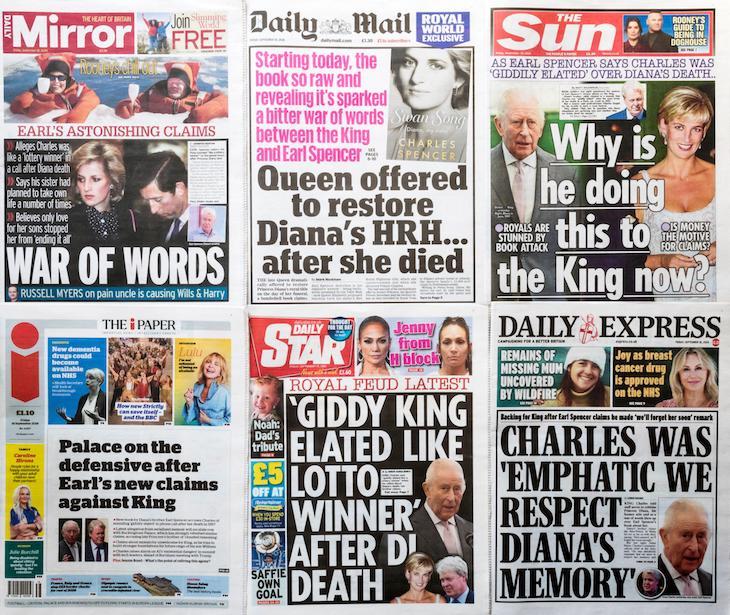
The new casus belli is a damaging allegation made in Charles Spencer’s new book about his sister: that in a phone call ahead of her funeral, the then Prince Charles told his brother-in-law: “Rest assured, we’ll forget her soon enough.” Earl Spencer has also claimed that in another phone call the prince was “giddily elated” and “like a lottery winner”.
Reasonable people, I think, will recognise that it is impossible for anybody to know exactly what was said, still less the tone of voice taken, in private phone calls between two men in a high state of emotion three decades ago. That very likely includes the two men themselves. Recollections really may vary.
The King, via his spin-doctors, has affected to take the high road – not quite calling his former brother-in-law a liar, but saying patronisingly: “While we do not comment on books as a matter of principle, His Majesty is mindful that the pain of fraternal grief can cloud reason, affect judgment and colour memory in ways others do not recognise, even many years after such a loss.” (Scholars of rhetoric will see this as a type-specimen of the figure called occultatio – pretending to be too high-minded to say something in the very course of saying it.)

Earl Spencer is right to say he’s being “gaslit”, and to note that the King does not directly deny his claim. Yet, of course, it is true that grief can cloud reason and play havoc with memory. If it’s true of Earl Spencer, it will also be true of Prince Charles. We could add that divorce, like grief, doesn’t always bring out the best in people. Nor does a squalid public row.
The backstairs briefings didn’t end there. The King’s licensed vipers have told the Sunday Times: ‘It is an irony lost on no one except perhaps the author that a man who once accused the media of hounding Diana to the grave has now peddled in the public bazaar what little remained of her privacy.’
And there’s the nub of it. Everyone is briefing the media while being outraged and horrified and, here and there, a bit sanctimonious about everyone else briefing the media. And that goes right back to where all this started, and to the lessons, or lack of them, that have been learned since.
The breakdown of the then Prince of Wales’s marriage, and the poisonous apparatus of leaks and counter-leaks, briefings and counter-briefings, that accompanied it, was what started it. And it seems to me to have marked a watershed in the history of the monarchy. It was the point at which – under the unbearable pressure generated by Diana’s mega-celebrity – the old “never respond to stories in the press” rule went by the board. I don’t say this to sit in judgment. It may well have been an impossible rule to sustain in the modern media environment. I say it only to note what happened.
But once it happened, the tiger was out of the cage. They were all at it. St James’s Palace had Mark Bolland; Camilla Parker-Bowles had Alan Kilkenny; Kensington Palace had, well, a spin-doctor whose name began with D.
I worked at the Daily Mail in the late 1990s and found myself drinking from time to time in company with their then royal correspondent Richard Kay. Whenever Richard’s phone would go, and he’d wince and scurry off into a corner with it clamped to his ear, the other hacks present would cheerfully chorus “It’s Diana!” in the hopes of embarrassing him.
They all fed the tiger, exactly as Charles Spencer is doing now and Buckingham Palace is doing in response. And all of them had, in their own minds, good reasons for doing it. They needed to set the record straight. They needed to get their side across. They needed to correct some monstrous injustice. They needed – as Lord Spencer has put it this time – “to tell the truth about Diana…to speak on Diana’s behalf”. Or, as the King’s people say this time round: “While there is usually dignity in silence, what hope of dignity could there be in days of such horrendous injustice going unchallenged?”
They were all victims of the press, which itself was following the market for royal gossip as it was always going to; and they all thought that the way to defend themselves against the behaviour of the press was…to brief the press. And thirty years on, the cycle repeats itself. This is one of those games where the only way to win is not to play.




Comments