
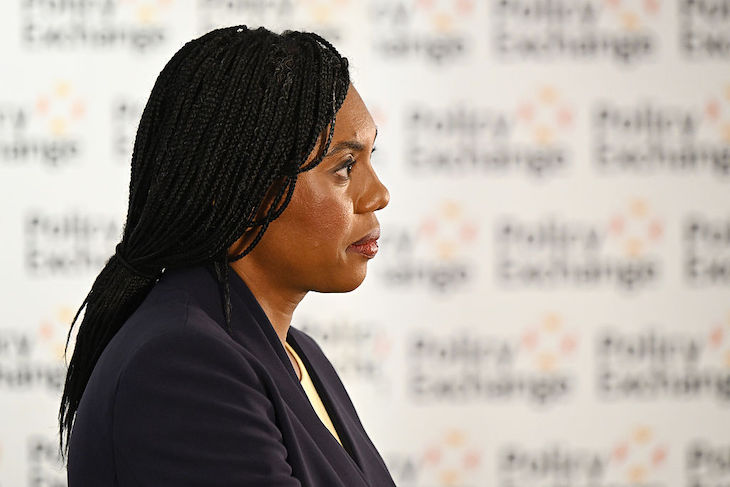
The higher the failings of multiculturalism pile up, the greater the effort required to ignore the fetid mound of societal consequences. But most of the political and commentary class is prepared to put in the shift. So Kemi Badenoch’s latest speech was a crisp break from the omerta that binds together our gutless establishment.
Multiculturalism is the enemy of multiracialism
Her words were not incendiary for the sake of it; this was a clinical, clear-sighted analysis of how a confluence of uncontrolled immigration, non-integration, state multiculturalism, and asymmetric tolerance turned Britain into a fractured, fearful, increasingly harder to govern nation.
Badenoch dismissed as ‘a fig leaf’ the idea that international law motivated Keir Starmer’s reluctance to give support to US-Israeli air strikes on Iran:
‘The real explanation is not legal. It is political. Across the UK, there are groups whose political loyalties, when it comes to conflicts in the Middle East, do not align with the British national interest.’
This sort of talk makes educated liberals queasy, so queasy that the mere attempt to start a conversation about ethnic and cultural separatism in the UK is deemed an act of bravery, even as it leads to no change in policy. A change is urgently needed – it was urgently needed several decades ago – and Badenoch rightly chided Labour for its long-running strategy of sectarian electioneering, though this is hardly a matter on which Tory hands are spotless.

Importantly, she put the outcome of the Gorton and Denton by-election in the proper context: it was not the result of ‘family voting’, but of there being a large number of voters in that constituency only too eager to vote along ethnic or religious lines or for sinister ideologies like anti-Zionism and Islamism. I made this very point on Coffee House last week.
The electorate in Gorton responded to ‘campaigning designed to mobilise voters on ethnicity and religion, not domestic priorities’, and cast their ballot based on ‘who will protect the interests of their identity groups and punish those they disagree with’. Badenoch rightly identified this as ‘not British’, but it is more than that: it sounds the death knell for Britain.
If ethnic and religious separatism is not stamped out, our future will be as a nation of strangers held together by a common fear of sectarian strife. Politics will cease to be about national priorities and become a contest between the competing priorities of rival nations in a Disunited Kingdom. Britain would be Lebanon with worse falafel.
Badenoch rightly identified the problem: ‘Britain has been complacent about our culture and too tolerant of those weaponising identity politics for their own gain.’ This she deemed the root cause of separatism and separatism, in turn, as the root cause of sectarianism. The distinction is crucial.
The Green campaign in Gorton and Denton did not invent sectarian electioneering; it has been with us for a long time, certainly long before there were any Muslims in great number in Britain. There are still people alive today who can remember the old Unionist Party, forerunner to the Scottish Conservatives, which until the mid-1960s was known colloquially as the ‘Protestants Vote Here Party’.
The difference is separatism. Over time mass immigration has created enclaves which effectively cease to be Britain and function instead as outposts of foreign countries and cultures. In some areas of the UK it is possible to pass through without encountering anything recognisably British bar the institutions and services of the state.
Badenoch’s speech was a crisp break from the omerta that binds together our gutless establishment
The denigration by the state, the media, and the education system of any aspect of British national life which cannot be credited to immigrants has created a civilisational vacuum and untrammelled immigration means it is being filled by other civilisations. The alternative Badenoch wants to see is ‘a Britain that feels recognisable wherever you are, not just a collection of tribes.’
Segments of the speech at the Policy Exchange think tank in Westminster on Monday fell into the familiar trap of framing separatism as harmful first and foremost to those within these ethnic groups who would rather live integrated, British lives. Without a doubt, Pakistani-heritage women who wish to dress as they please, marry whom they choose, and defy the precepts of Islam suffer from the rule of the biraderi.
But they are not its primary victims: that distinction belongs to the once coherent British culture which has been diluted and assailed; to the white British girls targeted by Pakistani-heritage rape gangs while traitors at various levels of authority facilitated and covered-up this racially-motivated predation; to British Jews whose loyalty to this country has been repaid with a government which prefers to make common cause with those disloyal to Britain, and two-tier policing by forces whose fidelity is not to the general public but to their favoured identity groups.
Multiculturalism is the enemy of multiracialism, inimical to a free and open society, and it should be fought on these grounds, but not only on these grounds. Liberals need to be prepared to fight for Britain, and not just prepared but driven. Trust me, if challenging multiculturalism troubles your liberalism, wait till you see how your liberalism fares in a Britain where multiculturalism goes unchallenged.
But what sort of challenge does Badenoch propose? British culture has to be ‘strong and self-confident’. Fair enough. Immigration has to be ‘at a pace and in numbers that can be easily absorbed’. Given the scale of immigration inflicted on the country, contrary to the democratic will, those numbers will have to be extremely low for the foreseeable future.
There are still questions more difficult than those Badenoch tackles
Her end goal is assimilation rather than integration, and she is right again here. Rather than ‘people living in tribes’, she wants ‘one society with shared norms under the same laws’. This is how it must be. If you want to live in Britain, you will do so according to our rules or you won’t do so at all.
Badenoch proposes a ‘muscular conservatism’, with a cultural and integration commission to prepare an integration and cohesion plan. This will include ditching racial preferences in hiring, promoting, admissions and procurement; forcing every public body to act on merit and aptitude; an end to two-tier policing and the teaching of multicultural ideology in schools; the protection of free expression, an overhaul of the Equality Act, and crackdowns on Islamism.
These are the beginnings of a decent plan, and while we’ve heard some of it before Badenoch deserves credit for going beyond rhetoric to outline concrete steps. No one else of any prominence is doing that right now. David Cameron made a few encouraging noises while in Number 10 but we have to go back to Tony Blair to find a political leader willing to speak bluntly about the failings of multiculturalism.
The UK is home to many races and ethnicities, but there is room for only one culture
Yet there are still questions more difficult than those Badenoch tackles. For one, what to do about the rapid, large-scale demographic transformation that means that some of our citizens not only do not share the British culture Badenoch wants to promote, but recognise it as a threat to their way of life? They have the vote, too, as they have just demonstrated with some flair, and they will use it to maintain the multicultural doctrine that serves them. As they grow in demographic strength, they will enjoy evermore political power with which to frustrate ‘muscular conservatism’. When Badenoch says, ‘Newcomers should join our country, not try to change it,’ the follow-up question should he: and what if they insist on changing it all the same?
That is a case for maintaining very low levels of immigration but also for reconsidering the criteria for acquiring citizenship, accessing public services, and availing yourself of the welfare state. It is grounds to consider how a future government might enforce assimilation by creating a hostile environment for separatists, sectarians and extremists while embracing and protecting the many patriotic Brits from minority backgrounds who see no contradiction between loyalty to their country and respect for their beliefs and traditions. The Britain they inhabit works because it is one in which most Britons already share, regardless of race, ethnicity, or creed. It is this Britain which multiculturalism and separatism threaten, and this Britain which will be central to defeating those noxious doctrines.
The UK is home to many races and ethnicities, but there is room for only one culture.






Comments