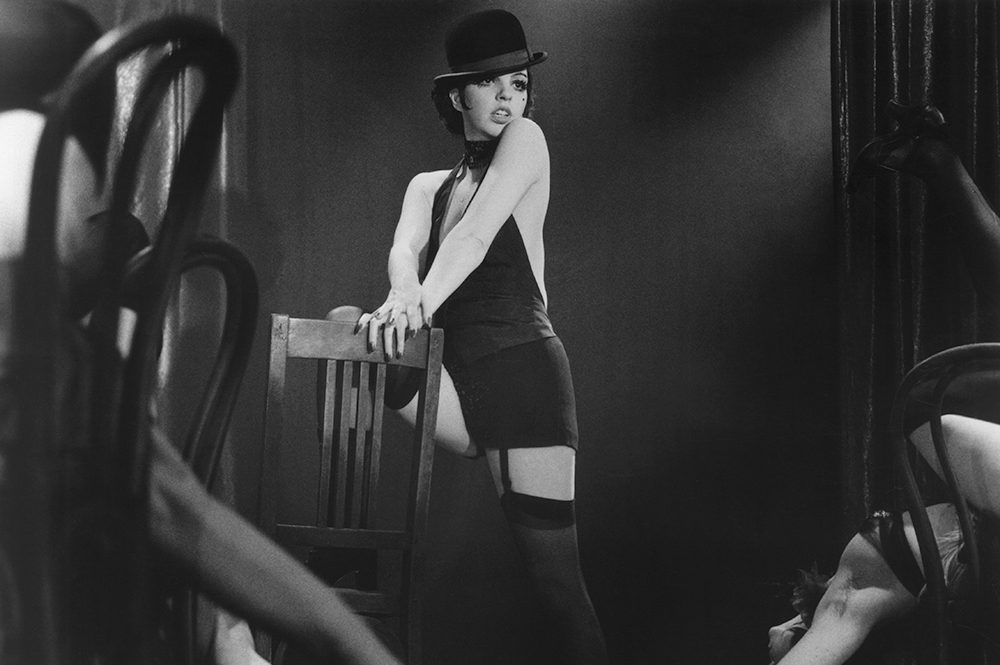

Though she may well have been “one of the world’s most celebrated, beloved and iconic performers,” who’d have wanted Judy Garland as a mother? When not remaining in bed “for days at a time, heavily drugged and in a deep state of depression,” she was, according to her daughter Liza Minnelli, slashing her neck with a razor blade because “she loved playing the victim… Hospitals are a way of life for her.” Judy died of a (possibly accidental) drugs overdose in 1969, aged 47. At the Frank E. Campbell Funeral Chapel on the Upper East Side, her corpse was prepared for public view by the very same make-up expert who’d worked years previously on The Wizard of Oz. Twenty thousand people filed past the open coffin – more than had come to gawp at Valentino.
Her daughter writes: “At 13, I was my mother’s caretaker, nurse, doctor, pharmacologist and psychiatrist rolled into one.” From the beginning, everything was outlandish. Liza never played with ordinary children, only the kids of Humphrey Bogart and Lauren Bacall and of Fred Astaire. One of their Hollywood neighbors was Lana Turner, whose daughter fatally stabbed Lana’s abusive mafioso lover. Down the street, Bing Crosby’s wife drank herself to death and two of his children committed suicide.
With her father Vincente Minnelli’s encouragement – he’d directed Meet Me in St. Louis – Liza started to perform in Off-Broadway shows with Marvin Hamlisch, even as Judy “tried everything in her power to stop me.” Far from being the dumpy waif of legend, unsteady on her pins and forgetting the lyrics, Judy, as described here, was a complete monster, beady-eyed, jealous and manipulative. As Liza, the recipient of several Tonys for musicals, mentions dryly, Judy always wanted to play the lead in a Broadway show. She never did.
Liza is the first to admit she was never an easy guest as ‘pills, drugs and alcohol turned me into a wreck’
When mother and daughter appeared together at the Palladium, Judy wasn’t happy about the applause Liza received, so she was to be seen freshening her lipstick “like she was putting on armor and getting ready for battle… I was invading her sacred space.” When Judy later threw a lavish first-night party for her daughter at the Waldorf Astoria, Judy sent her the entire bill afterward.
Reading Kids, Wait Till You Hear This!, which is wholly admirable for its brash candor, it is clear that Judy didn’t only have a competitor or a show business rival in Liza: she had a double. When Liza writes about Judy’s problems with booze and pills (“You might kick the habit, but it’s always there, lying in wait if you slip up”), these prefigure her own destructive issues, stints in rehab, where she was ferried back and forth in Frank Sinatra’s Lear jet, and sheer bad luck. Particularly nasty, for Liza, have been the long-term consequences of her addictions – neurological ailments, encephalitis and seizures, along with polyps on her vocal cords, hip and knee replacements, stomach ulcers, a hiatus hernia and “surgery to repair crushed discs in my lower back after my two dogs jumped on me.” Despite Liza’s non-stop throbs, stabs and aches, the press was told her only problem was a bad reaction to a mosquito bite.
Like her mother, Liza also kept marrying men who were not exactly, so to speak, pro-vagina. “I didn’t overthink the sexual orientation of someone I loved,” is how she justifies herself. One such husband was the Australian musician Peter Allen, who died of AIDS in 1992. “Returning from an indulgent shopping spree, I walked into our apartment and found Peter having passionate sex. With a man. In our bed.” Other spouses included Jack Haley Jr. (“I was Dorothy’s daughter and he was the Tin Man’s son”), a relationship which soon fizzled even though Sammy Davis Jr. was best man and Elizabeth Taylor matron of honor. Then there was some vague figure named Mark. Liza “grew impatient with his complaints that I didn’t do enough to help his career as a sculptor.”
The chapter on the “pasty-faced jerk” David Gest is very funny. He was “a freak with a mean streak a mile long,” who charged everything to do with their $3.2 million wedding to Liza’s American Express card. There were 850 invitees, and this time Michael Jackson was best man – though Elizabeth Taylor was, again, matron of honor. Afterward, the cash-strapped Gest sold all their wedding presents and prized possessions, including Liza’s bowler hat from Cabaret.
People Liza managed not to marry included Desi Arnaz Jr., Lucille Ball’s teenage son, and the dangerously mad Peter Sellers: “It always seemed like he was about to get violent.” With Liza in tow, Sellers dressed up as Hitler to visit Joan Collins. “He would scold me, taunt me, bully me in the voices of his many different characters.” Sellers moved into the Savoy with her and they didn’t emerge for a week. Liza doesn’t mention this, but Sellers thereby wrecked the schedule and budget of the forgotten 1970s sex-and-war comedy Soft Beds, Hard Battles, bankrupting Roy Boulting.
Another romantic dud was Martin Scorsese, “a heavier and heavier user of cocaine,” who directed Liza in the musical New York, New York, which lost money at the box office. Perhaps he regretted the experience of both film and relationship: when Liza recently approached Scorsese in a friendly way at an industry function, he turned his back on her.

Evidently, like her mother, Liza has not been good at organizing her private life. She has fallen victim to “lousy hangers-on and crooks who tried to take me for every last dime… I felt betrayed, humiliated, ripped off and wounded.” Every few hours, it seems, there were loud arguments, impending lawsuits, vicious threats and the fear that, like her mother, who lost all her money on medical bills, household staff and nights on the town, Liza will be thrown out of hotels for non-payment of bills. There have been accusations of unreliability, and Liza is the first to admit she was never an easy houseguest, as “pills, drugs and alcohol turned me into a wreck.”
Yet all this cracked energy and electric-blue chaos is rather reflected (or embodied) in Liza’s performance style. “Tone it down. Do half of what you’re doing,” her co-star Albert Finney advised her on the set of Charlie Bubbles. But the excitable, gabbling showgirl personality – speaking too fast, the river of shouts and murmurs, and nervous fidgets – is what becomes attractive (and dangerous) on screen and stage, and is why she has “touched literally millions of lives in resonant, meaningful and personal ways,” according to a preface by Michael Feinstein, the book’s ghost.
Liza received the Best Actress Oscar for Cabaret. (Judy never won one: though nominated for A Star is Born she lost to the more wholesome Grace Kelly.) Her Sally Bowles, the vampish singer, hardly notices the looming Nazi horror, she is so wrapped up in herself. Liza never equaled or surpassed this achievement. It is an enduring classic (and politically pertinent), with the cast’s white-gloved hands flipping up and down, the cross-cuts, zoom shots and helter-skelter images, all masterminded by Joel Grey’s satanic MC. Very Weimar.
Liza would like to have played Evita, but “I waited for the phone to ring. It didn’t ring.” She didn’t get along with Gene Hackman, who was “downright rude” on a film called Lucky Lady (“I lost box-office cachet in the process,” she sniffs), and as for Arthur, with Dudley Moore, making alcoholism a comic stunt doesn’t seem clever or hilarious today. If Mia Farrow, Diane Keaton, Jessica Lange, Gilda Radner, Susan Sarandon and Meryl Streep turned down Liza’s role, maybe they sensed it wasn’t clever or hilarious in 1981, either.
Instead, Liza’s real fame has come from her television spectaculars (the Emmy award-winning Liza With a “Z”, choreographed by Bob Fosse, has recently been remastered) and concerts, where, the sweat flying off her black hair, she belts out Kander and Ebb and all the classics. Over the decades, Liza has generated “enough energy to light up Manhattan with my very first number” in most of the iconic spots in the United States and beyond. She went on a world tour with Sinatra (“sometimes gracious; sometimes furious”), another temperamental little chap in a wig whose “moods changed from minute to minute.” Like her mother, Liza needs live audiences to cajole and dominate, enticing them to sob or cheer on command.
Feinstein wishes to present Liza as a saintly figure, who “sees common humanity and knows how to say the right thing to make people feel better.” If that suggests Princess Diana, then Princess Diana, who apparently kept a photo of Liza on the mantelpiece in Kensington Palace, duly makes an appearance. “We’d catch up on our lives and meet for tea,” says Liza, who, unsurprisingly, also taught Jackson to moonwalk and met John Paul II. (His holiness assumed, given her surname, he could speak to her in Italian.)
This is a glorious and durable account of appalling Hollywood sentimentality and incongruity, which, on the whole, Liza has had the wit and courage to see through and confront. Now 80 and living off the proceeds of the sale of her memorabilia, which include crates of artwork by Andy Warhol and recordings, videos and vintage clothes, Liza has been on the receiving end of much cruelty, status anxiety, phoniness and deadly self-interest. “There were days when I managed to be in control. There were more days when I wasn’t,” she confesses. No wonder.




Comments