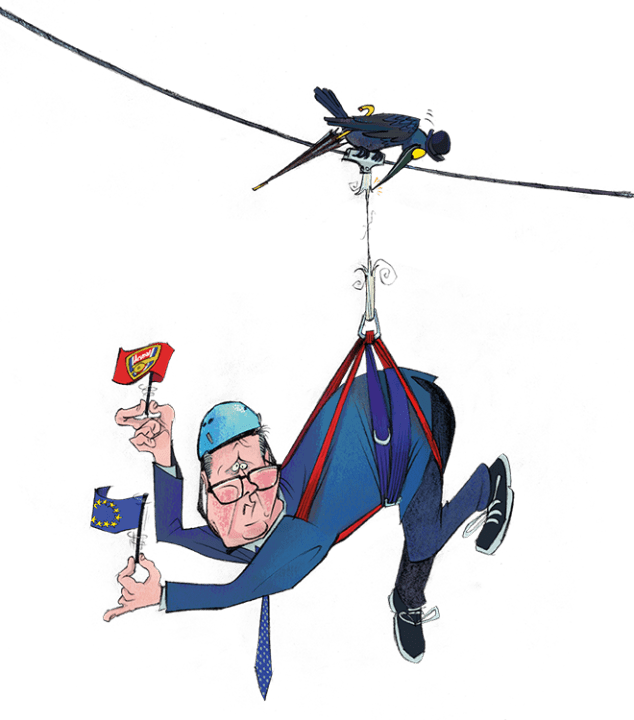


Somewhere in the vast array of documents the Cabinet Office has gathered on the appointment of Peter Mandelson as the UK’s ambassador in Washington, there is a text message which Keir Starmer sent the night before he made the announcement. ‘You’ll be brilliant in challenging circumstances,’ he told Mandelson. ‘And after many years of our discussions, we get to work together side by side. I really look forward to that.’
The message was leaked after one of Starmer’s most difficult weeks in charge, a week which senior civil servants believe proves, once and for all, that the Prime Minister himself will never be brilliant in challenging circumstances. His ‘vindictive’ decision to sack Sir Oliver Robbins, the permanent secretary at the Foreign Office, over the handling of Mandelson’s vetting may have terminally damaged the relationship between ministers and the senior civil service.
Those familiar with the cache of documents being prepared fear the most embarrassing will never see the light of day, like the one in which Darren Jones, the chief secretary to the Prime Minister, sent Mandelson what is described as a ‘warm’ missive on the day he was sacked.
‘I hope this will finally kill the absurd “Keir Starmer is a decent man” narrative. He’s a shitweasel’
Starmer is the only former permanent secretary (a post he held as director of public prosecutions) to go on to be prime minister, but his apparent incomprehension of the very process he advocates has led officials to conclude he is no better than the predecessor he most deplores – Boris Johnson.
A former official says: ‘Senior leaders who have been there under several prime ministers say it is worse than it was, even under the worst of Boris. People are furious at how the Prime Minister has treated Olly.’
Another Westminster veteran says: ‘I hope this will finally kill the absurd “Keir Starmer is a decent man” narrative. He’s a shitweasel whose sole political talent is blaming others for his own failings.’
In 22 months, the PM is now on his third chief of staff, third cabinet secretary and fifth director of communications. ‘The body count outstrips anyone since Thatcher,’ a former official notes. ‘Boris talked a lot about firing people but he was all mouth and no trousers.’ Even Morgan McSweeney, Starmer’s former chief of staff, who carried the can for the appointment, told a friend recently: ‘I always knew Keir would throw me overboard in the end.’

The irony is that Starmer did not initially back Mandelson. He wanted George Osborne, the former Tory chancellor. The Propriety and Ethics Team (PET) in the Cabinet Office were asked to do due diligence on the candidates. ‘At that point Osborne was his preferred candidate,’ an official says. ‘He had no intention of picking Mandelson until Morgan [McSweeney] made that happen. In his darkest moments the PM must be sitting going: “How am I in this mess over somebody I didn’t even want?”’
PET’s due diligence raised the issue of Mandelson’s closeness to the convicted paedophile Jeffrey Epstein. Starmer and McSweeney swept aside these concerns. Simon Case, then the cabinet secretary, said that Mandelson should not be appointed until he had been formally vetted. This was ignored too. Then the Cabinet Office said there was no need for vetting at all, a decision Philip Barton, the permanent secretary at the Foreign Office before Robbins, fought against tooth and nail, while Starmer’s private office put him under colossal pressure.
McSweeney has denied phoning Barton and demanding: ‘Just fucking approve him.’ But friends of McSweeney do not deny that he was encouraging the Foreign Office to ‘get on with it’. It is understood that the row contributed to Barton’s decision to leave his position in January last year. (Payoff: £260,000.) ‘Philip had had enough,’ a former colleague says. Though it is also true that Labour wanted Barton out ‘because he went on holiday during the fall of Kabul’.
Enter Robbins, who had made the final four to succeed Case as cabinet secretary, a job that went to Chris Wormald. Robbins was hired to sort out the Foreign Office while the vetting was still under way. He enthusiastically culled staff to save money. Multiple sources say the understanding was that Robbins had been promised that the job was not his last. ‘He was effectively told he could still be cabinet secretary if he blew up the FCDO,’ a Labour veteran says.
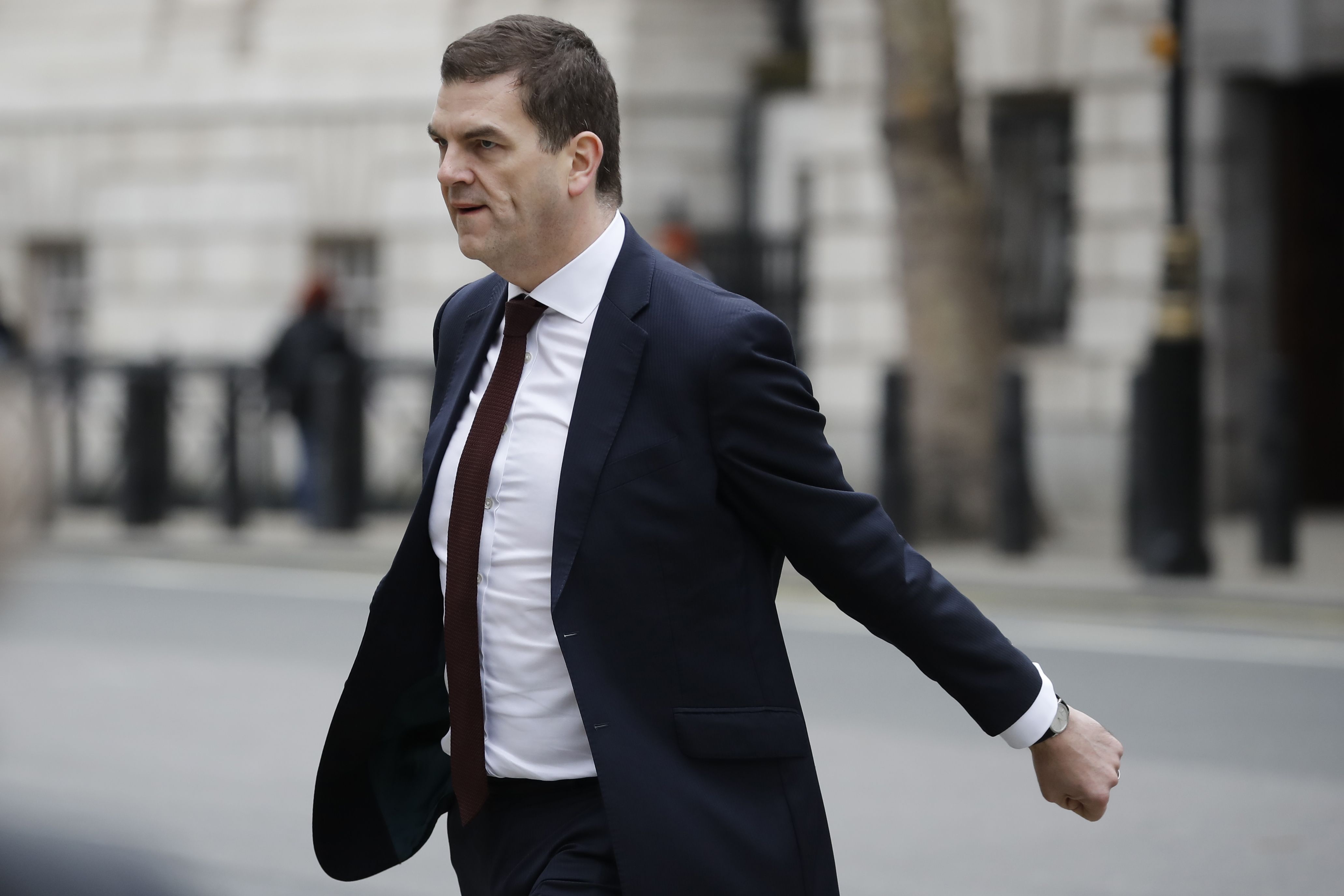
Robbins believed he was delivering what the Prime Minister wanted, just as he had delivered a clever but unpopular Brexit deal for Theresa May. That was also the case when Ian Collard, the head of security at the Foreign Office, presented him with the conclusions of UK Security Vetting (UKSV).
Downing Street says Mandelson failed and his clearance was denied. Robbins told MPs they don’t understand the procedure in departments like the Foreign Office and Ministry of Defence, where UKSV’s view is only a recommendation. Mandelson’s was a ‘borderline’ case in which the vetters were ‘leaning against’, which led to mitigations suggested by Collard and approved by Robbins. This meant he was granted DV (developed vetting) clearance. Robbins never even saw the UKSV report – he only heard Collard’s account of it.
None of the mitigations was about Mandelson’s connection to Epstein. They all related to his former business interests in China and Russia. A source says: ‘The DV revealed commercial red flags, not red cards, which required decisive mitigation because Mandelson was booked to fly to Washington the following week. It used to be sex that securocrats were worried about, now it is business. It reflected the ingrained Whitehall view that anyone who has been in the private sector is somehow contaminated.’
Starmer’s team – and some civil servants – think it very odd that Robbins did not then tell either Starmer or Wormald that Mandelson had only passed with mitigations. ‘I was genuinely amazed that Olly didn’t speak to anyone else about it,’ a serving civil servant says, ‘from a self-preservation point of view.’ This is the view in No. 10, because Starmer was making public comments that Mandelson had passed vetting. As far as Robbins was concerned, he had. But a civil servant admits: ‘I don’t think we served the PM very well. I think we did a bad job.’
James Lyons, Starmer’s former director of communications, said of Robbins on Tuesday: ‘He considered the information so secret that he didn’t even tell himself.’
This was in character for Robbins, who conducted the Brexit process with pathological secrecy. He did not tell Wormald, in part because ‘Olly’s relationship with Chris Wormald had completely broken down by that point,’ a Whitehall source says.
These personal dynamics matter. Even when Robbins was at the private intelligence firm Hakluyt, he was advising Sue Gray, Starmer’s first chief of staff, according to Labour sources. ‘He provided a lot of free help to her in thinking about structure of centre of government,’ a source close to Gray says. ‘As a result he went into selection process for Cab. Sec. as Sue Gray’s friend, therefore suspect in the eyes of Starmer and McSweeney. That meant that when he was appointed to the Foreign Office, he would have been especially nervous about blocking an appointment that Starmer had already announced and McSweeney had engineered.’
Robbins can expect a big payoff. ‘We’re looking at half a million quid minimum to make this go away’
While there is criticism of Robbins, Starmer’s behaviour in sacking him before he had the facts last Thursday has unleashed a tidal wave of fury. A serving senior official called it ‘an intemperate decision’. A former mandarin said Starmer’s decision to attack Robbins by name at the despatch box on Monday was ‘a disgraceful plan to demolish a public servant’.
Starmer realises he went too far, because on Tuesday No. 10 briefed that the PM told cabinet that Robbins was an ‘honourable and dedicated’ public servant who had made an ‘error of judgment’. The same retired official says: ‘Having machine-gunned his legs and his arms off, that was like handing him a plaster.’
It will be a costly mistake. The ‘payoff to beat’ is the £370,000 paid to Philip Rutnam when he was forced out of the Home Office in 2020. But it is understood that Wormald’s compensation (not yet revealed) was double or more than that (‘It will make your eyes bleed,’ says a source), and Robbins can expect even more. ‘We’re looking at half a million quid minimum to make this go away,’ says one serving official. Others think double that. ‘Olly was earning a million a year in the private sector,’ a friend of Robbins says. ‘He is a younger man, his loss of future earnings is higher and the price for the reputational damage is huge.’
Robbins’s supporters say he only really wants to serve in government. He told one friend: ‘I was an OK banker, but I was a brilliant civil servant.’ A former colleague predicts: ‘I think Olly will get his job back when we get a new prime minister.’
A week ago no one would have entered Robbins in a civil service popularity contest. At the Foreign Office he was engaged in a mass cull of senior officials, many of whom had been employed in the old international development department, which was folded into the FCDO in 2020. ‘He was in a tearing hurry,’ says a Foreign Office source. ‘He approached it like Gordon Gekko – if you disagreed with him, you could go hang. People actively sought postings abroad to get as far away as possible.’
But on Tuesday, Robbins put aside what one colleague called his ‘resting smug face’ and delivered the most consequential performance at a select committee since Dominic Cummings in 2021. ‘His performance is being very quietly but widely cheered across the civil service,’ a former colleague says.
He even managed to drop the bombshell that No. 10 also explored the possibility of giving an ambassadorship to Matthew Doyle, Starmer’s first communications director – and banned Robbins from discussing it with David Lammy, the then foreign secretary. Doyle has now been stripped of the Labour whip for his associations with the convicted paedophile Sean Morton. Labour aides deplore the fact that no one at No. 10 seems to have spotted that this was a bad idea.
Insiders say the collapse of confidence of the civil service in the government goes back to when Starmer, in his first months, denounced civil servants wallowing in ‘a tepid bath of managed decline’. One said: ‘It was straight from the Boris playbook. Beat people up then try to tell them to reform.’
From the start there was disappointment. ‘Civil servants were optimistic about Labour,’ a former official says. ‘They were sick of the chaos. But quite quickly it was clear the government had no idea what it was doing.’ Even a Labour politico agrees: ‘The biggest problem is that Starmer didn’t know what he wanted civil servants to deliver.’
Officials did not conceal their disdain. One political aide says: ‘Some in the higher echelons of the foreign office regard themselves as Jeeves to the government of the day’s Wooster. And there are civil servants at all levels who make it clear you are just passing through. You can see it in their eyes. They’re like the Taliban: “You have the democratic mandate, but we have time.”’
The view of Starmer is astonishingly negative. ‘He can’t get the basics right of governing,’ says a former mandarin. ‘The senior leadership of the civil service are particularly acute at observing how well power is being wielded. They might not like it, but they’ll respect power being wielded. What you have is a prime minister who can’t set political direction. He can’t take his party with him and use his majority. And he won’t take difficult decisions. This guy delegates to a fault. He is becoming very well-known in Whitehall as the man who wants to avoid taking responsibility for decisions. He’s the man with invisible fingerprints.’
The source explains that officials began to think: ‘We’ve seen this movie before. Let’s just tread water until we’ve actually got a prime minister again who can lead his party.’ Those in charge of rebuilding this relationship are a mixed bag. Cat Little, the permanent secretary at the Cabinet Office, is under fire for taking more than a week to inform Starmer about Mandelson’s vetting. ‘I wouldn’t use her to prop open a door,’ says one ex-colleague, ‘unless I definitely wanted the door to shut.’ (Her aides say she has a ‘brilliant record’.)
Antonia Romeo, the new cabinet secretary, is far more able. She turned up at an away day for permanent secretaries on Friday, just hours after Robbins was sacked, and ‘her efforts to boost morale were appreciated’. But some officials don’t think Romeo can be radical enough: ‘We, the civil service machine, are in danger of sleepwalking into a position where in 2030 you’ll have a government who will think the only way to fix this is to replace the top 200 with political appointees, which I think would be a mistake. I don’t think Antonio’s approach of doubling down on being brilliant at delivery has time to work.’
Starmer and Romeo first need a new Foreign Office permanent secretary, since Nick Dyer, the interim boss, is ‘a sandal-wearing, let’s-sing-kumbaya, development guy’. A source says: ‘You want him doing all-staff meetings when everyone’s very upset about Palestine. You don’t want him swinging the axe and whipping the Foreign Office into the 21st century.’
‘People who’ve been around for a long time see that Starmer is guilty of exactly the same behaviour as Boris’
Names in the frame include Menna Rawlings, Deborah Bronnert – a serial failed candidate for permanent secretary posts – and Karen Pierce, whom Starmer ousted as the UK’s ambassador to the US. Romeo is said to favour Matthew Rycroft, to whom she has long been close, but one insider says: ‘I think that is something that would lead Simon McDonald back to the nearest microphone,’ a reference to the former Foreign Office mandarin who seems to regard it as his public duty to police such appointments.
Some smart money is on ‘Beijing Barbara’ Woodward, the former ambassador to China who missed out on running MI6 because of her warmth towards Xi Jinping’s regime. However, she is now deputy national security adviser and widely expected to replace her boss, Jonathan Powell, later this year. ‘Jonathan put her in place so he can leave,’ a former mandarin says. ‘His departure will be pretty devastating for whatever effectiveness there is left at the centre.’
A former Labour cabinet minister says: ‘The public are allergic to Starmer and the party cannot stand him. He has no friend in politics apart from [the attorney general Richard] Hermer. He trusts no one. He has not a single real supporter in the cabinet. The civil service loathes him and the military are contemptuous. The media have seen right through him. Starmer is now thoroughly paranoid. He is terrified of the Rayner-Burnham threat to him. But Labour MPs cannot yet gather round an alternative.’
Officials believe the Robbins sacking isn’t just a political and personnel crisis – many believe it may be the moment the Starmer project forfeited the consent of the machinery of state.
One former civil servant says: ‘Cabinet ministers are in a nightmare position because they have a truculent and very surly workforce which was already worn out.’
Another, who served several prime ministers, says Labour MPs must wake up. ‘They don’t understand, because they’ve only been around for five minutes, that the people who’ve been around for a very long time look at Starmer and see that he is guilty of exactly the same behaviour as Boris Johnson. Things are worse in Downing Street than during the worst of Boris. The only people who can save the country now are Labour MPs.’





Comments