
The science writer Jared Diamond once called agriculture “the worst mistake in the history of the human race.” Yuval Noah Harari, author of Sapiens, dubbed it “history’s biggest fraud.” Yet newly identified plague outbreaks among ancient hunter-gatherers in southeast Siberia question whether they were right to be so negative about the introduction of farming.
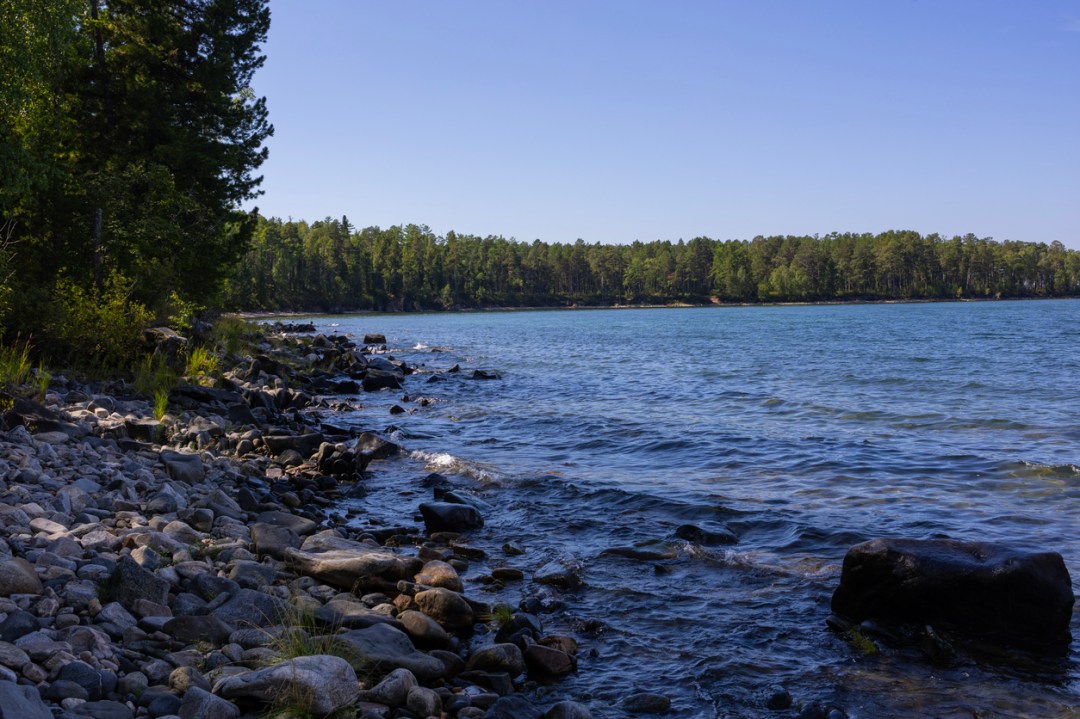
A new study published in Nature looks at archaeological sites on the west side of Lake Baikal. The lake is the world’s largest freshwater body, arcing for 400 miles between forested snow-covered mountains. Winter temperatures can drop below -22F, with parts of the lake surface frozen for half the year. Hunters and gatherers and nomadic herders occupied this challenging environment for millennia.
Because remains there are well preserved and its prehistoric people had a habit of burying their dead in cemeteries, archaeologists have been drawn to the area since the 19th century. A major modern field project began in the 1990s, using funerary practices and artifacts to define a succession of cultural traditions. The present focus is on people who lived by fishing and hunting game in the valley of the Angara river, the only watercourse draining the lake.
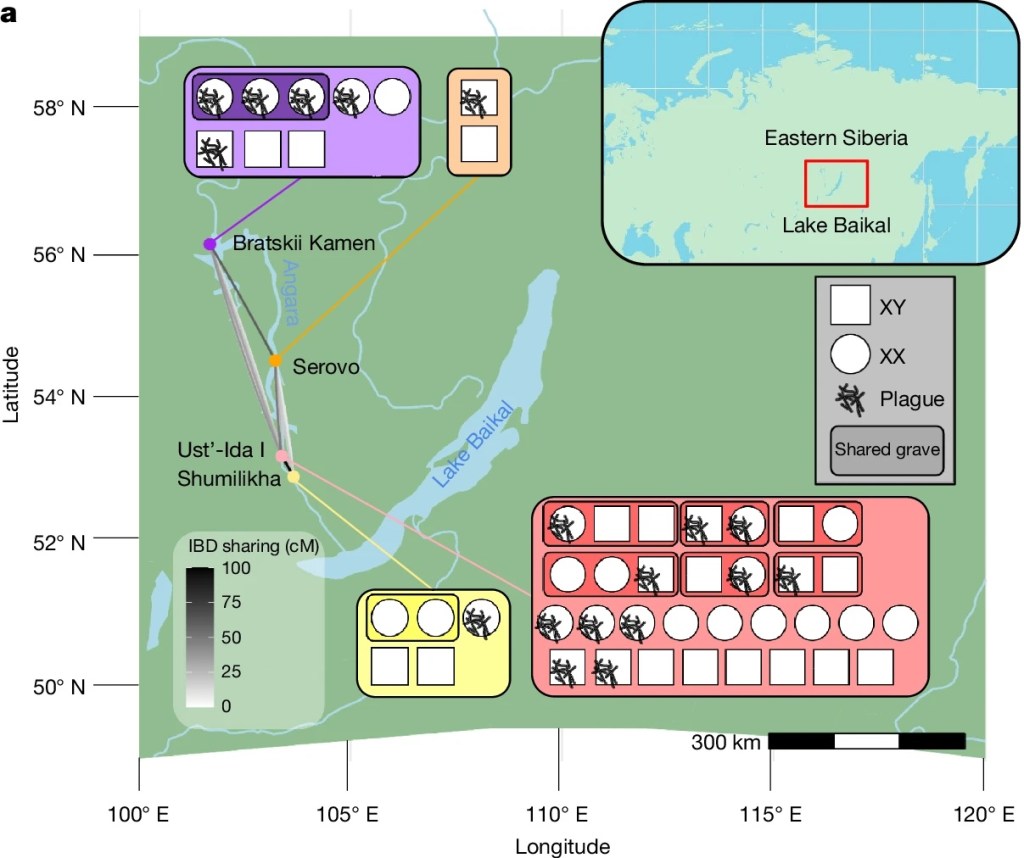
Genetic analysis of remains from four cemeteries there have identified early strains of Yersinia pestis, the plague bacterium. Two of the cemeteries date from around 5,400 years ago, where graves lie parallel to the river, and the other two 5,000 years ago, with graves perpendicular to the river. In both cases radiocarbon dating allows for the possibility of single, brief outbreaks of plague.
This is particularly clear at a site named Ust’-Ida I. Here, say the scientists, there was likely a “catastrophic mortality event” that disproportionately hit children. A network of family members affected by the disease, identified from their own DNA, confirms that the community was rapidly overcome by plague. In one case, a nephew and aunt buried together both carried Y. pestis.
At Bratskii Kamen, another site 23 miles downriver, three closely related young girls, all infected with the plague, share a grave. Overall, scientists detected the plague in 39 percent of the remains they examined across the four cemeteries. This compares to a lower rate of 20 percent found in an actual medieval plague pit in Smithfield, London.
It’s thought that marmots, ground squirrels the size of a small dog hunted for their fur and meat, were the source of the two ancient plagues. That so many relatives succumbed to the disease suggests that once it passed to humans, it spread rapidly by person-to-person transmission.
But beyond two forgotten tragedies some 5,000 years ago, why do archaeologists think these events raise wider issues?
Writers such as Diamond and Harari built their hostile view of the agricultural revolution on scientific studies conducted in the 1980s. These found that when people first started farming, in the Middle East or the Americas, for example, they appeared to suffer increased nutritional deficiencies and infectious diseases.
Partly reacting against the old Neolithic Revolution theory, which proposed that once farming was invented it bounteously made everything we think of as civilization possible, researchers expanded the list of agriculture’s alleged evils. To grow and maintain crops, it was said, people had to settle down in one place. Living together in permanent communities created new problems of hygiene and disease transmission. Not having to be on the move all the time meant farmers could build up possessions. Inequalities, privileged elites and wars followed. Farming was a great mistake. A fraud.
The idea has taken hold in popular culture. Joe Rogan, an American podcaster whose interview with Donald Trump has been viewed over 60 million times, promotes a modern lifestyle based on hunter-gatherers. They ate better than us, it is said. They exercised more than we do, were cooperative and egalitarian, and enjoyed stress-free lives. This was our inheritance – until farming came along.
The fundamental problem with all this is evidence. Or, in the case of ancient hunter-gatherers, the lack of it. Partly because of their sheer antiquity, they left barely any visible footprints for archaeologists to study. The Diamond-Harari-Rogan model relies on anthropological records of a handful of recent hunting communities, almost all of which occupied marginal land which was inhospitable to farmers. It is unlikely that agriculture would have massively benefited these communities – there were simply not enough resources.
One other case study contradicts the idea that all hunter-gatherers lived in a prelapsarian society, free from inequality and property-owning aristocracies. In the 19th century, hunter-gatherer societies thrived on the Canadian/US northwest Pacific coast. They exploited salmon runs and other wild foods, in villages with massive houses under a hierarchy of power built on accumulating wealth – wars were fought to capture slaves. Ah, say the hunter-gatherer lovers: this is the exception that proves the rule. Perhaps.
But the difficulty is, before farming the world was awash with wild riches. As David Graeber and David Wengrow argue in their recent book, The Dawn of Everything, until they were pushed out by farmers, hunters would have had many opportunities to choose to settle down, accumulate wealth and – in some cases – enslave others.
And sometimes, as we can now see, their lifestyle left them every bit as vulnerable as farmers to the worst diseases. Why almost all of them took to farming, is a hugely debated question for another column.






Comments