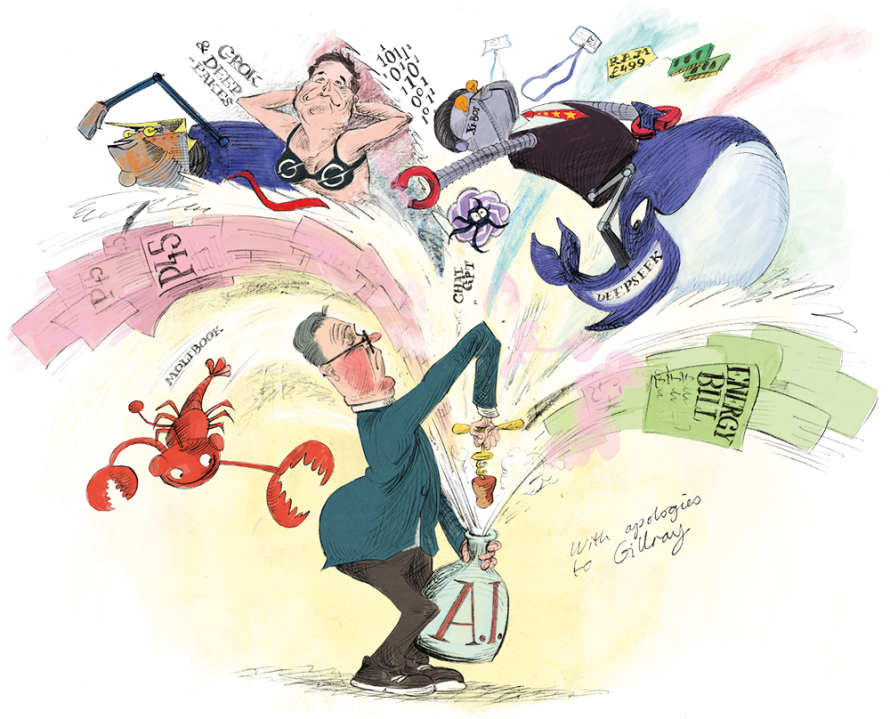


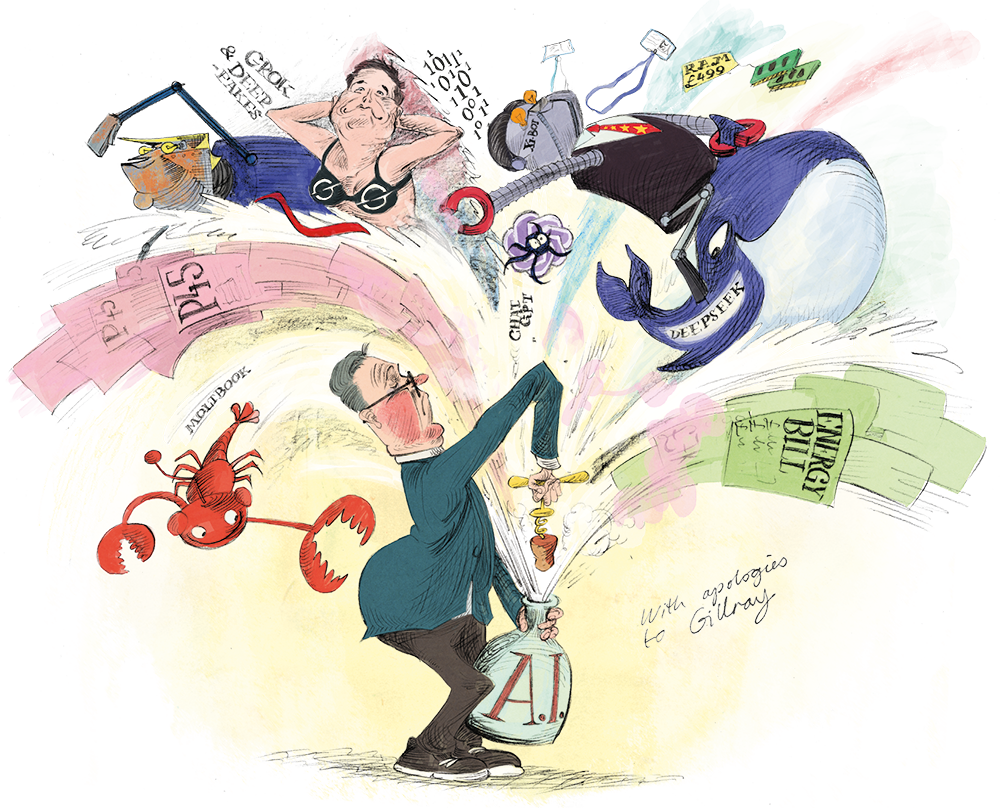
Is there any area of public policy which Keir Starmer’s government has got right? ‘Where very little is working, AI is a bright spot,’ says a former adviser. ‘They’ve started well but they are now in danger of blowing it.’
When Labour came to power they consigned much of the past 14 years of Tory rule to the dustbin. But Starmer poured resources into Rishi Sunak’s AI Security Institute and published an AI Opportunities action plan in January last year, declaring (very un-Starmerishly) that he wanted to ‘mainline AI into the veins’ of the economy. Last week an audit found that 75 per cent of the proposals had already been delivered – a level of success rare in Whitehall.
‘A government that really believed AGI was set to arrive would be treating it like a national emergency’
Plans to use AI to boost productivity in the public services ‘are the last credible part of Labour’s growth plan’, observes a former Tory cabinet minister. In Downing Street, Morgan McSweeney, the chief of staff, is a zealot, telling friends that AI will make ‘the least productive person more productive by 2030 than the most productive person now’. Kanishka Narayan, the AI minister, is regarded as one of the best junior ministers in government. Liz Kendall, the secretary of state for science, innovation and technology, who had a difficult time at welfare, now boasts she is running ‘the growth department’.
Last week, Labour announced a fifth AI growth zone, this time in Scotland with £8.2 billion of private investment in data centres, half a billion for local communities and 3,400jobs. The other four growth zones total £28 billion in private investment and 15,000 jobs.
Kendall’s predecessor Peter Kyle has predicted the advent of ‘AGI’, artificial general intelligence, where AI models outstrip humans in every area, before the 2029 election. The problem is that the tech firms at the frontier of AI development now predict AGI within two years, and in the race to exploit the technology Britain is being left behind.
At a recent dinner attended by a minister and Labour strategists, an American guest warned that Britain must develop its own sovereign AI capability or risk key technology being ‘turned off’ in a crisis. In the wake of Donald Trump’s threats to Greenland, the former MI6 chief Alex Younger was asked how the UK could get leverage over Trump or Xi Jinping’s China. He replied: ‘Twentyglobal-scale technology companies in Europe and the UK.’
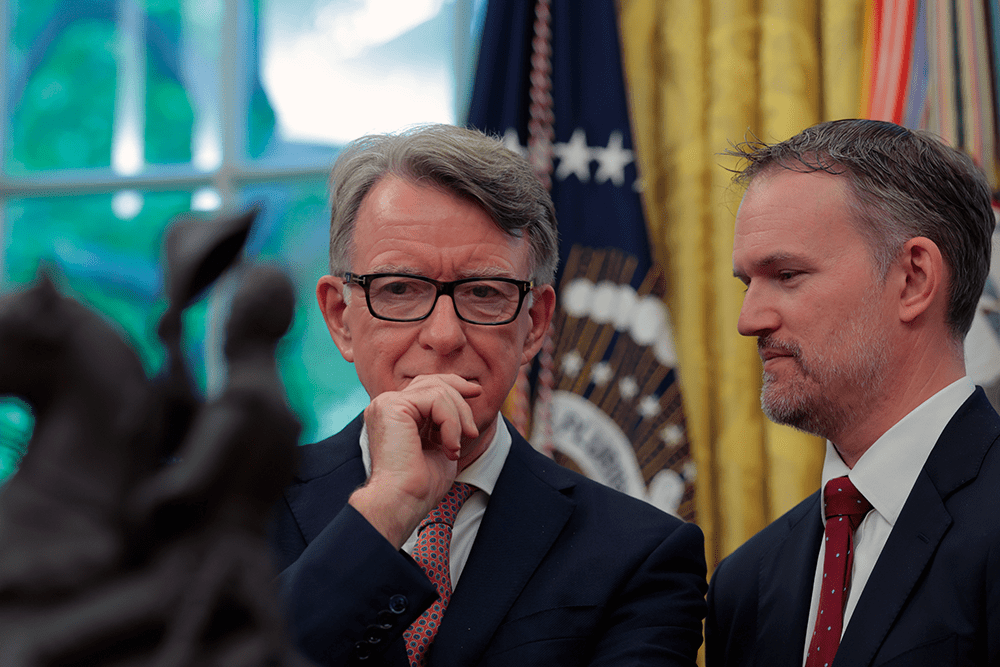
Henry de Zoete, senior adviser at the Oxford Martin AI Governance Initiative and a former No. 10 adviser on AI, says: ‘The government deserves credit for making genuine strides on AI. We are the world’s no. 3 AI power. We have the best technical team in any government in the West thanks to the AI Security Institute. But things move extremely fast in AI. We need to do more. The sovereignty of the UK depends on it.’
When it comes to developing ‘frontier’ AI capability, many experts think the ship has sailed. A report by the Tony Blair Institute (TBI) said: ‘The UK cannot and should not try to compete in the resource–intensive race to train frontier AI models… The smarter strategy for Britain is to focus on deploying and widely adopting AI, demonstrating to the world how to effectively apply it across sectors including health, education, government, defence and science.’ It concluded: ‘This is a now-or-never moment.’
Britain produces huge numbers of tech experts – American companies are stuffed with them – but small British firms tend to be bought up and their founders leave. The government has a £500 million sovereign AI fund to invest in and procure from British AI start-ups, but it is yet to invest a penny. Meanwhile, the US is spending trillions of dollars on AI and energy infrastructure. Individual US companies are building ten or so 5-gigawatt data centres. Britain’s operating capacity was 1.8GW last year and is on course to miss its target of 6GW of AI-ready capacity by 2030.
The TBI report’s lead author, Keegan McBride, says: ‘If you want the capability, it means making sure you have enough compute to train and deploy your models domestically, so that if you lose access to international compute, you still have enough to run your own systems. It requires a strong stock market and large companies that can acquire and retain the best companies at home. It means ensuring you have cheap, plentiful energy. The UK is doing well on talent, but there’s not enough energy, capital or compute.’
The biggest problem is energy, which costs industry four times as much in the UK as in the US. Matt Clifford, who advised both Sunak and Starmer, wrote Labour’s AI action plan and remains chairman of the Advanced Research and Invention Agency, says: ‘It was great that the PM went all-in on the AI action plan, and there’s been a lot of positive action since. The challenge is that AI is fundamentally an energy issue and that’s where we’ve seen the least progress. The UK is still the most expensive country in Europe to run an AI data centre.’
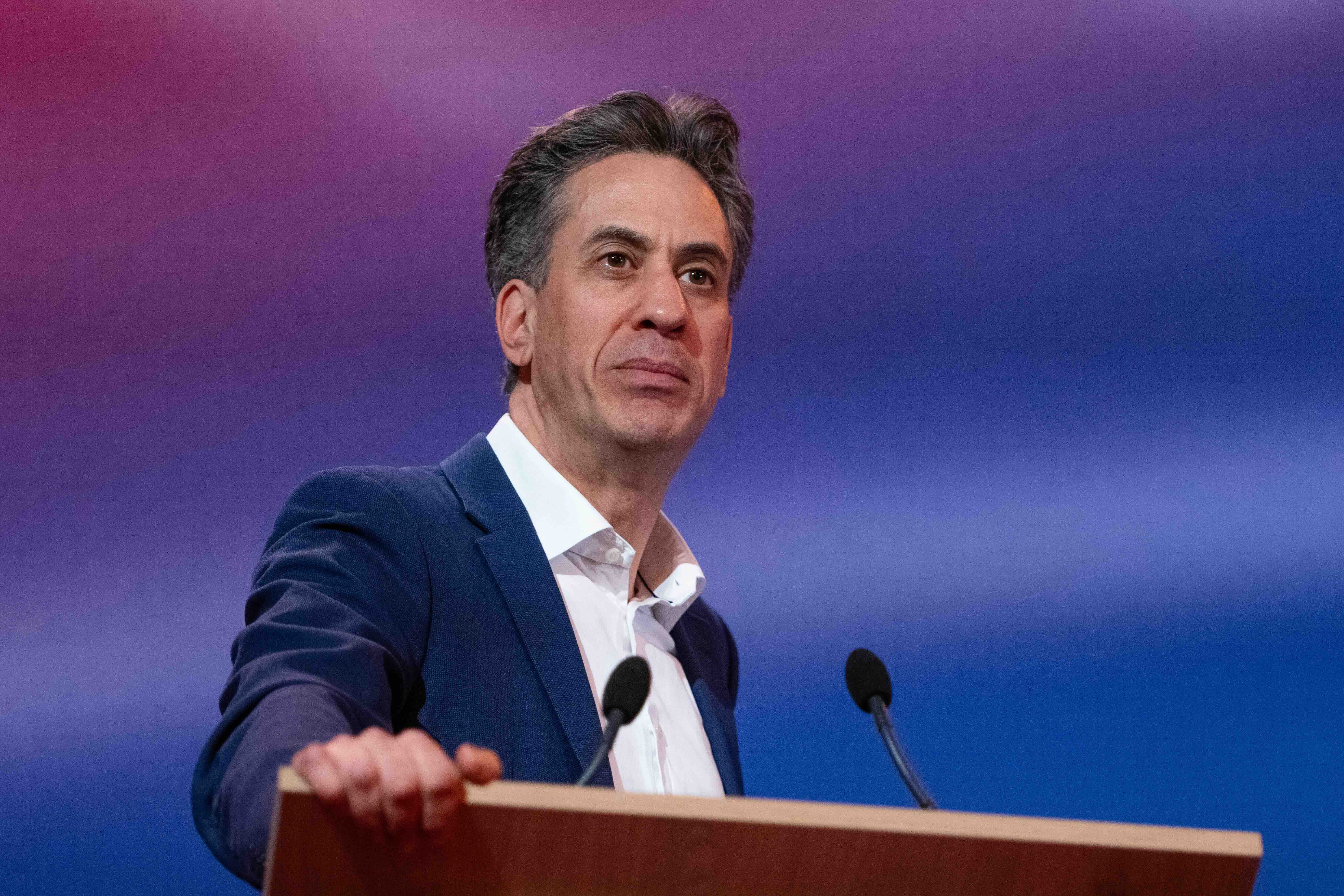
The roadblock is Ed Miliband, the energy and climate change secretary, who is fixated on delivering net zero whatever the consequences. ‘Ed Miliband does not like AI,’ a colleague notes. ‘He thinks it’s extremely inconvenient and annoying for net zero.’ At a cabinet away-day at Chequers last July, both Miliband and Lisa Nandy grumbled about there being a session on AI.
AI was not included as an energy intensive industry in the government’s industrial strategy, and grid connections for AI have not been prioritised. While energy production per capita is rising in the US and China, it is falling in Britain. The only area where it is expanding is Scotland. ‘But the grid is so crap that you can’t get the energy to where it is needed,’ says a source who is in close contact with ministers.
Miliband is the Mr Nyet of the AI Energy Council. ‘Every meeting is basically Ed saying: “It’s impossible. Can’t do it,”’ says a frustrated official. ‘He’s got his Green Energy 2030 target to hit and he won’t be pushed off it. He has a limited number of grid connections and doesn’t want to give priority access to a demand-side project like an AI data centre over a supply-side onshore wind farm.’ Contesting this would upset Labour MPs who are threatening to oust Starmer, and would drive more Labour voters to the Greens.
AI has also fallen foul of the sclerotic pace and risk aversion of the civil service and public sector. The government recommended the use of ‘ambient scribes’ (AI-powered transcription tools) in the NHS, to speed up paperwork for doctors – until NHS England told GPs not to use it because it has not been tested enough.
The government seems unprepared for the effect of AI on the jobs market too. The Blue Labour movement, allied to McSweeney, sees AI as ‘a great liberator of workers’, a government source observes. Maurice Glasman, its leading thinker, hopes AI will mean society once again ‘honours’ the blue-collar worker. The flip side, however, is a massive political headache, since AI could destroy half of all entry-level office jobs. James Kanagasooriam, the pollster who devised the concept of the ‘red wall’, calls what is coming the ‘collar flip’, where the secure jobs are no longer white-collar consultants and accountants but blue-collar plumbers and electricians.
He says: ‘We’re phasing out entire reams of human activity. The people who have had it good could very easily take the blunt force shock of that. There are millions of graduates now coming out whom we have promised a better life and then made them pay for it. Now that best life may not exist. Change and the scale of change is what makes politics volatile.’ With the top 10 per cent of earners paying 60 per cent of income tax, there could also be sweeping implications for the tax take.
Thomas Piketty, the left-wing economist, has warned that penniless postgrads will become a ‘Brahmin left’ driven towards left-wing populists – which explains the surge in support for the Green party. Piketty calls the high-income, low-education blue-collar brigade the ‘merchant right’, fuelling support for nationalist parties such as Reform.
A new report by Focaldata shows that AI sovereignty, or its lack, could also become a ‘potent’ political issue since ‘voters value tech autonomy as an extension of national security’. While just 12 per cent of voters say the issue ‘feels urgent to me’, this would rise dramatically in the event of a major cyberattack, such as China gaining access to British citizens’ data or tech service disruptions.
The one area where Britain leads the world is AI safety. Sunak held the first global summit on the issue at Bletchley Park. The third is in India the week after next. David Lammy, the deputy prime minister, is heading the UK delegation: ‘He’s the other minister who gets it,’ a source says. Sunak will also attend. ‘If I was Starmer, I would ask Rishi to take a global AI role,’ says a former advisor. ‘He cares about it and he knows about it and he’d probably do it, if asked.’
The importance of AI safety was vividly highlighted in last week’s reports that AI bots have begun to discuss the creation of their own language so they can interact without human oversight. Even Elon Musk called this ‘concerning’. In a chilling 19,000-word essay, Dario Amodei, the CEO of Anthropic, warned: ‘It cannot possibly be more than a few years before AI is better than humans at essentially everything’ – something that will ‘test who we are as a species’. He notes that AI models ‘trained on vast amounts of literature’ could emulate ‘science-fiction stories involving AIs rebelling against humanity’, or could ‘decide that it is justifiable to exterminate humanity because humans eat animals or have driven certain animals to extinction’.
Britain has put up several hundred million pounds to test AI systems for their ability to help terrorists unleash chemical and biological warfare or mass cyberwarfare and to see whether AI can escape human control, but there is little sense of urgency. Harry Law, a former researcher at Google DeepMind, who is writing a doctorate on AI at Cambridge University, observed in a blog: ‘A government that really believed AGI was set to arrive before the decade is out would be treating it like a national emergency.’
Perhaps this is a general failure of imagination, not just Labour’s. AI is not an issue on which the Tories or Reform have yet made any noise. Whoever is in power will face what De Zoete calls ‘the AI dilemma’ – the need to go all in to protect UK sovereignty and save the economy, unleashing howls of anger from MPs and voters who want money spent elsewhere. Fail to act and it won’t just be Starmer who has blown it, but Britain.




Comments