
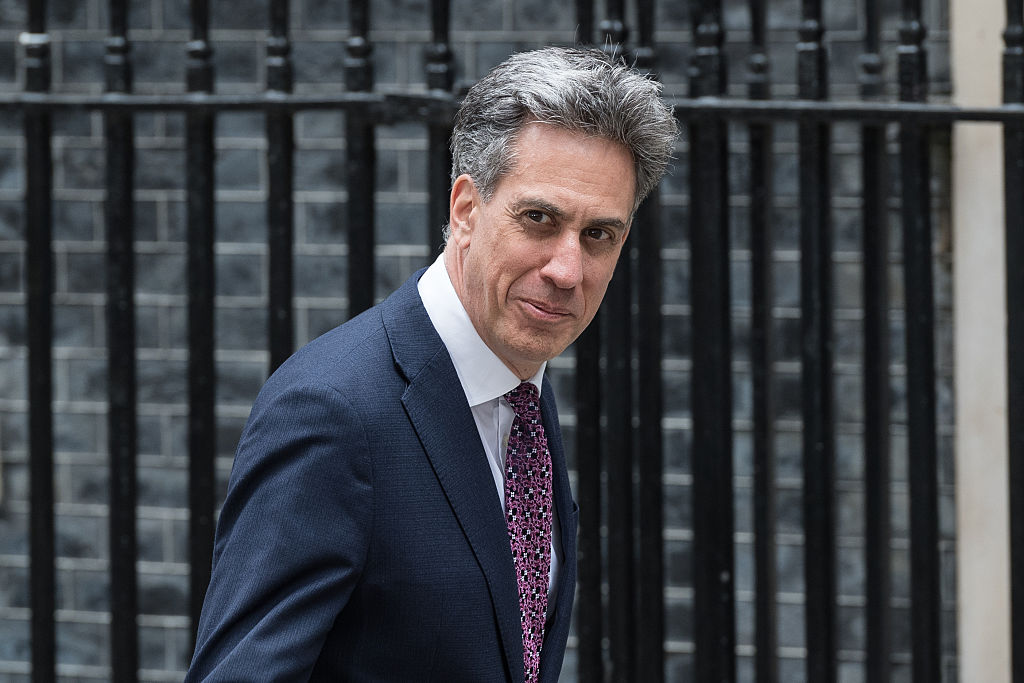
Just one day after Ed Miliband was made UK Foreign Secretary we heard in the Telegraph that the White House is upset about the appointment, and even warned against it. Donald Trump is apparently unimpressed by Miliband’s role in blocking North Sea oil drilling.

Miliband has also railed against Trump in the past, calling him a “racist, misogynistic self-confessed groper” on the BBC’s World at One in 2016, as an example – but in fairness his predecessor David Lammy called Trump “beneath contempt” before he became foreign secretary.
Trump can forgive and forget – so long as his interlocutor is willing to forget their own pride. Miliband could bend the knee, but there is also some appetite to confront Trump. Due to his rhetoric on Greenland, tariffs and the Iran disaster Trump is even more unpopular with British voters than he was at the start of his presidency. In January last year 34 percent of Brits polled by YouGov had a positive view of Trump. As of this month that number is 19 percent. Once the cost of living pressures from the ongoing interruption of shipping through Hormuz begin to mount further towards the end of the year this may well significantly worsen.
It is rumored that Andy Burnham is considering a public showdown with Trump, with Labour’s polling suggesting this would go down very well with the electorate. The party sees parallels with Mark Carney, who transformed the Canadian Liberals’ electoral fortunes in 2025 when he took over from the unpopular Justin Trudeau and entered into a war of words with President Trump.
As well as possibly presaging a tougher attitude towards the United States, the appointment of Miliband is also a signal that Burnham will restore the target of spending 0.7 percent of national income on foreign aid. Miliband is a longstanding supporter of international development aid and his 2015 Labour manifesto cited it as one of the key achievements of New Labour. In the lead-up to the 2015 election he also said that spending on overseas aid would be ringfenced from cuts, alongside health.
Returning to the 0.7 percent target has become a hot topic in the Labour party recently. A forthcoming collection of essays to be published by the New Economics Foundation will call on Burnham to recommit to the target, which was abandoned by the Sunak government. Its authors include former Labour ministers like Fleur Anderson and Gareth Thomas, and Brown era figures like Lord Malloch-Brown. This could be a very risky play politically if Burnham needs to find cuts elsewhere while increasing taxes, but it will play well within the PLP.
It will certainly signal a change from Starmer’s approach. All the way back in February of 2025 the then international development minister Anneliese Dodds resigned because Starmer wanted to cut international aid from 0.5 percent of national income to 0.3 percent to fund an increase in defense spending.
The third aspect of UK foreign policy where Miliband’s appointment will be interesting is China. It is perhaps underappreciated in political commentary how much Starmer has sought to reset relations with China. Miliband is likely to continue this process of engagement. Just last year he signed a “UK-China Clean Energy Partnership” and he previously resisted having anti-slavery compliance in Great British Energy’s supply chain. China produces around a third of the world’s polysilicon – a raw material needed for solar panels – in Xinjiang, where the Muslim Uighur population is allegedly subject to forced labor.
Miliband’s instincts elsewhere in foreign policy draw from the left of the Labour party. His most significant intervention as leader of the opposition came when he voted against David Cameron’s government when it wanted to intervene in Syria in 2013. Miliband was one of the key figures encouraging Starmer to back away from the American intervention in Iran and also voted in 2014 for the UK government to recognize Palestinian statehood.
Burnham, like Rishi Sunak, is a Prime Minister who wants to focus on domestic issues. His decision to put a big beast in as Foreign Secretary, as with Lord Cameron, could be a sign that he is trying to compartmentalize foreign policy so he can keep his attention on devolution and the cost of living at home. Miliband may have preferred to be Chancellor – but if he is given a free rein as Foreign Secretary he could still make as big a mark in the department as he did at energy.





Comments