


Matthew Parris has narrated this article for you to listen to.
Much has been made of the adjective ‘asymmetric’ when discussing warfare in recent years. The word enjoys a renewed currency now that Israel and America are engaged in combat with enemies who, unable to match them with comparable armed forces, instead disperse, hide and strike at the soft underbelly of their foe. David and his sling, I suppose, when David met Goliath thousands of years ago, was a forerunner of this strategy.
But I want to discuss another kind of asymmetry, and another Old Testament hero, Samson. Alone, captive and blinded, Samson reached for a secret weapon unavailable to his captors: the weapon of self-sacrifice.
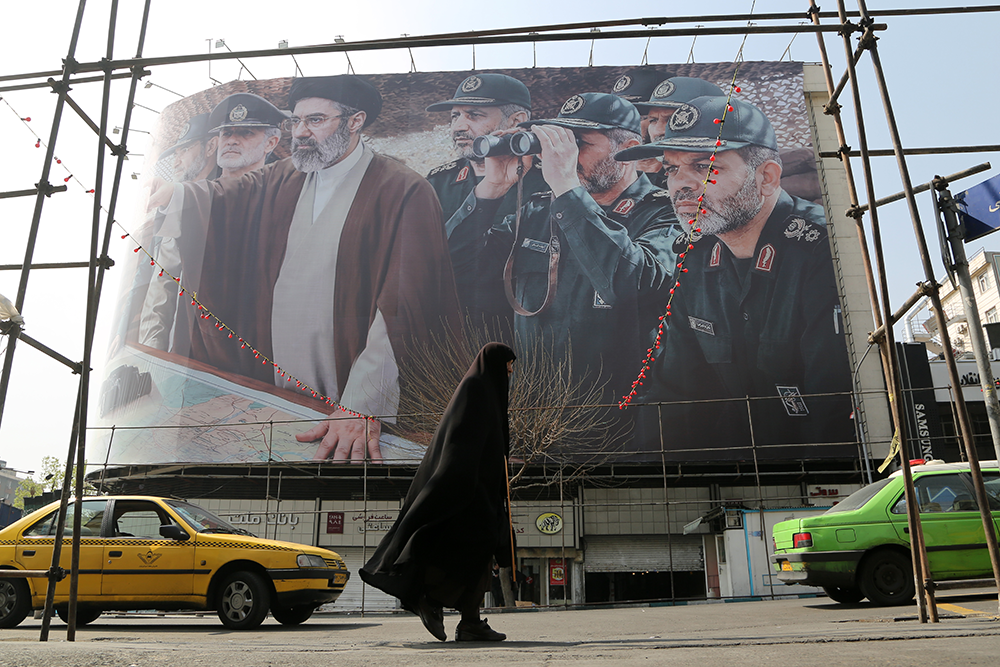
The Islamic Revolutionary Guard Corps and their forces do not fear death. They do not believe in it
Knowing that he himself was certain to perish in this final assault, Samson was not afraid to bring the temple down on his enemies. The Philistines, celebrating in the temple, had reckoned without the opportunity that presents itself to an enemy who is un-afraid of death.
And so it is with the assault by the American-Israeli complex on the Islamic Revolutionary Guard Corps (IRGC). The deaths of thousands of American troops in the Middle East would spell political disaster for their Commander-in-Chief, Donald Trump. But the Islamic Revolutionary Guard Corps and their forces do not fear death. Indeed, they do not believe in death: only in martyrdom, and resurrection in paradise.
They are of course cornered in a way that American and Israeli leaders are not. Benjamin Netanyahu and Donald Trump will not be killed if, in the end, their military coalition has to walk away from this conflict having failed to achieve its goal. By contrast, if Iran is properly conquered then the IRGC will be dead men walking. Pete Hegseth, the American Secretary of War, keeps reminding them of this, perhaps supposing he can demoralise the regime thus. In fact it must spur them on. Believing yourself to be cornered is itself a spur to courage. So far, so obvious.
But how much thought has been given to another powerful reason for the ferocity under fire of the Iranian resistance? Islamists believe, and believe absolutely literally, in the afterlife. Hand on heart, how many professed Christians really do?

Holy Week is a good time to think about this. We find the Easter story immensely moving – or I, anyway, even as a non-believer, do. I find the person and the fate of Jesus Christ inspiring. He has so much that is profound to teach us, and I am almost certain he existed and believe it likely he was put to death. But do most of those who would call themselves Christians, let alone the much larger number of us who are of Christian heritage, really believe that (in the words of the Apostles’ Creed), ‘[Jesus] was crucified, dead, and buried; he descended into hell; the third day he rose again from the dead; he ascended into Heaven, and sitteth on the right hand of God the Father Almighty…’?
Does your average American marine honestly believe that? And if so, does he also (in the words of the Nicene Creed) ‘look for the Resurrection of the dead, and the life of the world to come’?
There will be some readers of this column who, speaking for themselves at least, can honestly answer ‘yes’. I do not belittle their faith, but ask them to consider in how small a minority they now are. It must take almost unbounded faith to brush aside questions like ‘How old will I be in Heaven? Will I see my mother again, and how old will she be?’ with the catch-all answer that these are mysteries to which God alone can know the answer.
I love wandering through country graveyards in Derbyshire and reading the inscriptions on the stones – ‘Reunited in Paradise’, ‘Touched the Earth’ (of a days-old baby) ‘and gone to Glory’. How many who commissioned the epitaphs, how many who wielded the chisel, really believed their words? We cannot know. But nor can we deny that such unquestioning faith is uncommon in the Christian-heritage West today. Judaism, meanwhile, (so far as I can understand that family of beliefs) sets no great store in an afterlife of any kind, but focuses on God’s purpose in the present world.
So I stick my neck out and venture that, from Donald Trump, Benjamin Netanyahu, their commanders and strategists, right down to their airmen and soldiers in the field, relatively few have any lively belief that, even if everything goes wrong in this war in this world, a new life in a new world where they will sing a new song, awaits them.
Contrast that with the firm conviction of Islamist believers that this life is only a preparation for the next. For many such, martyrdom is a glorious prospect. Perhaps we should not take too literally those claims that terrorists who perish in explosions they cause believe they’ll find 72 virgins waiting for them in Paradise, but there’s no doubt that the Islamist vision of the afterlife is a real, almost tangible prospect.
It’s difficult to word this without giving unintended offence, but, however wicked their intentions, suicide bombers do demonstrate something we would in other circumstances call courage. Imagine how much more mayhem and slaughter the IRA could have inflicted on us if their members had been routinely willing to encompass their own suicides in their plans.
I wonder, even now, even after the killing of so many tens of thousands of Palestinians in Gaza, the Israeli public really understand the concept of generating martyrs.
It’s said that the formidable African proto-emperor Shaka Zulu marched regiments over cliffs to teach the nobility of self-sacrifice. Combine self-sacrifice with the efficacy of political leadership that is unafraid to die, and a culture ever-ready to replace a dead leader with new candidates for the prospect of posthumous glory and the delights of eternal life, and extend this faith to the fighters whom they lead, and you have what I call the asymmetry of sacrifice. A US Commander-in-Chief who dodged the draft by means of a ‘bone spur’ on his foot can hardly be expected to understand the concept.





Comments