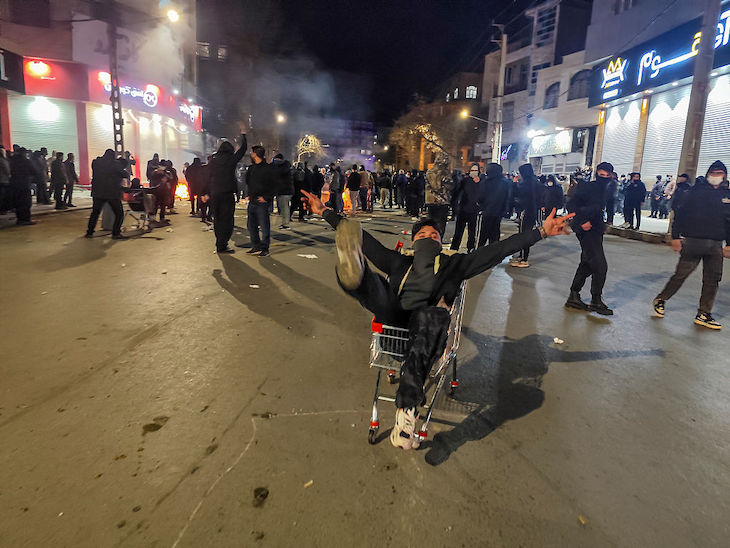
The most recent spate of protests in Iran have escalated since 28 December and raised hopes once again that the end of the Islamic Republic may be imminent. As the security forces ignore the government’s offer of dialogue and the death toll rises, how realistic is that?
Iranians – much like the French – are healthily predisposed to taking to the streets to voice grievances
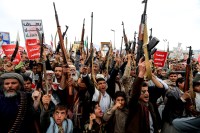
Protests in Iran are nothing new. In fact, Iranians – much like the French – are healthily predisposed to taking to the streets to voice grievances. In France, marches tend to focus on the Champs-Élysées and Place de la Concorde; in Tehran, protestors habitually march along the main Ferdowsi and Enghelab (Revolution) boulevards to congregate in the central Ferdowsi Square. The first route leads up from the bazaar past the British Embassy and has been a scene of protest for over a century.
The national predisposition to revolt and march against oppressive authority predates the 1979 revolution. Notable uprisings include the Constitutional Revolution of July 1906 when 14,000 Iranians demanding reform from the Qajjar Shah sought asylum at the British Embassy compound until their demands were met.
In July 1952 – following the resignation of prime minister Mossadegh resulting from a power struggle with Shah Mohamed Reza Pahlavi over who should control the army – massive Street demonstrations in Tehran and provincial capitals saw many killed when the military opened fire. Mossadegh was reinstated as prime minister, though removed definitively the following year in a coup following large demonstrations – apparently incited by the CIA and MI6 in response to Mossadegh’s uncompromising policies to nationalise western oil interests.
The demonstrations of 1978 and 1979 against Pahlavi’s rule culminated in some of the biggest protests seen during Iran’s history and the overthrow of the Shah. In more recent times, periodic uprisings against the Islamic Republic have been brutally oppressed. Most notably during the green Revolution of 2009 protests continued for months after the fraudulent re-election of president Ahmadinejad. At the end of 2017, when I was UK ambassador in Tehran, protesters marched against government economic handling and social oppression. In September 2022, the brutal killing by security forces of Mahsa Amini for wearing an imperfect hijab provoked the largest demonstrations since the 1979 revolution. Four months of street protests and over 500 deaths followed before the protests faded out under pressure from the security forces.
What all of these protests had in common was a diversity of participants. At the risk of stating the obvious, Iran is a big complex country with a broad range of political factions. In the Islamic revolution that brought Ayatollah Khomeini to power secular, socialist, liberal, ethnic and religious minorities and pro-Western activists played a significant part, as well as religious Shia extremists who ultimately seized power and imposed an Islamic state. The same pattern emerged when the country rose up in disgust at the apparently random killing of an innocent young Kurdish woman in 2022.
One reason why protests against the Islamic regime have failed to significantly change Iran’s oppressive theocracy is the lack of a credible opposition leader to unite the various factions. The most prominent Iranian figure currently speaking out against the Islamic Republic is Reza Pahlavi, son of the former Shah. In exile since the revolution, he has been increasingly vocal since the 2022 protests and enjoys significant support among some of the hundreds of thousands in the Iranian diaspora in the US, UK and continental Europe. In response to the latest protests, Pahlavi issued a statement to Iranians calling for ‘national revolution. The continuation and expansion of your presence, and taking control of the streets’. He also proclaimed that.’victory is ours because our cause is just and because we are united.’
Generation Z, prominent in the protests, see this as a struggle for their future
It is undoubtedly true that some protesters have been chanting for a return of Pahlavi rule and shouting slogans such as ‘Long live the Shah’. But it is far from clear that this is the majority view. Indeed, many Iranians, while thoroughly fed up of the brutal and incompetent Islamic Republic, would not support a return to monarchy or further violent revolution. Some accuse Pahlavi of being an Israeli puppet, perhaps not surprisingly, given his position during the 12-day war in June between Israel and Iran. The welcome Pahlavi has given to president Trump’s ‘clear and firm support for the Iranian people’ and apparent openness to a Venezuela-style leadership decapitation is unlikely to resonate with all Iranians, given their strong sense of national sovereignty and patriotism. Nonetheless, those supporting a return of the Shah, including some directly in touch with the ‘Prince’, are adamant that he does not want to be a political figure or king like his father and grandfather. Rather, he is offering to play a transitional role, stabilising and unifying the country until a democratic referendum is held to allow Iranians to choose what should come next.
The ongoing popular uprising has been triggered by the Islamic Republic’s economic mismanagement, a plummeting currency, high inflation, a water crisis and the struggle many Iranians face to make ends meet. But it is about more than that. It seems that a majority are increasingly fed up with the Islamic Republic and want something better. Generation Z, prominent in the protests, see this as a struggle for their future. They may be less concerned about what or who replaces the current regime, so long as it is different and offers hope.
Based on experience, Iran watchers doubt that the moment of regime change will come soon as a result of the current demonstrations. As a western diplomat told me, ‘It is just more of the same – the regime is so vulnerable to shocks now, and so unable to prevent them coming. The tipping point was the Mahsa protests in 2022. This is just another chapter of them sliding uncontrollably down the slope – and hitting a few rocks on the way. At some point they will hit the bottom, but no one can know in advance when that will be,’ That said, an American Iran expert gave me pause for thought saying that ‘after the US’ Venezuela operation, it feels like anything is possible’.
The size and intensity of these protests are unmatched since 2022. They must be taken seriously and are potentially different to previous protests, according to one seasoned observer living in Tehran ‘The demonstrations are universal and made up of everybody.’ It does seem possible, as my interlocutor believes, that ‘the fall of the Islamic Republic will be very quick.’ It may even happen in 2026, should internal and external forces align in as yet unforeseen ways. For the moment, many Iranians are hoping that what follows will lead to a secular, rule-of-law and equality based Iran. But that seems a long way off in these bleak days of protest and murderous repression.
Listen to more on Americano:


Comments