The politics of the Iranian war feature an observable gap between interest and action for nearly all parties. The Americans possessed overwhelming casus belli versus Iran for nearly half a century, and did not act upon it until three weeks past. The Iranians possessed none against America for just as long, but exerted themselves with religious fanaticism to bring this war upon themselves. The Arab autocracies of the Persian-Gulf region find themselves under direct attack from the Iranians, but do not respond in kind. The Chinese observe a core strategic proxy and key commodities supplier taken off the chessboard – for the second time in under 90 days – and refrain from direct engagement. The Russians watch a literal ally come under attack from their own signal rival, and do nothing except, perhaps, share targeting data.
Only the Israelis, it seems, have a consistent record of perception and response to events, in the light of their own interests, throughout.
Then there are the Europeans. The European Union’s foreign-affairs chief, Estonia’s Kaja Kallas, pronounced that “this is not Europe’s war, but Europe’s interests are directly at stake.” She’s half right. Europe has an Iranian war on its hands by reason of those interests, whether Europe cares to see it or not.
Those European interests are obvious and manifest. Start with Europe’s own casus belli versus the Iranian Islamic theocracy. European territory has been directly attacked by Iranians, with drone attacks on British sovereign areas on Cyprus. European military facilities outside of Europe, including a French naval base in the United Arab Emirates and an Italian deployment in Kuwait, have been directly attacked by the Iranians. European personnel have been killed by the Iranians. European security partners, including counterparts by treaty, have been attacked by Iran, including NATO ally Turkey and Anglo-French defense partner UAE. Terrorism inspired by Iran, if not directed by it, has struck across Europe.
Yet it all arguably pales before the systemic and societal threat from the Iranian closure of the Straits of Hormuz. Now several days old, this closure represents more than an armed attack upon the personnel, facilities, and territory of Europe’s nations. Approximately one fifth of the world’s oil, and well over one tenth of Europe’s liquified natural gas, are shipped through the Straits annually.
With European energy markets and European economies already struggling with the loss of Russian oil and gas, the additional Iranian-driven market constriction is a new crisis that they can ill afford. Add in the threatened re-closing of the Bab-al-Mandeb by Iran’s Yemeni-Houthi proxies – which would have the effect of severing or re-routing about forty percent of European trade with the Middle East and Asia – and Europe is at the precipice of a whole-of-society crisis made in Tehran.
Taken to its logical ends, as the still-living leaders of the ayatollahs’ regime seem determined to do, the closure therefore threatens a series of consequences for which Europe at large is ill prepared.
Outside the security of France’s robust nuclear-power grid, Europe will sink into reduced productivity and stagflation as the combination of high energy costs and increased food costs – about one-third of all global fertilizer shipments also pass through the Straits of Hormuz – constrict the liquidity of both households and governments. Among the many budgetary effects on the latter will be an increasing difficulty in fully funding the Continent’s defense build-up, as it responds to an aggressive Russia.
Russia, by contrast, already severed from most of the world’s economy, will experience a windfall in energy-sector profits with the situation in the Straits – as it is already starting to, with the recent relaxation of American sanctions in light of their closure.
For the Europeans, then, that observable gap between interest and action with respect to Iran is nearly a chasm. Much less comprehensible is the European acquiescence to the Iranian stranglehold upon their economies, and therefore their societies. States and nations with an interest in survival do not tolerate the imposition of that sort of existential risk by annihilationist-minded antagonists absent force majeure. But Europe does.
Incomprehensible it may be, but it is sadly explicable. European powers themselves have stated openly why they will not act to reopen the Straits: doing so would necessitate a wartime partnership with the United States of America, and their politics are more strongly oriented against the American President than the Iranian Ayatollah. As articulated by French, British, German and other European leadership, they didn’t start this war, and they therefore should not be expected to join it, even in their own direct interest.
A series of X posts from the German Foreign Office illuminates the balancing act at hand: “the Iranian regime poses a serious threat,” it says, and “this threat cannot be allowed to persist.” Therefore, declares the Bundesrepublik Deutschland, “We first need to hear from the US & Israel when they expect to have achieved their military objectives in Iran before we can jointly define a future security architecture for the region. As “serious” as the threat is, German officialdom will await the assurances of third parties before lifting a finger on behalf of itself and its citizenry.
French Lieutenant General Michel Yakovleff was more candid than his German counterparts. “The Americans demand our help but are incapable of setting a clear strategic objective on paper,” he said, “They improvise day by day. In reality, they couldn’t care less about our frigates. They just want us to split the political bill for their fiasco.”
There you have it: the critique of the American absence of operational planning (real or alleged) and the discontent with American refusal to consult prior to launching the war (more fiction than fact) operationally supersede the obligation to the nation and its people. European leadership, having accumulated across generations the reflex of defining itself against America rather than with reference to its own history and heritage, now shows itself unable to react to a threat even when clearly recognized.
This was already manifest in the years of European slowness in reacting to the Russian threat – who can forget the German delegation to the United Nations laughing openly as President Trump warned them of their fatal dependency upon Russian energy in 2018? – and now the deficiency in statecraft is cast into sharp relief by the Iranian war in which they are already participants, if only as victims.
All this is a function of European political obsession and resentment overriding duties of stewardship. The European civic class was never enthusiastic about the American President, and the events of his second term – from the psychological shock of the first Munich Security Conference, to the American retreat from the defense of Ukraine, to the aggressive coveting of Greenland, to the disparagement of America’s European allies in Afghanistan, and beyond – have transformed a skeptical wariness into a positive revulsion. The Americans, they reason, have treated the Europeans with disrespect, as wayward subordinates rather than dissenting friends, and now that the Americans are asking for help opening the Straits of Hormuz, it will be refused.
European resentment and pique propel the Europeans on the same political trajectory which have led them into their strategic cul-de-sac. Americans have insulted the Europeans, but Iranians have murdered them. Americans have coveted European territories, but Iranians have attacked them. Americans have lectured the Europeans, but Iranians have terrorized them. Americans have injured the European psyche, but Iranians are crippling European societies.
Yet for all this, Europe’s policy is driven in reaction to America, and not Iran.
The crisis of the European strategic mind is laid bare in the most stark terms. Incapable of discernment and action alike, it orients itself against the American antagonist – the one it knows will never do it real harm – rather than the Iranian one, which it knows will sow death and mayhem against itself given the chance. A mature and capable European civics might be able to hold two ideas at once: that the Americans have behaved unjustly and insultingly toward them; and also that Iran has made war upon Europe, and that the Iranian closure of the Straits of Hormuz is an intolerable threat to European prosperity, security, and stability. It might be able to act in light of the latter without conceding dignity or subordination to the former.
It isn’t that Europe doesn’t grasp the Iranian threat on some level. Of course it does: it says it does, its aircraft are downing Iranian drones, its synagogues dread the next Iranian-terror attack, and its dead at Iranian hands are coming home. They know it, but that doesn’t mean they will do something about it. They won’t, because they know who will.
They know that we will.
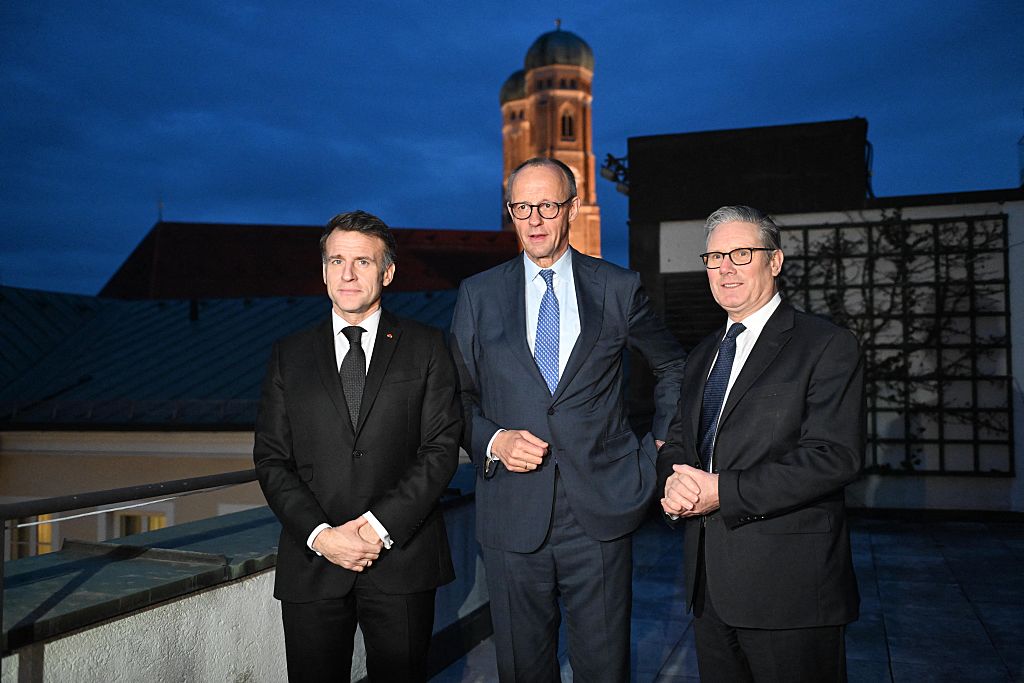
The Europeans expect the Americans to do it. They expect us to handle all of it: the regime, the nuclear program, and the Straits of Hormuz. They expect we’ll do it, and they’ll help us do it as much as they can while avoiding all risk and moral implication for themselves. They’ll help us to the extent that they can do so while posturing against us. Writing in the New York Times this past Sunday, Anton Jäger, no enthusiast for the American war upon Iran, condemned the Europeans for the double game. After initially refusing, Prime Minister Keir Starmer of Britain allowed the United States to use British bases, and Chancellor Friedrich Merz of Germany backed the effort “to get rid of this terrible terrorist regime.” President Emmanuel Macron of France has been more circumspect in words but clearer in action, deploying several warships to the region. Not to be outdone, Prime Minister Giorgia Meloni of Italy offered the country’s bases to America and dispatched air defense weapons to the Persian Gulf.”
Just so. They’re no vassals: just dependents.
This is the one thing they get right: we will do it. And when they’re right about us, we will be right about them. Europe the critic, Europe the complainant, Europe the beneficiary gazes upon America the aggressor, America the capricious, America the protector with its resentment, its condemnation, and its hope. “Open war is upon you, whether you would risk it or not,” says Aragorn to Théoden at Edoras.
Fortunately for Europe, though it may refuse to fight its Iranian war, America won’t. It is not that we are fundamentally different. The ties that bind us are civilizational, to use a phrase much in favor at the US Department of State. Europe and America are inheritors of a common history. They are us, and so we care for their fate more than they do themselves. And yes, we are them.
But we are the best of them.

Comments