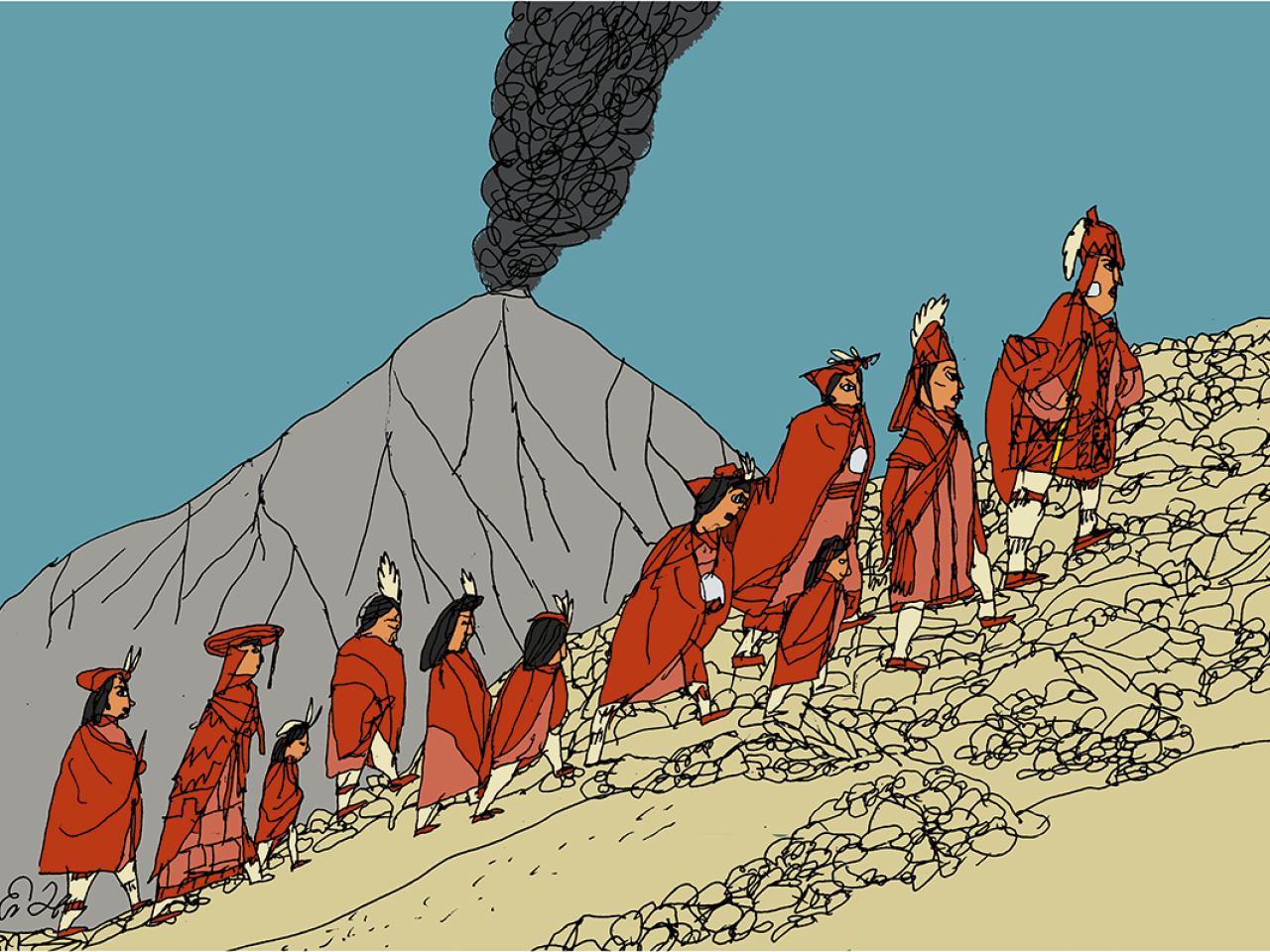
The children of Llullaillaco don’t look too different from the living children I’ve seen around Salta. They’ve got the same diamond-shaped faces, pecan-colored skin and straight, pitch-dark hair. Of course, the children of Llullaillaco are smaller, as people five centuries ago were wont to be – and dead.
I’m talking about three Incan child-sacrifice mummies, estimated ages five, six and 15. As of about 25 years ago, they’re permanent residents of Salta, Argentina, the capital of a province of the same name in the country’s northwest. As the crow flies, the city isn’t that much closer to Buenos Aires than to Lima.
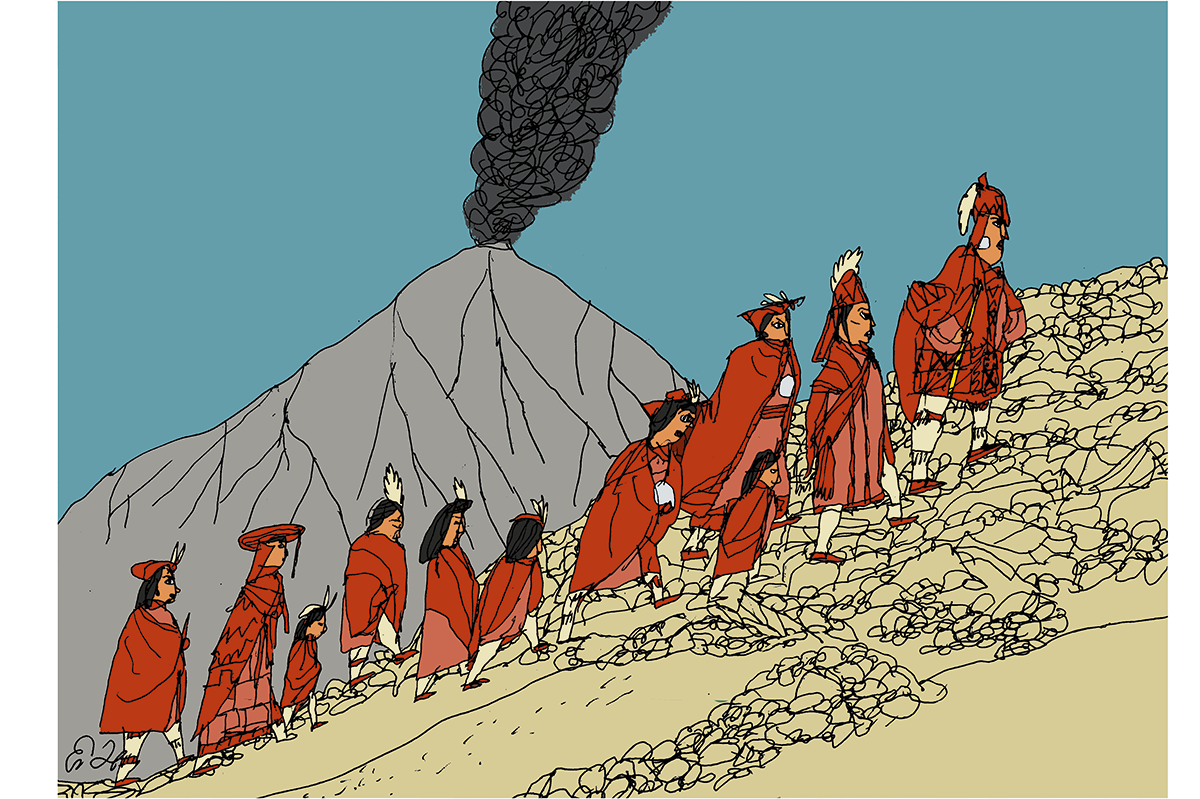
Due west of Salta, in the Andes, is the peak of the volcano Llullaillaco. It’s the second-highest active volcano peak on the planet, though in the last couple of centuries no eruptions have been confirmed. In 1999, however, it made other news when a team of archaeologists turned up three bodies near its peak – bodies that happened to be 500 years old. They were perfectly preserved. But these weren’t mummies in the intentional sense. Their preservation was an accident of the climate: they were buried at an altitude of over 22,000ft on the edge of the Atacama, the driest nonpolar desert in the world.
Since being disinterred, the so-called children of Llullaillaco reside just off of Salta’s main square, where, since 2004, a museum has been dedicated to conserving and exhibiting them. It’s called Museo de Arqueología de Alta Montaña, MAAM for short. In English, that’s the amusingly euphemistic Museum of High-Altitude Archaeology.
As for the children’s new home, Salta is the capital of an Argentine province famous for its folk music, tourism and tobacco. The city’s population is 600,000. We’re only a couple of hours’ drive south of the Tropic of Capricorn. Even in winter, pink flowers are in bloom and the sky overhead is a rich, clear blue.
When I mentioned back in Buenos Aires that I was on my way here, without fail I was met with a wistful “Ah, Salta la linda!” That’s the province’s epithet: “Salta the Beautiful.” And, it’s true, the landscape promises to be striking. I’ve booked seats on tour buses that will cart me around to multi-colored rock formations, white salt flats and eerie stretches of cactuses that, at a distance, look like blackheads on a Bioré nose strip.
On my off days, I wander the capital. MAAM is close to my hostel, and when I visit, its stairwell smells like cigarettes. Only one of the three children is on view at any given time, stored in a stout, climate-controlled glass tube in a dark room, lit at waist height in dim pink. To get a good view of the mummy, I’ve got to press a button for lights that are timed to shut off again in a few minutes. Light causes decay: think of yellowing newsprint. Flesh, hair and nails happen to last a little longer.
When I’m in town, “El Niño” (“The Boy”) is on display. He’s been four or five years old for the last 500 years. (There’s also “La Doncella” (“The Maiden”), who was maybe 15 when she died, and “La Niña del Rayo” (“The Lightning Girl”), a six-year-old whose corpse was scarred by lightning in the intervening centuries.) “The Boy” slumps over himself in the shape of a cone, draped in red fabric, his face meeting his knees. His head is also conical, though I can’t tell by looking. Apparently it was purposely deformed to augment his physical beauty: MAAM informs me this was not uncommon. “The Boy” was of noble origin, signaled by the feather on his forehead, tied in place by a tiara-like llama-wool rope.
From the side, “The Boy’s” features are easier to discern: a shuttered eye, lips resting against the rough cloth over his legs. An earlobe peeks from under shaggy black hair and tiny feet in sack-like slippers emerge from the bottom of his cape. The flesh of one bare forearm looks like potato skin: rough, dry, hard and pocked. I can see little fingernails and cuticles clear as day.
When the Spanish first came into contact with the Incas around 1528, in what is now Peru, the empire splayed along the South American coast from present-day Colombia all the way down to Chile and Argentina. It was divided into four administrative regions called suyus, with the capital of the whole empire, Tawantinsuyu, seated in Cusco. Here, I’m in what used to be the southernmost province, Collasuyu.
These children were sacrificed in a ritual called capacocha that was performed on various occasions: to fend off natural disasters, for instance, or to commemorate the death of an emperor. From each of the four suyus, a child would be picked for his or her surpassing physical beauty – not a freckle was permitted – and sent to Cusco. There, the group would be dressed up like little royals, paraded around an altar in a central plaza (one conquistador reported that “the children who could went by foot, and the ones who couldn’t were carried by their mothers”), and paired off for ceremonial marriages. Then the children and their entourages would make a pilgrimage back to their towns of origin, traveling, according to the ritual, in a perfectly straight line. After being received with great joy and fanfare at home, the parties set off to their respective offering sites, including but not limited to Llullaillaco. The museum suggests that many aspects of these rituals were intended to represent an ideal life on a miniature scale. That’s why these kids were married off to one another, as well as why they were buried alive – sorry, sent off to join the gods – with tiny objects representing the traditional activities of Incan adults. For instance, “The Boy”was found with shepherd figurines as well as little llamas no more than an inch high, some carved from vibrant orange shell and some made of silver.
The children were also sedated with chicha, a candy-sweet maize drink, and coca leaves, a baggie of which today would get you kicked out of any music hall in Salta.
This cocktail of substances explains why the three bodies found on Llullaillaco conveyed no sign of struggle. They died of hypothermia, or maybe from lack of oxygen, in relative peace.
On my tour days, I wake up before six to get on a bus with 11 or 12 other tourists, mostly city-slicker Argentines save for me and, one day, a Brazilian taking three months of vacation. I’ve traveled from my hemisphere’s summer to this one’s winter, and I have to be prepared for it to get even chillier as we increase in altitude. “Up here,” our guide Ignacio tells us as we drive, “the people are pura colla” – pure Inca.
Ignacio and the Salta bus drop us off in the town of Humahuaca, where, for lack of oxygen, you’re warned not to talk too quickly, move too fast, or eat too much. We’re here to get a good look at the Serranía de Hornocal, a rock face so beautiful I’d seen it as a default PC home screen before I knew its name.
So we board another bus, this one suited to unpaved terrain, which takes us up a hill, switchback after switchback, for at least an hour. As I’m looking through the windshield, I fleetingly catch sight of our driver’s profile. It’s uncanny: there’s the same high nose bump, prominent philtrum and stout, flat forehead I saw on “The Boy.”
My companions pass slime-green coca-leaf candies around the bus: they’re supposed to assuage altitude sickness. I’ve opted for the leaves themselves, like Ignacio and my mummy friends. The leathery stack is poking into my gums, and a bad green-tea taste is leaching across my tongue. I can’t actually tell what the coca’s effects are, since by the time we reach the lookout point I feel lobotomized anyway.
We’re more than 15,000ft above sea level, which is still 7,000 short of where the children were unearthed. The pictures I’ll later develop from my camera will show a dazzling ridge with jagged stripes of pink, red, green, brown and ocher. Thinking back to it now, though, it’s hard to recall much else besides the half-brained feeling of oxygen deprivation. At the peak of Llullaillaco, so close to the heavens, the usual barrier between life and death must have been only a gauzy, fluttering curtain.
This article was originally published in The Spectator’s December 22, 2025 World edition.





Comments