Following my appointment as shadow justice secretary, I was moved to a bigger office in parliament. Where once I enjoyed a tiny room directly above the chamber (perfect for rushing to votes), now I have a plush room much further away. It is directly above the irksome Steve Bray, who continues his noisy campaign against Brexit. Of course his anti-social behaviour should mean he is moved on by the police, but these days officers balance the public interest against Bray’s ‘rights’. I recently relied on some Anglo-Saxon vernacular to tell Bray what I thought of his protest, and realised afterwards in today’s upside-down world the police would probably finger my collar – not his.
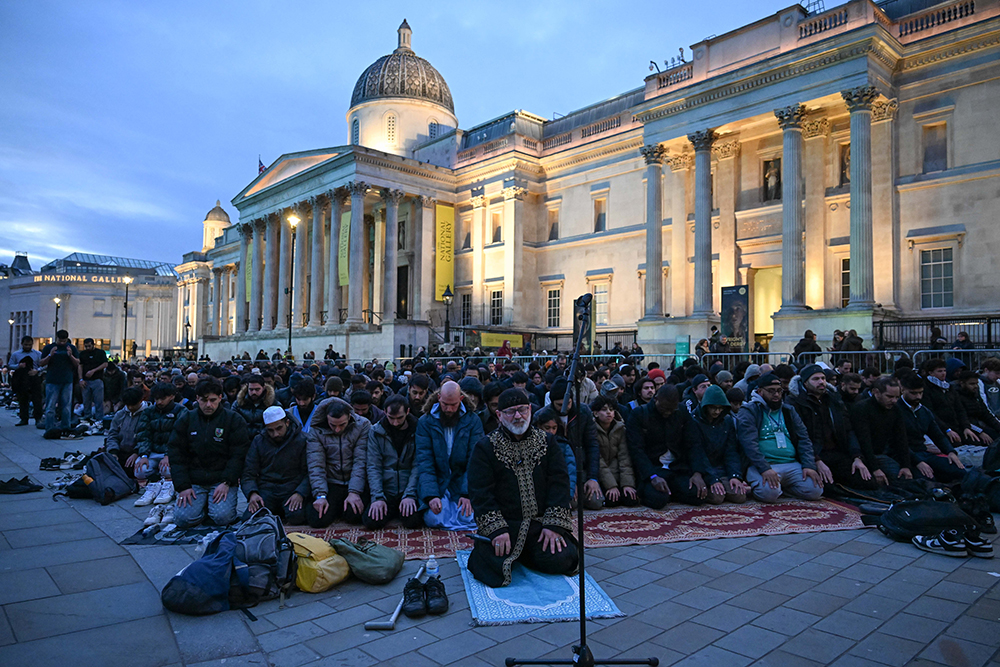
Opponents of Labour’s ‘Islamophobia’ definition warned it would stop us debating religious ideas. Ministers insisted we were wrong and dismissed concern about the confusion of racial identity with religious belief. Yet the week after the definition was announced, the Communities Secretary accused me of racism and Keir Starmer demanded my head. My crime was to call the ritual prayer by Muslim men in Trafalgar Square – and the adhan, the Islamic call to prayer – an ‘act of domination’. I did not question the freedom of Muslims to gather to break their Ramadan fast, nor their right to pray in mosques. But using public spaces to pray is a growing trend, and it makes a political statement. Islamists do this to achieve what the scholar Ed Husain calls the ‘total Islamisation of public space’. I saw Ed on Sunday, and we discussed how the Quran, like the Bible, warns against proud public displays of piety.
Politicians stick safely to the line that Islamism and Islam are entirely separate. But Islamism is inspired by Islamic teaching and Islamists pursue their goals in the name of the faith. More than other religions, Islamic theology promotes the application of religious principles to the political sphere. And it is far less open than Christianity to the separation of the spiritual and the secular. The people praying in Trafalgar Square were probably not Islamists. They were doing what they would have done had they broken their fast at home. But that does not make it appropriate in a shared public space, and certainly not one of national significance like Trafalgar Square. In public and in private, many Muslims agree with me. I regret that I offended at least a couple of Muslim friends. But many say there is no theological need for the adhan or for prayers before an iftar. Others I have attended have been held without them.
So I wonder why, if the event was supposed to be inclusive, the organisers felt it necessary. The adhan declares – very loudly – the unchallengeable truth of Islam. It asserts there is no god but Allah, and Muhammad is his messenger. It rejects other beliefs, including the Christian belief in Jesus as the son of God. This – and the Muslim method of prayer when performed in public – is inevitably exclusionary. Indeed, barriers were erected to create a specific prayer area. Those who pretend there is no difference between the iftar and other celebrations in Trafalgar Square miss the point. Everyone is free to enjoy Sikhs and Hindus dancing for Vaisakhi or Diwali, and to watch the Passion Play at Easter. Chanukah events there do not require a special area for Jews to pray alone. There is no declaration of the supremacy of the Jewish faith. This is not a question of religious freedom: there is no automatic right to the exclusive occupation of shared civic space.
Just speaking out about these issues brings risk, of course. Last year, after I proposed a law to protect our freedom to criticise religious beliefs, I received a serious death threat. Contemplating the danger of speaking out is sobering enough, but it is a reminder of what is at stake for the future of our country. With public institutions like police forces corrupted by the politics of communalism – as we saw with the ban on Israeli football fans from Villa Park – and MPs defending first-cousin marriage in the House of Commons, Britain is changing fast. Some studies estimate that 17 per cent of our population will be Muslim by 2050. I worry that many ordinary Muslims do not realise they are being used by an Islamist political vanguard with a subversive agenda. We need politicians to lead for we have two futures before us. One, where British Muslims can reconcile their faith with their place as citizens of our country and another where intolerance and extremism lead us to an uneasy and violent co-existence. Keir Starmer says by asking these questions I reveal my ‘problem with Muslims’. But this is cowardice. He should ask himself why many British Muslims agree with me.



Comments