
By my bed at home is a little shelf on which I put useful things for the morning. Coins, keys, my smartphone, some eardrops and… I looked at it, and it looked back at me. ‘You won’t be needing me any more,’ it seemed to say, ‘probably ever again in your life.’
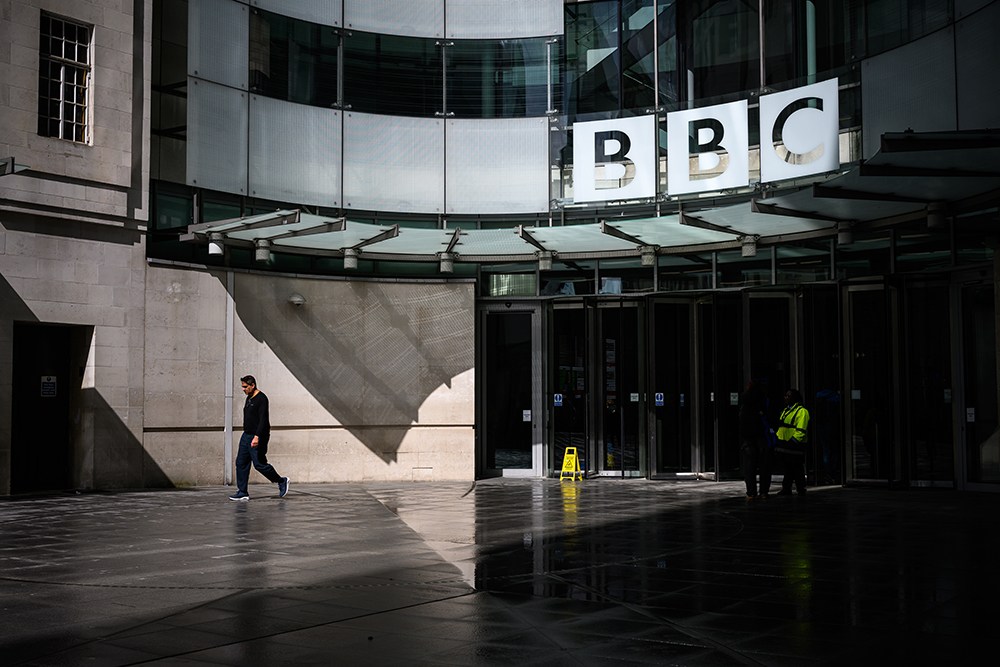
I confess a tear pricked my eyes. It was true. My BBC pass, on its blue lanyard, is often beside my bed, ready for when I go straight from Derbyshire to the BBC studios in New Broadcasting House near Oxford Circus.
Some of my most memorable programmes have celebrated a life most listeners won’t have heard of
How many times have I walked from the Tube station, up Upper Regent Street, past the ‘pepper pot’ church, John Nash’s All Souls at Langham Place, and in through those BBC revolving doors. In fact the question is not rhetorical. I’ve done it more than 500 times because that’s how many Great Lives programmes I’ve presented for Radio 4 since I started 20 years ago, in 2006.
I’m leaving. Probably my last programme, already recorded, will be broadcast this month; and I’m not confident the corporation will decide to continue the series. I so hope they do.
You may have heard an episode or two. The format is beautifully simple. We invite as our guest somebody notable in public life and ask them to nominate, from the ranks of the dead, a figure – famous or obscure – whose life they have greatly admired. Then we get a third person to join us in the studio – an academic, perhaps, or a biographer, even a descendant or old friend of the person nominated: someone who can augment my guest’s enthusiasm with some extra information. We chat for 40 or 50 minutes – it’s a chat, not a symposium – which my producer then edits down to the half-hour of the broadcast programme.
The Great Lives idea was not mine. That distinction goes to an extraordinary BBC producer and presenter, Miles Warde. He started the series and has been my senior editor ever since I joined it, a few years in. Miles is a quirky genius whose own output has been prodigious. When the corporation (faced with the need for further cuts) asked him to interview for his own job, Miles declined. Best, then, I thought, to leave when Miles does, for I can’t imagine the programme without him. And, at 77, I should probably be looking at stepping back soon, anyway. Not for me the ‘Gosh, he’s 88 and still churning it out!’ reputation. Not for me words like ‘sprightly’. Slowly we lose our edge: I’m not as quick with responses as I once was, so I’ll confine myself mostly to print and quit regular broadcasting while (I flatter myself) I’m ahead.
But what a ride it’s been! I’ve had walk-outs (Christopher Hitchens, who, feeling I was giving him too hard a time over his choice of Leon Trotsky, called me a bleeding Tory, stormed out, then promptly stormed back in again). I’ve had awkward requests (Lord Snowdon, Princess Margaret’s ex-husband, nominating Alec Issigonis, designer of the original Mini, who asked for wine at 2.30 in the afternoon: we had to send someone out to buy a bottle). I’ve had some remarkable out-of-studio locations (interviewing the climber Joe Simpson of Touching the Void in the wind and rain perched on Stanage Edge in Derbyshire; and our programme on Roger Deakin, the water-loving nature writer and right-to-roamer, whom we celebrated by recording from a houseboat on the Thames, after which we stripped naked and dived into the river – only our guest from the Guardian kept his pants on).
My favourites? Too many to name, beyond saying this: some of my most memorable programmes have celebrated a life most listeners won’t have heard of, but more should. Ada Lovelace, Byron’s daughter, whom he never returned to England to see, an invalid and mathematical prodigy who died young but has some claim to have co-invented the computer along with Charles Babbage, has stayed always in my memory, not so much for her computing as for her passionate belief that poetry, art and beauty are cosmically linked with mathematics.
Speaking of great women, many years ago Miles decided to tally their prominence in our programmes. He found that, among more than 300 nominators, half the women had chosen a woman and half had chosen a man as their great life. Among male nominators, all but three had chosen another man. We resolved to put that right, and we have.
We might otherwise never have featured Princess Vera Gedroits, Russia’s first woman military surgeon and professor of surgery, decorated for her battlefield work after the Russo-Japanese war, openly lesbian, who honed her skills in a cement factory, became a favourite of the Tsarina and (a towering figure of a woman) manhandled a whimpering Rasputin out of her surgery in the Imperial Palace. Vera even survived the transition to revolutionary communism, was a noted author and died peacefully in Kyiv, where she’d moved with her lover. She was nominated by her distant relative Mel Giedroyc, the actress and comedian best known forco-presenting The Great British Bake-off.
I often imagine what our great life would think if she or he were hovering above us in the studio. I believe Princess Vera would have been proud of Mel. On present plans, Vera will be my last great life.
I bow out sadly but without the least bitterness. Should I ever do Desert Island Discs, I know one choice I’ll make. Noël Coward’s ‘Why Must the Show Go On?’ about show business. ‘Butchers and bakers,’ he writes, ‘Get little applause for their pains/ When I think of miners and waiters in diners/ The query forever remains/ Why must the show go on?’ So…
Stop being gallant, and don’t be such a bore.
Pack up your talent, there’s always plentymore.
And if you lose hope, take dope
And lock yourself in the john.
Why must the show go on?



Comments