
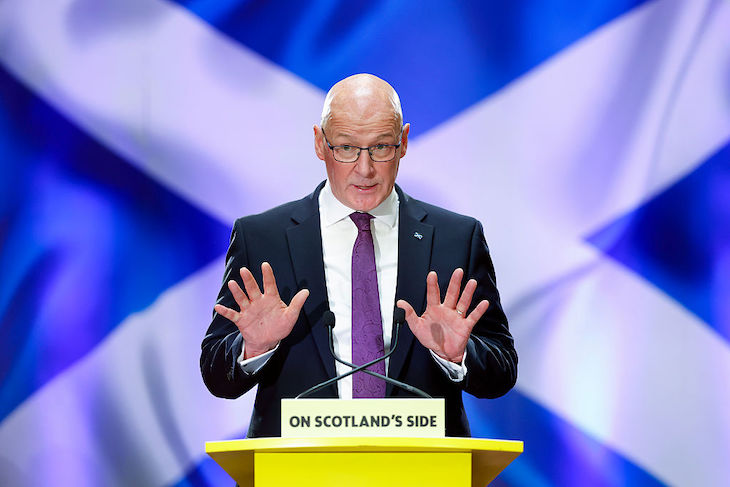
It’s been the favourite gotcha question put forward by supporters of the SNP and the Scottish Greens at hustings events and TV debates throughout this Holyrood election period. What is the democratic route to a second independence referendum? The result has usually been awkward deflections by non-nationalist politicians as they try to avoid being framed as anti-democratic – which is, of course, the point of the question in the first place.
If the SNP were truly good democrats would they not be more tolerant of the inclusive democracy they are already part of?
Scottish Labour, which more than any other party must woo a section of the electorate that has previously voted SNP, is particularly vulnerable to this attack. In an attempt to keep softer, independence-leaning voters onside while moving the conversation on to the more comfortable territory of holding the SNP accountable for its failings in government, the party’s leader, Anas Sarwar’s, response has generally been another version of ‘now is not the time’.
This is less than optimal. Pro-Union politicians should instead confront this argument head-on. Indeed, they can turn it around and show that it is, in fact, the SNP and the Scottish Greens that do not respect democracy. How so?
It starts by stating that the route to Scotland leaving the UK is entirely clear for all to see. It is the same process by which any nation within a nation in any established democracy can secede. It is the same for Bavarians seeking independence from Germany (Bavaria was a sovereign, independent nation until 1871 and support for Bavarian independence tends to sit at around the same level as that for Scottish independence when Alex Salmond negotiated his referendum: at about a third of the electorate), or for Corsicans in relation to France (Corsica has a long-established nationalist movement).

That process is the following: build so much support for the separatist cause that secession becomes not only the clear will of the people but also plainly front-and-centre of people’s desire for change. Under such a scenario, of sustained, large majority support for separation, with ongoing peaceful political agitation by that majority, secession will ultimately come to pass. The process, in other words, is primarily political rather than legal. No democracy can ultimately force coexistence on people who form their own distinct nation within a bigger nation. At the same time, however, it is not for politicians who are content with coexistence to put forward plans to rip apart established democracies. There is no obligation on German federalists to give Bavarian nationalists a route to independence.
As for the 2014 referendum. That was clearly exceptional, a one-off, not to mention legally ‘decisive’. It did not rework Britain’s constitution to make the UK a confederation of sovereign states, and it did not set a precedent for ongoing repeats.
This ties in with arguments around international law and self-determination. When the Scottish government went to the UK Supreme Court in 2022 to argue the case for a unilateral second independence referendum, Nicola Sturgeon’s SNP at the time put forward an argument based on the premise, but the court effectively dismissed the submission, with Lord Reed, the head of the court – and a Scot – stating: ‘The principle of self-determination is simply not in play here.’
Citing previous case law in relation to the province of Quebec and Canada, as well as the UK’s 2009 submission to the International Court of Justice in the case of Kosovo, the court pointed out that appeals to self-determination are only applicable under foreign or colonial type occupation, and that in contexts where self-determination arguments are non-applicable, such as Scotland, then international law favours existing state territorial integrity. In the context of established western democracies therefore there is a general expectation that people should tolerate democratic coexistence. You can’t, after all, be liberated from a liberal democracy.
Which brings us to the argument that it is, in fact, the SNP and the Scottish Greens who refuse to respect democracy in this debate. How can they accuse others of being anti-democratic when their fundamental starting point is that democratic coexistence with fellow compatriots in an established liberal democracy free of oppression is intolerable? If they were truly good democrats would they not be more tolerant of the inclusive democracy they are already part of?
The next time the SNP’s leader John Swinney or his supporters come out with their gotcha question and accuse opponents of being anti-democratic, those opponents need not be evasive. They can instead get on the front foot: the route to another referendum is as clear as day and is the same difficult but ultimately fair process that any other nation in an established democracy would have to undertake to secede. If Swinney finds that hard to take then he could always try being more tolerant of the inclusive democracy he has, instead of constantly trying to re-shape the world around him to make it narrower and more exclusive. In short, he could try being a better democrat, and in the meantime refrain from expecting those who live by the values of liberal democracy to indulge him in his intolerance.





Comments