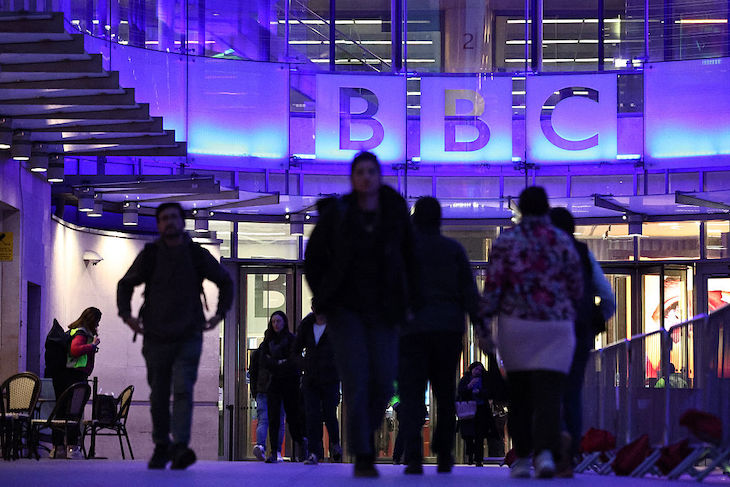
Donald Trump’s $10 billion lawsuit against the BBC has accidentally done Britain a favour. One ‘fake news’ moment involving the US president has turned what would normally be a media-page squabble into a question on the doorstep: should every household in the UK continue to pay to receive a live television signal, enforceable by law, to fund the BBC? In a world of monthly subscriptions for global streamers, the licence fee has never felt more like an anachronistic tithe.
The British public are fed up with the licence fee
BBC Charter renewal – due at the end of 2027 – has become an election issue. There’s a chasm that needs to be bridged between the BBC’s past and the future. For all the deserved criticism of the licence fee, it’s vital for the creative health and wealth of the UK that there is a publicly funded broadcaster with deep pockets. At the moment, that publicly funded broadcaster is the BBC – and the BBC is the engine that drives most of the UK’s creative sector’s value. Content production is one of our few real growth industries – and the BBC has played a vital role in ensuring its success.
But the British public are fed up with the licence fee. Take up has been falling by two percentage points a year for the last seven years. It now stands at 83 per cent. More and more UK households are saying they don’t watch live television – not just on the BBC, but also ITV, C4, C5 and even Sky Sports and Sky News – so they don’t need to pay for a TV licence.
If all that happens is a new ten-year Royal Charter with some tinkering around the edges (as Lisa Nandy’s Green Paper appears to be) then licence fee take up will be in the mid-60s by the next Charter’s end. It will be too late to save the UK’s creative economy and broadcasting independence.

As the government is grappling with the BBC’s existential crisis, at the same time it will likely whistle through a mortal blow to the UK’s broadcasting and creative independence. Philadelphia-based Comcast, owner of NBC and Sky amongst very many others, is about to add ITV to its global media assets for £1.6 billion.
Here, hiding in plain sight, is a once-in-a-generation opportunity for the government to re-tool the BBC to make it a publicly funded broadcaster both fit for purpose and future-proofed. It should block the sale of ITV to Comcast and instead buy ITV to slam together with the BBC (I use the word slam deliberately because there’ll be significant C- Suite collateral damage) to create a publicly funded broadcaster truly worth paying for.
Cue guffaws from those C-Suite dinner tables in London’s Zones one and two. We should ignore them. It’s only C-Suite self interest when you realise that creating a super-public service broadcaster is the only way to fix three fundamental problems at once: the BBC doesn’t look or sound like the country paying for it; it has a funding model designed for a world of five channels rather than subscription apps; and an in-house news operation that has become the corporation’s most dangerous vulnerability in an age when a single ‘fake news’ moment can scorch its reputation at home and abroad.
To justify a compulsory fee, the BBC must demonstrably serve the people who fund it. That means being recognisably British in its geography as well as its branding. It has to look and sound like the country that is forced by law to pay for it. And the BBC doesn’t. It never really has. Founded by a patrician, its centre of power has always been in Portland Place. It’s always been posh and a bit uptight. Recognising this, it moved some departments to Salford. But this didn’t fix the wiring. When push comes to shove, commissioning power and cultural reflexes still sit in a very small corner of W1, where they always have.
ITV, conversely, always had regionality hard-wired into its DNA. Lisa Nandy knows this from her upbringing. That regionality has been diminished since the consolidation of the regional franchises, but regionality and representation still runs through its programming. Coronation Street and Emmerdale bear witness to that. Not just on screen five nights a week, but also launching the careers of Sally Wainwright, Jimmy McGovern, Kay Mellor, Jack Thorne and Paul Abbott, amongst many others.
Under Tim Davie, the BBC did make strides in regional representation. There are some key non-scripted commissioners, but not enough yet to counter-balance the BBC’s innate metropolitan bias when it comes to commissioning. In drama Blue Lights, written and made in Belfast, captures the anxieties and dark humour of a city we usually only see in news archives. Peaky Blinders did something similar for Birmingham, turning a local story into a global export. That is what properly British public service broadcasting looks like when it gets its geography right: rooted somewhere real.
The point of Charter renewal and the creation of a new super-broadcaster should be to make that kind of success feel normal, not miraculous.
Putting commercial breaks into this new broadcaster’s programming and allowing ITV Sales to sell the inventory will future-proof it. The objection to allowing the BBC to generate income through advertising has always been that it will distort the market to ITV’s disadvantage. Putting the two biggest and most successful brands in British broadcasting together neatly removes that problem. You don’t have a wounded commercial ITV staring enviously at a fat, ad-funded BBC; you have one super-PSB using ITV’s savvy sales house to make every second of commercial airtime work harder in support of British content.
In a world of monthly subscriptions for global streamers, the licence fee has never felt more like an anachronistic tithe
Between a BBC–ITV super-broadcaster powered by ITV Sales, and Sky handling the rest, you have a funding ecology that is simple, transparent and robust enough to offer a sustainable alternative to California and Seattle.
The competition is no longer BBC vs ITV vs Channel 4 vs Channel 5. It is all of them vs California and Seattle. If we allow each to wither separately, we will end up renting our own culture back from American tech companies. Anne Mensah’s leadership of Netflix’s London office has achieved incredible things, not least in Adolescence, a British story with global resonance. But we should be honest about the power dynamic: Netflix is a global platform that happens to be commissioning here, not a British public service broadcaster answerable to British voters.
To ensure its future, the BBC must also relinquish its in-house production of the news. Hand the contract to ITN, under its own separate, arm’s-length deal, removing at a stroke the structural flaw that has just been exposed in painful close-up.
The Trump episode is not a passing Westminster row; it is the logical consequence of a news division that is both the BBC’s most powerful editorial engine and its most vulnerable point of attack. When the man who turned ‘fake news’ into a catch-all slur manages to stick that label on the BBC, he doesn’t just drag one programme or one editor into disrepute: he splashes an indelible stain across the entire corporation. The newsroom, the management and the brand are perceived as one and the same, so the damage is total.
Outsourcing BBC News to ITN would not magically prevent mistakes, but it would create distance between the broadcaster and the news operation that bears its name. It would put the BBC’s bulletins in the hands of a supplier with a proven track record of serving multiple owners and multiple audiences impartially. And it would give the public a clearer line of accountability: if ITN gets something wrong, it answers for it under contract; if the BBC mishandles that relationship, it answers for that as the commissioner.
Imagine what that super-broadcaster would actually look like. A place where there is room for Claudia Winkleman and Ant & Dec, Michael McIntyre and Bradley Walsh, not as rival tribal totems but as part of one genuinely representative, properly accountable national shop window. From Coronation Street to EastEnders, from Britain’s Got Talent and Strictly Come Dancing to The Traitors and I’m A Celebrity, there would be one schedule that feels like a mirror of modern Britain rather than a patchwork of competing empires.
The same logic applies to drama: Blue Lights, Trigger Happy, Call The Midwife, Red Eye and Ludwig with the next wave of regional stories developed alongside them, rather than squeezed in around the edges. The combined organisation could also offer ‘bonus’ drama, comedy and sports channels – linear or streamed – as added value for licence fee payers, or as we should really start to think of them: subscribers.
Charter renewal is an opportunity to ask the only question that matters in a subscription world: do we want to be a branch office of other people’s media empires? Or do we want to own at least one broadcaster that is big enough, British enough and accountable enough to deserve a compulsory fee?



Comments